A Weapons Pipeline Stops, Temporarily
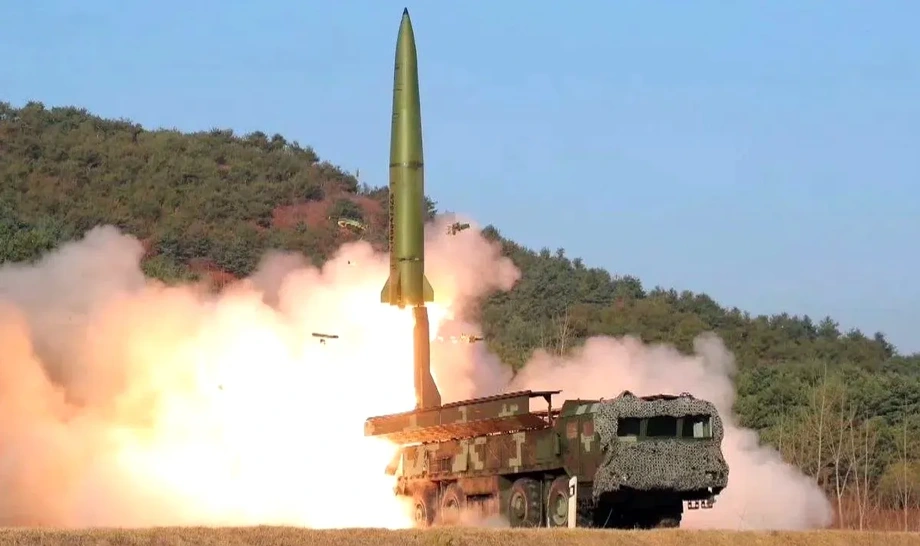
North Korea has suspended deliveries of KN-23 ballistic missiles and a new batch of artillery ammunition to Russia, closed its airspace to Russian military transport planes and is holding back a Russian request to expand the North Korean contingent inside Russia from 8,500 soldiers to 50,000. Ukraine's Main Intelligence Directorate, the military intelligence service known as HUR, set out the measures in a note posted on its website on November 26, 2026, and said Kim Jong Un gave the order himself.
Contents
HUR described the suspension as temporary. No date has been announced for deliveries to resume, the directorate did not say how it gathered the information, and neither Moscow nor Pyongyang has commented on the record.
North Korean factories had become one of the largest outside suppliers to the Russian artillery and missile effort. By the end of 2025, up to half of the 122mm and 152mm shells fired by Russian units came from North Korea, according to HUR's estimate, and about 150 KN-23 and KN-24 ballistic missiles had reached Russia by September 2026. The KN-23 is a ballistic missile with a range of a few hundred kilometers that falls on its target at high speed, which makes it far harder for air defenses to stop than a cruise missile or a drone.
A halt in that flow matters most for Ukrainian cities, which take regular ballistic missile and drone strikes far behind the front line. Whether the pause holds is the open question. HUR's own tally of North Korean deliveries has grown through the war, and Ukrainian officials were still describing monthly missile shipments in mid November.
The Remark About Seoul That Angered Pyongyang
The dispute began with a sentence from a Russian deputy foreign minister. On October 20, 2026, Andrei Rudenko said Russia would welcome practical steps by South Korea to normalize relations with Moscow, according to the state news agency RIA Novosti. HUR's account describes the remark differently: the Kremlin, it said, intended in the long term to help reduce tension between Seoul and Pyongyang.
Pyongyang read that as a breach of the partnership it signed with Moscow in 2024. At the end of October, Foreign Minister Choe Son Hui told the Russian side that such statements did not match the nature of the allied agreements between the two countries and demanded an explanation of Russian policy toward South Korea, according to the intelligence directorate.
At the end of the month, North Korean Foreign Minister Choe Son Hui stressed that such statements were inconsistent with the nature of the alliance agreements between the two countries and demanded clarification of Russia's policy toward South Korea.
Choe then announced the temporary suspension of military support for Russia, in the same account, and Kim approved it. The independent Ukrainian outlet Hromadske reported that Rudenko's remarks concerned relations between Moscow and Seoul rather than between the two Koreas, and said it could not verify the diplomatic conflict HUR described.
What Stops and What Keeps Running
HUR listed the restrictions in a single paragraph of its note, and they reach beyond weapons.
In particular, the restrictions include a ban on the use of North Korean airspace by Russian military transport aircraft, as well as the suspension of deliveries of KN-23 ballistic missiles and the next batch of artillery ammunition.
Three measures form the core of the pause: the airspace ban, the missile and shell freeze, and the refusal so far to enlarge the force. The first two hit Russian logistics, because transport aircraft have been used to move people and cargo between the two countries. The third removes, for now, the prospect of a much larger North Korean presence on Ukrainian soil.
None of it has pulled North Korean soldiers out of Russia. Units of the 11th Special Operations Corps remain in the Kursk region, where they hold positions in the second echelon of the Russian Kursk grouping, meaning they sit behind the units that absorb the first attacks.
A combined North Korean missile unit has been based in the Voronezh region since mid summer, HUR said, operating as part of the 112th Missile Brigade of the 1st Tank Army of the Moscow Military District and firing at targets inside Ukraine. In August 2026, a Russian ballistic strike killed seven workers at the Zaporizhstal steel plant in Zaporizhzhia as they headed for a shelter, and President Volodymyr Zelenskyy said the attack used North Korean missiles.
The Cost in Soldiers
HUR puts North Korean losses in the Kursk fighting at 7,058 service members, of whom 2,251 were killed or permanently out of action and the rest wounded. South Korean, Ukrainian and Western officials have given a different figure, saying more than 6,000 of the roughly 14,000 North Korean soldiers sent to Kursk were killed.
Those two counts measure different things. HUR's figure is a casualty total for the whole contingent; the 8,500 it cites describes the force now deployed inside Russia, while the 14,000 describes everyone sent since North Korea joined the fighting, a step Pyongyang acknowledged in April 2025.
Zelenskyy said on November 16 that Russia was still taking delivery of dozens of North Korean ballistic missiles every month, and that the transfers threaten countries beyond Ukraine, because each launch gives Pyongyang live data on how its weapons perform. In August he said Russia had decided to host between 30,000 and 50,000 North Korean troops, close to the expansion request HUR now says is stalled.
Why the Alliance Was Already Under Strain
Weapons were the easy part of the partnership. Soldiers were not. HUR lists the problems that have limited how far the two armies can work together: a low level of operational compatibility, a language barrier, too few interpreters and weak logistics support from Pyongyang. It also points to the attitude of Russian commanders.
The attitude of Russia's military leadership toward North Korean troops also does not contribute to deepening cooperation. According to available information, representatives of Russia's senior military command openly display contempt for North Korean soldiers, viewing them as a politically imposed burden.
That complaint matters because the stalled request was for a much bigger deployment. Filling it would place tens of thousands of North Korean soldiers under Russian commanders who, in HUR's account, treat the existing contingent as a nuisance. A shortage of translators makes a large force harder to command, and North Korean supply lines have not kept pace with the numbers already committed.
How the Partnership Was Built
The two countries moved a long way in three years. Military ties expanded from 2023, and on a state visit to Pyongyang in June 2024 Putin signed a strategic partnership treaty with a mutual defense provision, the clause that underpins the arrangement.
Official contact continued right up to the breach. On September 7, 2026, the two governments opened a road bridge across the Tuman River, the waterway that forms their shared border, to increase the volume of traffic between them. Two days later, Xi Jinping and Vladimir Putin sent messages marking the 78th anniversary of North Korea's founding, carried by the state news agency KCNA, and Putin promised continued cooperation under the "comprehensive strategic partnership" for regional security and a multipolar world order.
- June 2024: Putin visits Pyongyang and signs a partnership treaty with a mutual defense clause
- April 2025: Pyongyang publicly acknowledges its troops are fighting in Kursk
- End of 2025: up to half of Russia's 122mm and 152mm shells come from North Korea, by HUR's estimate
- August 2026: Zelenskyy says Russia has decided to host 30,000 to 50,000 North Korean troops; seven Zaporizhstal workers are killed in a strike he links to North Korean missiles
- September 7, 2026: a road bridge over the Tuman River opens
- September 9, 2026: Xi and Putin send anniversary messages to Pyongyang
- September 2026: about 150 KN-23 and KN-24 missiles delivered, according to HUR
- October 20, 2026: Rudenko speaks about normalizing ties with Seoul
- Late October 2026: Choe demands clarification and announces a suspension of military support
- November 24, 2026: a warned deployment of new North Korean troops has not appeared
- November 26, 2026: HUR publishes its note
Putin met Jo Yong-won, a secretary of the Workers' Party of Korea central committee and one of Kim's closest aides, about ten days before the note appeared, and used the meeting to praise what he called military brotherhood.
We greatly value the practical and friendly relations we have developed. We will never forget the heroic actions of North Korean soldiers who fought shoulder-to-shoulder with the Russian military in the Kursk region.
Jo replied that he was carrying Kim's warmest greetings and highest regards, on the chairman's instructions. Ten days later, Ukrainian intelligence said the same chairman had signed off on a pause in support.
Slowdown, Not a Breakup
HUR frames the development as a slowdown in military cooperation rather than a breakdown, and the extent and duration of the restrictions remain unclear. Signals from the region point in both directions.
On November 24, two days before the note appeared, Deutsche Welle reported that a large new North Korean deployment Ukraine had warned about had not materialized, which fits an account of a hold on troop numbers. Zelenskyy's statement on November 16 that missiles were arriving by the dozen points the other way.
HUR has published no evidence for the suspension, Moscow and Pyongyang have stayed silent, and the Russian comment at the centre of the dispute has been described differently by different outlets. What can be checked is the shape of the supply line. North Korea has shipped artillery shells, ballistic missiles, rocket artillery and mobile guns, and HUR has said Pyongyang at one point supplied between 25% and 40% of the ammunition used by Russian forces.
What Seoul Is Watching
South Korea's government has not endorsed the Ukrainian assessment. A senior official said Seoul's position on the partnership is unchanged.
Military cooperation between North Korea and Russia remains a matter of serious concern for the Republic of Korea and the international community. (The Republic of Korea's) position remains unchanged that military cooperation in violation of relevant UN Security Council resolutions must cease immediately.
The official declined to comment on HUR's specific claims. Seoul's own trade figures show how tangled the picture is. In the first eight months of 2026, South Korea imported 18 million metric tons of Russian coal, 34% more than in 2025, and more than 176,000 metric tons of fuel was loaded at South Korean ports onto tankers bound for Russia in July and August 2026, while Ukrainian strikes on refineries left Russia short of fuel at home.
For Ukraine, the practical question is what reaches Russian launch sites in the coming weeks. A lasting pause in KN-23 deliveries would ease pressure on cities that have few defenses against ballistic missiles. A short one would change little beyond the diplomacy, and HUR has given no indication of which it expects.
What to Know
- Ukraine's Main Intelligence Directorate reported on November 26, 2026, that North Korea has temporarily suspended military support for Russia, on Kim Jong Un's personal order
- The restrictions cover Russian military transport aircraft using North Korean airspace, KN-23 missile deliveries and a new batch of artillery ammunition
- Pyongyang is holding back a Russian request to grow its contingent in Russia from 8,500 to 50,000 troops
- The trigger was an October 20 remark by Deputy Foreign Minister Andrei Rudenko about improving Russia's relations with South Korea
- Foreign Minister Choe Son Hui called the remarks inconsistent with the alliance and demanded an explanation of Russian policy toward Seoul
- North Korean units of the 11th Special Operations Corps remain in Kursk, and a missile unit is still firing from Voronezh as part of Russia's 112th Missile Brigade
- HUR estimates North Korean losses in Kursk at 7,058, including 2,251 killed or permanently out of action
- By the end of 2025, up to half of Russia's 122mm and 152mm shells came from North Korea, and about 150 KN-23 and KN-24 missiles had been delivered by September 2026
- Moscow and Pyongyang have not commented, HUR did not disclose its sources, and no date has been set for shipments to resume
- Putin praised "military brotherhood" with North Korea at a meeting with Workers' Party secretary Jo Yong-won about ten days before the report