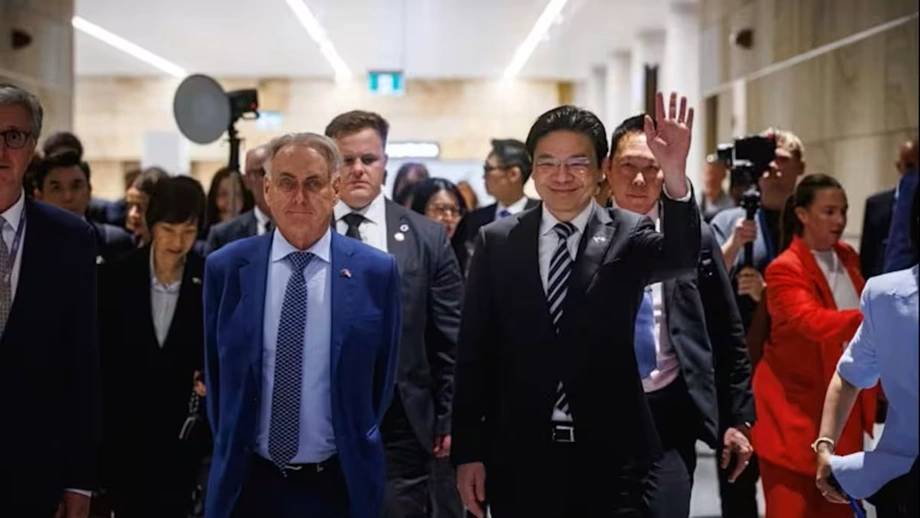
A Historic Touchdown in Badgerys Creek
Singapore Prime Minister Lawrence Wong touched down in Australia on Monday, November 23, 2026, aboard the inaugural Singapore Airlines flight to the newly opened Western Sydney International (Nancy-Bird Walton) Airport (WSI). By stepping off flight SQ261, Mr Wong became the first foreign leader to arrive at the A$5.6 billion (S$4.80 billion) facility, which sits in Badgerys Creek about 60 kilometres west of central Sydney.
Contents
Firefighting trucks lined the tarmac to greet the aircraft with a water cannon salute, an aviation custom where plumes of water form arches over a plane to celebrate a first flight or major milestone. Australian Minister for Trade and Tourism and Special Minister of State Senator Don Farrell met Mr Wong on the tarmac upon his arrival. The visit marks the beginning of a three-day official trip from November 23 to 25, during which Mr Wong and Australian Prime Minister Anthony Albanese will co-chair the 11th Singapore-Australia Annual Leaders' Meeting in Canberra.
Flight SQ261, operated using a medium-haul Airbus A350-900 carrying registration 9V-SHR, pushed back from Singapore Changi Airport at 9:26 a.m. local time and took off at 9:44 a.m., departing two hours ahead of its regular daily schedule for the special occasion. While the airport's official media release scheduled the touchdown for 8:20 p.m. Sydney time, flight tracking data recorded the plane landing 37 minutes early at 7:43 p.m.
Mr Wong wrote on Facebook that he had deliberately timed his official trip to coincide with the carrier's first service to the terminal.
It is an exciting milestone for Australia, and I am glad to be part of it.
In a Sunday statement from his office, Mr Albanese described the arrival as a historic occasion for Australia's newest international gateway and noted that he had advocated for a second Sydney airport since his maiden parliamentary speech in 1996.
Prime Minister Wong's arrival on the first Singapore Airlines flight into Western Sydney International Airport represents the newest chapter of our friendship. I look forward to our discussions on how we can expand our partnership, increase our investment opportunities and enhance technological cooperation between our nations.
Breaking the Midnight Curfew
For travellers and cargo operators in Greater Sydney, the opening of Western Sydney International removes a regulatory barrier that has constrained flights for three decades. Sydney's primary gateway, Kingsford Smith Airport in Mascot, operates under the Sydney Airport Curfew Act 1995. The law restricts take-offs and landings between 11:00 p.m. and 6:00 a.m. to protect nearby residents from aircraft noise, limiting scheduling options compared with other major Australian cities such as Melbourne.
Western Sydney International operates 24 hours a day without a curfew. Singapore Airlines built its new timetable around that late-night window. The return service, flight SQ262, is scheduled to depart Western Sydney at 11:55 p.m., nearly an hour after Kingsford Smith closes its runways for the night. Western Sydney International reports the flight lands in Singapore at 5:15 a.m. the following day, while the airline's seasonal timetable lists the regular arrival at 5:05 a.m. Beginning Tuesday, November 24, the regular inbound flight SQ261 will depart Changi at 11:30 a.m. and arrive at Western Sydney at 10:20 p.m. under a daily schedule running through March 27, 2027.
Singapore Airlines originally announced the route on March 24 under the flight numbers SQ201 and SQ202, before notifying travel agents on August 18 that the services had been renumbered to SQ261 and SQ262 with no changes to the aircraft or timings. The airline flies the route with a 303-seat Airbus A350-900 configured with 40 business class seats and 263 economy seats.
The new daily flight complements the four existing daily services Singapore Airlines operates into Kingsford Smith Airport, bringing the carrier's total flights between Singapore and Sydney to five per day and making Western Sydney its eighth destination in Australia. According to Western Sydney International, the early-morning arrival at Changi connects travellers to over 130 destinations served by the Singapore Airlines Group, while the airline itself puts that network figure at more than 135 destinations. Passengers leaving Sydney at 11:55 p.m. can catch a 7:00 a.m. connecting flight in Singapore to reach Bangkok by 8:25 a.m., or board a 9:00 a.m. service to London Heathrow that lands at 3:20 p.m. the same afternoon.
WSI Chief Executive Officer Simon Hickey stated that having Mr Wong as the first passenger arriving on the inaugural flight allowed the facility to demonstrate its round-the-clock capabilities.
WSI's 24-hour capability is unlocking new connectivity for Sydneysiders to enjoy more choice and flexibility. From tonight, passengers can leave Western Sydney before midnight, arrive in Singapore for breakfast and connect seamlessly to destinations around the globe. Just over a year from now, WSI will connect travellers to more than 250 destinations, with Singapore Airlines playing a major role in bringing the world closer to Western Sydney.
Singapore Airlines Regional Vice President for the South West Pacific Foo Chai Woo said the schedule gives travellers across the region new options.
Western Sydney is an important and growing region, and we are proud to support its communities and businesses through our new passenger service and the cargo capacity it provides. WSI's 24-hour, curfew-free operations allow our customers to make the most of their day in Sydney before taking our late-night flight to Singapore and connecting onwards to destinations across the SIA Group's global network.
Inside Australia's Newest Gateway
The Badgerys Creek terminal brings several new technological and logistical features to Australian aviation. Passengers arriving on Monday night's flight were among the first to use the digital Australia Travel Declaration (ATD). Replacing the traditional paper Incoming Passenger Card, the online system allows travellers to submit their customs, immigration, and biosecurity declarations up to 72 hours prior to departure.
Before boarding the late-night return service, eligible passengers have access to The Rayleigh Lounge on the terminal's mezzanine level. Operated by aviation services provider dnata, the shared international lounge offers views across the airfield toward the Blue Mountains, a UNESCO World Heritage site located closer to Badgerys Creek than to central Sydney.
Beyond passenger travel, the route expands air freight capacity for exporters in western New South Wales. Ground handler Menzies Aviation secured the contract to provide passenger, ramp, and cargo services for Singapore Airlines' daily flights and ad hoc freighter planes at the new airport. To support these operations, Menzies built a 12,500-square-metre cargo facility within the airport's freight precinct. The warehouse, which is the company's largest across Oceania and Southeast Asia, can process up to 200,000 tonnes of goods annually, including pharmaceuticals, fresh agricultural produce, e-commerce parcels, and heavy machinery, tracked in real time through its MACH cargo management software.
Federal Minister for Infrastructure, Transport, Regional Development and Local Government Catherine King noted that the Albanese government is investing A$18 billion across Western Sydney, with the airport as its centrepiece alongside the new M12 motorway and upgrades to Elizabeth Drive, Fifteenth Avenue, and Mamre Road. While a dedicated Sydney Metro rail line connecting the terminal is not expected to open until mid-to-late 2027, a free shuttle bus currently bridges the public transport gap for passengers travelling from Penrith, Parramatta, and the central business district.
New South Wales Minister for Jobs and Tourism Steve Kamper credited the state's Western Sydney International Take-Off Fund with helping draw carriers to the facility, which houses both domestic and international gates under a single roof and can handle up to 10 million passengers a year in its initial phase, with long-term capacity for more than 80 million.
The history of the airport and its initial airline rollout spans more than five decades:
- 1969: A federal advisory committee first proposes Badgerys Creek as a site for a second Sydney airport.
- 1996: Anthony Albanese calls for a second Sydney airport in his maiden speech as a Member of Parliament.
- 2014: The Australian federal government officially confirms Badgerys Creek as the airport site.
- 2018: Major earthworks and construction commence on the site.
- August 2024: Singapore Airlines becomes the first international carrier to commit to flying into Western Sydney International.
- October 25, 2026: The airport opens to commercial traffic with Jetstar flight JQ362 departing for the Gold Coast.
- October 26, 2026: Air New Zealand flight NZ165 from Auckland lands as the facility's first international arrival.
- November 23, 2026: Singapore Airlines launches daily Changi services on flight SQ261 with Prime Minister Lawrence Wong aboard.
- January 2027: Vietjet is scheduled to launch flights between Western Sydney and Ho Chi Minh City.
- March 28, 2027: QantasLink plans to begin domestic services to Melbourne and Brisbane.
- Mid-to-late 2027: The Sydney Metro rail line to the airport is projected to open.
- December 2027: Qatar Airways is scheduled to begin flights from Doha.
The Canberra Agenda: CSP 2.0, Energy Security, and AI Guardrails
From Sydney, Mr Wong travelled to the Australian capital of Canberra for the diplomatic core of his visit. On Tuesday, November 24, Mr Albanese will host Mr Wong for a private one-on-one breakfast at The Lodge, the official residence of the Australian Prime Minister, before the two leaders co-chair the 11th Singapore-Australia Annual Leaders' Meeting.
Talks will centre on the upgraded Comprehensive Strategic Partnership, known as CSP 2.0. The two nations originally established their Comprehensive Strategic Partnership in 2015, completing more than 110 joint initiatives across trade, defence, innovation, and cultural exchanges over the subsequent decade. In October 2025, Mr Wong and Mr Albanese launched CSP 2.0 to guide cooperation over the next ten years through 80 specific initiatives organised under five pillars: contributing to peace and stability at home and in the region, connecting the two economies, transitioning to net-zero carbon emissions, forging new frontiers, and deepening friendships and capabilities.
Economic integration and supply chain security sit at the top of the bilateral agenda. Underpinned by the Singapore-Australia Free Trade Agreement, which was signed in February 2003 and entered into force in July 2003, bilateral merchandise trade reached S$30.3 billion in 2025. That volume made Singapore Australia's sixth-largest trading partner overall and its largest two-way trade and investment partner in Southeast Asia, while Australia ranked as Singapore's 12th-largest trading partner.
Energy trade forms a critical part of that relationship. Singapore imports crude petroleum oils, natural gas, semi-precious stones, metals, and animal and vegetable oils from Australia, while exporting refined petroleum oils, machinery, and electrical equipment back to the continent. Because Singapore is Australia's largest supplier of refined fuel, Mr Albanese made an urgent visit to the city-state in April 2026 during the global oil shock triggered by the United States war with Iran to secure petrol and diesel shipments. During that April meeting, both prime ministers pledged to make maximum efforts to meet each other's energy security needs and speed up the exchange of goods.
Emerging technologies, particularly artificial intelligence governance, are also set to feature in Tuesday's discussions. Abdul Rahman Yaacob, a Southeast Asia expert at Verve Research, pointed out that Singapore serves as a cultural and financial bridge for Western economies entering the region, and noted that both governments are examining safety rules for artificial intelligence.
Singapore is the most westernised country in Southeast Asia, and it also understands the nuances, the culture of that region. It is keen to be the entry point to facilitate external power, especially Australia or Europe, for them to invest. I think both of them could look into the possibility of working on AI, the governance. Singapore is keen to develop further, but I think the important issue here is guardrails.
The leaders' summit coincides with domestic debate in Canberra over establishing national standards for artificial intelligence, with Australian Foreign Minister Penny Wong scheduled to address parliament on Tuesday to call on Australia to take a leading role in safeguarding the technology.
A Year of Intensive Defence and Diplomatic Exchanges
Mr Wong's trip caps a year of frequent military and cabinet exchanges between the two governments. Earlier in November 2026, armed forces from both nations conducted Exercise Trident, a joint amphibious military drill held at Shoalwater Bay in north Queensland.
Cabinet officials have also maintained a regular schedule of visits throughout 2026. In April, alongside Mr Albanese's fuel security trip, Foreign Minister Penny Wong and Trade and Tourism Minister Don Farrell each visited Singapore. In May, Australian Deputy Prime Minister and Minister for Defence Richard Marles travelled to Singapore to attend the Shangri-La Dialogue security summit. Two months later, in July, the foreign affairs, defence, and trade ministers from both nations convened in Australia for the 15th Singapore-Australia Joint Ministerial Committee meeting.
Following Tuesday's summit with Mr Albanese in Canberra, Mr Wong, who also serves as Singapore's Minister for Finance, will hold talks with Australian Leader of the Opposition Angus Taylor. He will later return to Sydney to meet New South Wales Premier Chris Minns, call on Australian Governor-General Sam Mostyn, and attend an evening reception for overseas Singaporeans living in Australia.
Mr Wong is accompanied on the three-day visit by his wife, along with a high-level delegation that includes Minister for Foreign Affairs Dr Vivian Balakrishnan, Minister for Sustainability and the Environment and Minister-in-Charge of Trade Relations Grace Fu, Minister for Transport and Second Minister for Finance Jeffrey Siow, and Members of Parliament Alex Yeo and Dr Hamid Razak. During Mr Wong's absence from Singapore between November 23 and 25, Deputy Prime Minister and Minister for Energy, Trade and Industry (Trade) Gan Kim Yong is serving as Acting Prime Minister.
Key Points
- Singapore Prime Minister Lawrence Wong landed at Western Sydney International (Nancy-Bird Walton) Airport on Monday, November 23, 2026, aboard inaugural Singapore Airlines flight SQ261, becoming the first foreign leader to arrive at the A$5.6 billion (S$4.80 billion) airport.
- Unlike Sydney's main Kingsford Smith Airport, which enforces an overnight curfew from 11:00 p.m. to 6:00 a.m. under the Sydney Airport Curfew Act 1995, the new airport in Badgerys Creek operates 24 hours a day.
- Singapore Airlines now operates five daily flights to Sydney, adding the late-night SQ262 return departure at 11:55 p.m. from Western Sydney to its four daily services at Kingsford Smith.
- Mr Wong and Australian Prime Minister Anthony Albanese are meeting in Canberra on Tuesday, November 24, for a private breakfast at The Lodge before co-chairing the 11th Singapore-Australia Annual Leaders' Meeting.
- Talks focus on the 80 initiatives across five pillars of the Comprehensive Strategic Partnership 2.0 (CSP 2.0), supply chain and fuel security, defence ties following November's Exercise Trident in Queensland, and artificial intelligence governance.
- Bilateral merchandise trade between the two countries reached S$30.3 billion in 2025, making Singapore Australia's largest trade and investment partner in Southeast Asia and sixth-largest trading partner globally.