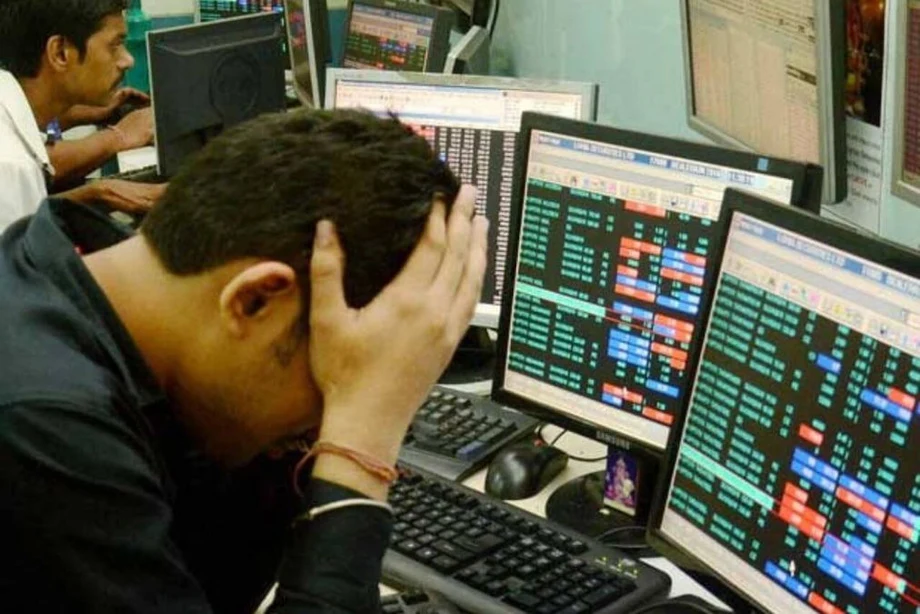
How Did a Record Morning Turn Into a Massive Selloff?
Monday, November 23, 2026, began with historic optimism on Dalal Street, the financial heart of Mumbai, before rapidly turning into the sharpest single day decline Indian equity markets had seen in nearly five months. The Bank Nifty, a major stock market index that tracks the performance of the largest and most liquid banking companies in India, opened at 65,012.05 and quickly climbed to an all time record high of 65,193.40. Crossing the psychological threshold of 65,000 for the very first time, the banking index appeared poised to extend a massive rally that had lasted for four straight weeks. Within hours, that enthusiasm evaporated as heavy selling pressure swept across both private and public sector lenders.
Contents
- How Did a Record Morning Turn Into a Massive Selloff?
- Which Banking Stocks Led the Downward Spiral?
- Why Did the Four Week Rally Suddenly Snap?
- How Did the Global Artificial Intelligence Selloff and Holiday Schedule Add Pressure?
- What Role Did US Interest Rates, the Rupee, and Domestic Liquidity Play?
- Why Did Metal Stocks Plunge While Information Technology Shares Gained?
- How Did the November Rally and Crash Unfold?
- Are Banking Stocks Now a Bargain or a Risk for Investors?
- At a Glance
By the time the closing bell rang, the Bank Nifty had plunged 2,050 points, or 3.17 percent, from its previous Friday record close of 64,635.20 to finish the session at 62,585.35. During the worst of the afternoon downturn, the index hit an intraday low of 62,546, marking a staggering drop of more than 2,647 points from its morning peak. The sudden reversal erased nearly 60 percent of the gains the banking sector had accumulated over the previous week, leaving every constituent stock in the index in negative territory by the end of the day.
The collapse in banking shares dragged the broader Indian stock market down with it. The BSE Sensex, which tracks 30 of the largest and most actively traded companies on the Bombay Stock Exchange, tanked 1,483.72 points, or 1.77 percent, to settle at 82,435.99 after touching a morning high of 84,662.96 and an intraday low of 82,395.88. The NSE Nifty 50, the flagship benchmark of the National Stock Exchange that represents 50 major companies across various industries, tumbled 450.95 points, or 1.75 percent, to close at 25,349.65 after coming within striking distance of the 26,000 milestone at an early high of 25,992.60.
This widespread selloff wiped out between Rs 5.24 lakh crore and Rs 6.39 lakh crore in investor wealth in a single trading session, pulling the combined market capitalization of all companies listed on the BSE down from Rs 515.32 lakh crore on Friday to Rs 508 lakh crore by Monday afternoon. Market breadth, which compares the number of rising stocks to falling stocks, showed two declining shares for every one advancing share, while 14 out of 16 major sectoral indices finished in the red. The Nifty Midcap index lost 627 points, or 1 percent, to close at 61,404, and the Nifty Smallcap index dropped 0.7 percent.
Gaurav Garg, Head of Research at the investment firm Lemonn, explained how the technical structure of the market broke down once the indices failed to hold their morning highs.
The Indian equity market witnessed sharp selling pressure on Monday, with the Nifty 50 declining nearly 1.75% to close around 25,366.40. The index reversed its initial gains and remained under pressure throughout the session, forming a clear lower-high and lower-low structure on the intraday chart. The sell-off intensified after the index failed to sustain above the psychological 26,000 mark and broke multiple intraday support zones.
Which Banking Stocks Led the Downward Spiral?
Because major stock indices like the Nifty 50 and Bank Nifty are weighted by market capitalization, the largest companies have the greatest influence on how the index moves. When giant lenders experience even a moderate percentage drop, they pull the entire benchmark down much faster than declines in smaller companies. On Monday, the top five heavyweights of the banking index, namely HDFC Bank, ICICI Bank, Kotak Mahindra Bank, State Bank of India (SBI), and Axis Bank, all suffered heavy losses.
Private sector banks bore a massive share of the selling pressure, pushing the Nifty Private Bank index down by 2.14 percent. Axis Bank fell 3.95 percent, ICICI Bank dropped 3.39 percent, and HDFC Bank declined 3.22 percent. HDFC Bank alone commands a 9.9 percent weightage in the entire Nifty 50 basket, and its drop came as investors locked in gains following a 20 percent surge in the stock over the previous month. Kotak Mahindra Bank shed 2.52 percent, while IndusInd Bank dropped 2.53 percent during the session.
Public sector undertaking (PSU) banks, which are lenders majority owned by the Indian government, faced an even steeper percentage drop after rallying 22.4 percent over the previous four weeks. The Nifty PSU Bank index fell 2.5 percent as every single government lender traded lower, including Bank of Maharashtra, UCO Bank, Indian Overseas Bank, Punjab and Sind Bank, and Central Bank of India. Among the PSU banks that are part of the Bank Nifty, Union Bank of India was the hardest hit, dropping 4.45 percent. Bank of Baroda declined 3.37 percent, Canara Bank slipped 3.09 percent, State Bank of India fell 2.91 percent, and Punjab National Bank (PNB) lost 2.66 percent.
During the morning hours, a few smaller lenders attempted to resist the downturn. At 10:40 am, Yes Bank was the lone constituent in the banking index trading in positive territory, up 0.22 percent at Rs 17.95, while AU Small Finance Bank, Bandhan Bank, and IDFC First Bank showed relative resilience compared to their larger peers. By the close of trading, however, the selling pressure engulfed the entire sector, leaving all 12 to 14 constituents of the Bank Nifty in the red.
Why Did the Four Week Rally Suddenly Snap?
To understand why investors rushed for the exits on Monday, it is necessary to look at how rapidly Indian stock prices had climbed in the weeks leading up to the crash. Throughout November, the Indian market enjoyed a historic surge fueled by foreign institutional investors (FIIs), who are large international asset managers, pension funds, and investment banks. After shunning Indian equities earlier in the year, foreign investors bought Indian stocks for 15 consecutive trading sessions, pouring more than Rs 1.3 lakh crore into the domestic market in November alone, including Rs 10,308.42 crore on Friday, November 20. That wave of foreign money pushed India to an overweight rating in the Bank of America Asia Fund Manager Survey for the first time since January.
Riding this wave of liquidity, the Nifty 50 gained more than 11 percent during the November derivatives series, marking its biggest advance since April 2020 and its strongest November performance since 2009. Prior to Monday's drop, the Nifty 50 was sitting just over 2 percent below its all time peak of 26,373.20, while the Sensex was less than 3 percent shy of its record high of 86,159. Banking and financial services stocks had been the primary engine of this rally, surging between 18 percent and 22.5 percent over the preceding four weeks, with the Bank Nifty alone climbing 19.1 percent.
Such a rapid ascent pushed the market into what technical analysts call overbought territory. Ahead of Monday's session, the Bank Nifty's daily Relative Strength Index (RSI) had crossed above 80. The RSI is a momentum gauge on a scale from 0 to 100 that measures how fast and how far prices have moved; any reading above 70 generally indicates that an asset has risen too quickly and is vulnerable to a pullback. When the Bank Nifty crossed 65,000 on Monday morning and failed to attract new buyers at those elevated prices, traders who had bought stocks at much lower levels over the past month began selling to turn their paper gains into cash, a routine market process known as profit booking.
Dr. V. K. Vijayakumar, Chief Investment Strategist at Geojit Investments Limited, noted that the sheer speed of the November rally made a market correction unavoidable, pointing out that the benchmarks had delivered double digit percentage returns in just 14 trading days.
R. Ponmudi, Chief Executive Officer of the online trading and wealth technology firm Enrich Money, also pointed to profit taking at major milestone numbers as the primary trigger for the reversal.
Indian equity markets ended sharply lower on Monday, reversing an initial gap-up opening as investors booked profits following four consecutive weeks of gains, recent record highs in Bank Nifty and the Nifty's approach towards the 26,000 mark. Selling was concentrated in banking, financial services and metal stocks, dragging the benchmark indices lower.
How Did the Global Artificial Intelligence Selloff and Holiday Schedule Add Pressure?
While domestic profit booking set the stage for a pullback, international financial turmoil and a quirk in the local trading calendar accelerated the speed of the crash. On Friday, November 20, equity markets in the United States suffered a steep drop led by technology and semiconductor companies. Global investors have grown increasingly anxious about whether the massive, debt funded investments that technology giants are pouring into artificial intelligence (AI) data centers and infrastructure will actually generate enough profit to justify their high stock prices.
Those valuation fears caused the tech heavy Nasdaq Composite in New York to plunge 5.28 percent on Friday, while the broader S&P 500 fell 3.70 percent and the Dow Jones Industrial Average declined 1.93 percent. When Asian markets opened on Monday morning, the panic spread across the region, with Japan's Nikkei index dropping 5 percent and South Korea's KOSPI tumbling between 3.31 percent and 5.8 percent during the day.
At the same time, Indian traders had to contend with a rescheduled derivatives expiry. In the stock market, futures and options (F&O) are financial contracts that allow traders to bet on future price movements or hedge their portfolios, and these contracts expire on a set day each month. Because Indian stock exchanges were scheduled to remain closed on Tuesday, November 24, for the festival of Guru Nanak Jayanti, the monthly November F&O expiry for the Bank Nifty was moved forward to Monday, November 23. On expiry days, institutional and retail traders must either close out their expiring contracts or roll them over to the next month, which routinely triggers sudden, high volume price swings. That nervousness was visible in the India VIX, often called the market's fear gauge because it measures expected volatility over the next 30 days, which jumped over 6 percent to cross above the 18 mark.
Avinash Gorakshkar, Founder of Avinash Mentor Research, explained how the global technology rout and the holiday calendar converged to hit the banking index.
Continuous selling in the tech and semiconductor stocks in the global markets finally weighed on the continuous rally on Dalal Street. The AI bloodbath finally triggered profit-booking in the Indian stock market after a three-week rally. Tomorrow will be Tuesday, but due to the stock market holiday falling on Tuesday, derivative expiry got rescheduled to Monday, which also triggered sharp selling in the Indian key benchmark index.
Sunny Agrawal, Head of Fundamental Research at SBI Securities, echoed this assessment while emphasizing the need to watch whether foreign investors continue moving money out of overseas AI stocks and into Indian companies.
Profit booking after four consecutive weeks of gains, a sharp sell-off in global technology stocks and volatility around derivatives expiry weighed on sentiment. The AI-led selloff hit Asian markets, with South Korea plunging 3.3% while Nikkei dropping 5%. Concerns over US Federal Reserve rate decisions and rupee weakness added to the pressure.
What Role Did US Interest Rates, the Rupee, and Domestic Liquidity Play?
Beyond the immediate trading mechanics of Monday's session, banking stocks are facing broader macroeconomic pressures tied to interest rates and currency exchange levels. In the United States, expectations of further monetary tightening have returned to the forefront ahead of the Federal Reserve's next policy decision scheduled for December 9, 2026. On Friday, November 20, Federal Reserve Governor Lisa Cook spoke in favor of additional interest rate hikes, warning that the current US policy rate was not sufficient to bring persistent inflation under control. Following her remarks, the Chicago Mercantile Exchange (CME) FedWatch tool showed traders pricing in a 93 percent probability of a 25 basis point interest rate hike in December, while the yield on the US 10 year Treasury bond hovered near 4.96 percent after climbing as high as a 19 year peak of 5.106 percent during recent market volatility in September.
When US interest rates and bond yields rise, American government bonds pay higher guaranteed returns, which strengthens the US dollar and often tempts foreign investors to pull money out of emerging markets like India. That dynamic put direct pressure on the Indian Rupee on Monday. Snapping a five day winning streak against the US dollar, the rupee weakened by 0.25 percent, or roughly 23 to 30 paise from its previous close of 92.67, to finish between 92.9050 and 92.92 per dollar. A weaker rupee makes imports like crude oil more expensive, stoking domestic inflation and reducing the dollar value of Indian stock returns for foreign funds. Brent crude oil offered a small cushion on Monday, dipping 0.68 percent to trade at $91.94 per barrel.
Vinod Nair, Head of Research at Geojit Investments, noted that while global monetary policy and AI debt concerns hurt sentiment, India's domestic economy still holds advantages.
Last week's late global sell-off, triggered by concerns over an AI bubble and tighter US monetary policy, weighed on Indian equities today. Selling was concentrated in heavyweight banking and commodity stocks amid weak FII sentiment. The domestic market also remains vulnerable to profit booking after the recent sharp rally and a holiday-shortened week.
Inside India, banks are also navigating tighter funding conditions. The Reserve Bank of India (RBI) raised its benchmark repo rate, the interest rate at which the central bank lends money to commercial banks, to 5.50 percent in October, a month that also saw the banking system's surplus cash liquidity narrow. When liquidity tightens and rates rise, commercial banks often have to pay higher interest rates to attract deposits faster than they can raise rates on loans, which can squeeze their net lending margins. In addition, higher bond yields reduce the market value of existing government bonds that banks hold in their trading and Available for Sale (AFS) investment portfolios. The wider financial services sector has also been digesting regulatory shifts since late September, when the Insurance Regulatory and Development Authority of India (IRDAI) proposed capping health insurance distributor commissions at 15 percent to 20 percent for new policies and 5 percent to 10 percent for renewals.
Why Did Metal Stocks Plunge While Information Technology Shares Gained?
While the banking sector caused the largest point drop in the headline indices, the metal sector suffered the worst percentage decline of the day, with the Nifty Metal index falling between 3.11 percent and 3.7 percent. Softer global commodity prices and a stronger US dollar weighed on metal producers like Hindalco Industries and JSW Steel, while a massive corporate deal triggered a steep selloff in two prominent steel companies.
Tata Steel emerged as the biggest loser on both the Sensex and the Nifty 50, plummeting 8.16 percent to Rs 163.60. The selloff followed Tata Steel's announcement of a major restructuring agreement with the steel pipe maker APL Apollo Tubes Ltd. Under the deal, Tata Steel agreed to transfer its steel tubes and color coated steel businesses to APL Apollo for up to Rs 28,000 crore. At the same time, Tata Steel agreed to acquire the entire 26.38 percent to 26.6 percent promoter stake in APL Apollo Tubes for approximately Rs 15,510 crore to Rs 15,511 crore, and launched an open offer to buy an additional 26 percent stake from public shareholders for Rs 16,756 crore, a move designed to triple Tata Steel's downstream production capacity.
Investors reacted with immediate skepticism toward the size and complexity of the transaction, sending shares of APL Apollo Tubes crashing by 21.39 percent to a 52 week low of Rs 1,668.15 after hitting an intraday bottom of Rs 1,651, marking the company's worst single day stock drop in 20 years. Four other companies in the broader BSE 500 index also fell to fresh 52 week lows on Monday: Inox Wind dropped 3.58 percent to Rs 53.80, Tata Power fell 3.29 percent to Rs 328.80, Cochin Shipyard slipped 2.87 percent to Rs 1,092.70, and PI Industries declined 1.75 percent to Rs 1,571. Separately, state owned engineering firm Bharat Heavy Electricals Ltd (BHEL) fell 4 percent after the state government of West Bengal permitted the import of power plant boilers, turbines, and generators.
Ambareesh Baliga, an independent market expert, explained why the market punished both Tata Steel and APL Apollo following the acquisition announcement.
The positive is the sort of cash flows which they'll have, and the negative is on the metal overall. We are seeing metal prices correcting further. So that's putting pressure on Tata Steel. But when it comes to APL Apollo, it's a good fit for them, no doubt. But then, whenever, I mean, any company takes over another vertical or a company which is at least 50% or bigger than its current operations, then the question comes up: whether this management can handle that integration. So that is left to be proven. But still, in case we see a further correction as of 15-18% of a correction in APL Apollo, it could be a good time to again start looking at it.
In sharp contrast to banks and metals, Indian information technology (IT) stocks defied the global tech rout and finished as the day's strongest performers. Because Indian IT firms primarily provide software outsourcing and consulting services rather than spending billions of dollars building speculative AI hardware, investors rotated money into the beaten down sector, which also benefits when a weaker rupee increases the rupee value of its US dollar revenues. Tata Consultancy Services (TCS) led the Nifty 50 gainers with a 3.47 percent jump, while Tech Mahindra rose 2.13 percent, HCL Technologies gained 1.94 percent, and Infosys advanced. Other notable winners included Shriram Finance, which climbed 2 percent after being added to the Sensex index, as well as Titan Company and ITC Ltd. Furthermore, five companies in the BSE 500 managed to hit new 52 week highs despite the market crash: Honasa Consumer rose 2.65 percent to Rs 539.30, DLF gained 1.10 percent to Rs 792.10, Apollo Hospitals Enterprise added 1.03 percent to Rs 9,284.40, Eicher Motors climbed 0.89 percent to Rs 8,162, and Welspun Living increased 0.56 percent to Rs 270.70.
How Did the November Rally and Crash Unfold?
The dramatic reversal on Monday capped a volatile period for Indian financial markets. The sequence of events leading up to the selloff and the upcoming policy milestones includes the following developments:
- September 24, 2026: An earlier wave of global pressure pushes the 10 year US Treasury yield to a 19 year high of 5.106 percent while the IRDAI proposes new health insurance commission caps, causing the Bank Nifty to drop 1.8 percent to an intraday low of 55,505.
- October 2026: The Reserve Bank of India raises its benchmark repo rate to 5.50 percent as surplus liquidity in the domestic banking system narrows.
- Late October to November 20, 2026: Foreign institutional investors embark on a 15 session buying streak totaling over Rs 1.3 lakh crore in November, driving the Bank Nifty up 19.1 percent over four weeks to a record Friday close of 64,635.20.
- Friday, November 20, 2026: Fears of an artificial intelligence valuation bubble trigger a 5.28 percent crash in the US Nasdaq Composite, while Federal Reserve Governor Lisa Cook calls for further US interest rate hikes.
- Monday, November 23, 2026: The Bank Nifty opens at 65,012.05 and hits an all time peak of 65,193.40 before crashing 2,050 points on its rescheduled monthly derivatives expiry day to close at 62,585.35, while the Sensex falls 1,483.72 points to 82,435.99.
- Tuesday, November 24, 2026: Indian stock markets close for the Guru Nanak Jayanti holiday.
- Wednesday, November 25, 2026: Trading resumes on Dalal Street as global investors await the release of US Personal Consumption Expenditures (PCE) inflation data.
- Wednesday, December 9, 2026: The US Federal Reserve is scheduled to announce its next monetary policy and interest rate decision.
Are Banking Stocks Now a Bargain or a Risk for Investors?
With trading set to resume on Wednesday, November 25, market analysts and fund managers are divided on whether retail investors should immediately buy the dip in banking shares or wait for the dust to settle. The central debate revolves around valuation metrics, specifically the price to book value (P/B) ratio. A bank's book value is the net value of its assets minus its liabilities; a P/B ratio under 1.0 means the stock is trading for less than the accounting value of its net assets, which value investors often view as a bargain.
Anuj Gupta, a market expert registered with the Securities and Exchange Board of India (SEBI), argued that Monday's drop has left several public and private lenders at attractive price to book multiples for buyers looking to hunt for bargains. Gupta pointed out that Punjab National Bank shares are trading at a price to book value of 0.90, Bank of Baroda is at 0.95, Canara Bank is at 1.05, Union Bank of India is at 1.10, State Bank of India is at 1.80, and private heavyweight HDFC Bank is trading at a price to book ratio of 2.10.
One should look at those banking stocks that are available at attractive valuations. Leading PSU banks are among such Bank Nifty stocks, as shares of Bank of Baroda are trading at a price-to-book value of around 0.95.
Rachit Khandelwal, Head of Research at BNK Capital Group, also expressed strong confidence in government owned lenders, advising investors to allocate 75 percent of their banking portfolio to PSU banks and the remaining 25 percent to select private banks.
I would be more selective in private banks and would be comfortable with Axis Bank and ICICI Bank. I believe IndusInd Bank has already made its move. In PSU banks, given the recent move in PNB, it may hit Rs 180-200 levels, which we last saw around 10 years ago. That said, Canara Bank and SBI are also looking good in the PSU banks segment.
Other money managers urged caution against rushing in too quickly after a single day of selling. Ravi Singh, Chief Research Officer at Master Capital Services, warned that several PSU bank stocks had reached expensive valuations during their recent run and advised investors to buy gradually in small installments rather than investing a lump sum all at once. Similarly, Prasenjit Paul, Fund Manager at 129 Wealth and Research Analyst at Paul Asset, stated that after an 18 percent surge in November, banking stocks could remain weak in the near term until a fresh economic catalyst emerges, such as a drop in inflation or signals of an interest rate cut.
Hariselvan Radhakrishnan, Founder and Chief Executive Officer of the market analysis firm HST Wealth, noted that the broader Indian market cannot recover unless institutional buyers step back into financial stocks to defend key price floors.
A renewed recovery in financial stocks will depend on the Bank Nifty stabilising above key support levels and a return of institutional buying interest. In the absence of these factors, the sector's substantial weight in benchmark indices could continue to exert downward pressure on the broader market.
From a chart perspective, technical analysts have mapped out exact price zones that will determine whether Monday's crash is a healthy pause or the start of a deeper slide. Vaishali Parekh, Vice President of Technical Research at Prabhudas Lilladher, explained that Monday's drop formed a large red candlestick known as a bearish engulfing pattern on the daily chart, which occurs when a down day completely wipes out the previous day's price range. She identified the 61,700 level as the critical support floor for the Bank Nifty.
The Bank Nifty index would have the important support positioned near the 61700 zone which needs to be sustained to maintain the overall trend intact and thereafter, can expect for regaining the positive move for another fresh round of upward movement in the coming days.
For the broader benchmarks, Sudeep Shah, Head of Technical and Derivatives Research at SBI Securities, identified the 25,410 to 25,430 zone as immediate support for the Nifty 50, with a secondary support floor at 25,240 to 25,260 and overhead resistance between 25,720 and 25,740. Options market data showed heavy call writing at the 25,600 and 25,700 strike prices, meaning derivatives traders are betting the Nifty will struggle to climb back above those levels right away. For the Sensex, Shah placed key support at 82,700 and resistance at 83,600. Looking beyond short term chart patterns, analysts pointed to a nine month high in India's manufacturing Purchasing Managers' Index (PMI) and expectations of 7.7 percent gross domestic product (GDP) growth for the September quarter as fundamental strengths that could cushion the domestic market against global shocks.
At a Glance
- The Bank Nifty hit an all time record high of 65,193.40 on the morning of Monday, November 23, 2026, before plunging 2,050 points (3.17 percent) to close at 62,585.35.
- The BSE Sensex fell 1,483.72 points (1.77 percent) to close at 82,435.99, and the NSE Nifty 50 dropped 450.95 points (1.75 percent) to settle at 25,349.65, wiping out up to Rs 6.39 lakh crore in investor wealth.
- Heavy profit booking followed a four week rally in which the Bank Nifty had climbed 19.1 percent and foreign institutional investors had bought over Rs 1.3 lakh crore in Indian equities over 15 sessions.
- All constituents of the Bank Nifty ended in the red, led by steep drops in Union Bank of India (down 4.45 percent), Axis Bank (down 3.95 percent), ICICI Bank (down 3.39 percent), Bank of Baroda (down 3.37 percent), and HDFC Bank (down 3.22 percent).
- Intraday volatility was magnified by the monthly November derivatives expiry, which was moved from Tuesday to Monday because of the November 24 Guru Nanak Jayanti market holiday.
- Global sentiment soured after AI valuation fears caused the US Nasdaq Composite to plunge 5.28 percent on Friday, while markets priced in a 93 percent chance of a US Federal Reserve rate hike on December 9, 2026, and the Indian Rupee weakened to 92.92 per US dollar.
- Outside banking, Tata Steel fell 8.16 percent and APL Apollo Tubes plunged 21.39 percent following a Rs 28,000 crore business transfer and stake acquisition agreement, whereas IT giant TCS gained 3.47 percent.
- Technical analysts place crucial downside support for the Bank Nifty at 61,700 when trading resumes on Wednesday, November 25, 2026.