Morgan Stanley Adjusts Ratings Across Major Taiwanese Memory Suppliers
Major investment institution Morgan Stanley recently issued a series of sweeping downgrades that rattled the Taiwanese semiconductor sector. The financial firm cut the investment ratings of several prominent memory manufacturers, including Winbond Electronics, Macronix International, Phison Electronics, and Powerchip Semiconductor Manufacturing Corporation. At the same time, the firm adjusted its target price for Nanya Technology to 550 New Taiwan dollars while maintaining a positive rating on the company. This wave of evaluation cuts triggered extensive debate across the market, especially as local stock indices faced severe downward pressure and many memory stocks plunged near their lowest levels in recent months.
Contents
- Morgan Stanley Adjusts Ratings Across Major Taiwanese Memory Suppliers
- Traditional Memory Vulnerabilities and 2028 Supply-Demand Normalization
- Broader Market Sell-Off and Leveraged Position Liquidation
- Divergent Industry Views on AI Demand and Future Supply Constraints
- Timeline of Key Market Developments
- At a Glance
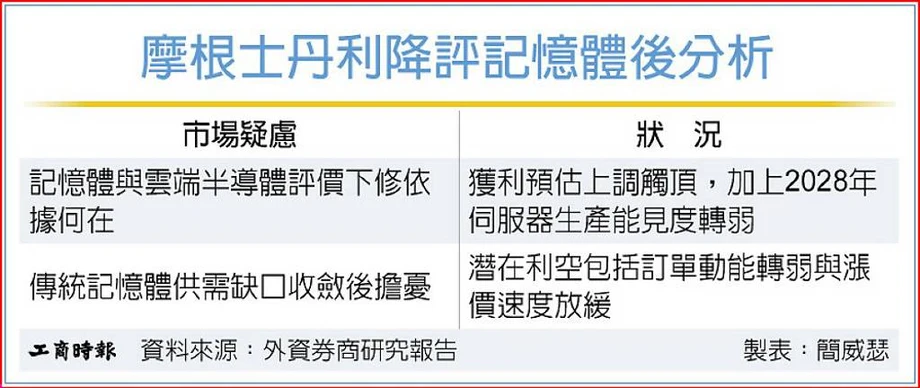
Market observers questioned why analysts would reduce ratings while end-market demand for memory chips still appeared robust. In response to client concerns, the financial institution explained that investors should reduce their holdings before visible signs of a slowdown emerge in cloud capital expenditures. The core reasoning behind the adjustments centers on the timing of valuation changes relative to corporate earnings peaks. Analysts indicated that if investors begin to re-evaluate the long-term sustainability of current growth rates, valuations may contract even before corporate profits actually peak. Furthermore, declining visibility into server production schedules for the year 2028 reduced confidence in the sector's long-term momentum.
Traditional Memory Vulnerabilities and 2028 Supply-Demand Normalization
Traditional memory products face distinct structural challenges that influenced the recent rating changes. Unlike sectors with extensive long-term agreements that lock in fixed pricing, traditional memory suppliers rely heavily on spot market conditions and short-term contracts. While this flexibility allows manufacturers to raise prices rapidly during market upswings, it leaves them with minimal price protection when demand eventually softens. Updated supply and demand models suggest that the current market imbalance will gradually normalize by 2028. This expected return to equilibrium means that price-to-earnings multiples are likely to decline well ahead of any actual drop in corporate profitability.
Potential headwinds for the industry include a weakening of order momentum and a deceleration in price increases. Although the exact timing of these shifts remains uncertain, analysts warned that waiting until these trends become fully apparent would leave investors too late to adjust their portfolios effectively. Market research firm TrendForce noted related shifts during an industry event in Seoul, projecting that NAND flash memory contract prices would begin falling in the second quarter of 2027. This anticipated decline stems largely from capacity expansions by Yangtze Memory Technologies Corp, whereas general DRAM prices are expected to find better support through the end of 2027 due to high manufacturing complexities associated with High Bandwidth Memory production.
Broader Market Sell-Off and Leveraged Position Liquidation
The downgrades arrived amid a broader systemic correction in the broader Taiwanese stock market, which experienced historic single-day plunges and massive liquidations of leveraged trading accounts. The sudden drop triggered widespread margin calls as retail investors faced severe maintenance margin pressures. Memory stocks bore the brunt of the non-rational selling, with several leading manufacturers experiencing significant price drops from their earlier peak values recorded in mid-2026. Nanya Technology, for instance, witnessed sharp declines during mid-November trading sessions, while peers like Winbond Electronics and Macronix also registered steep pullbacks as general market sentiment deteriorated.
Despite the steep declines in share prices, fundamental performance for several memory makers remained robust through the third quarter of 2026, with companies like Winbond and Macronix reporting gross profit margins exceeding 70 percent. However, equity markets tend to price in future expectations rather than past achievements. The growing divergence between strong historical earnings and cautious future outlooks created intense friction among institutional investors, local brokerages, and retail participants. While foreign institutional investors exhibited mixed trading patterns by selectively accumulating certain battered stocks, domestic investment trusts faced heavy redemption pressures that contributed significantly to the selling wave.
Divergent Industry Views on AI Demand and Future Supply Constraints
Industry leaders and independent analysts offered contrasting perspectives on the health of the memory market, pointing to the structural differences between consumer electronics and artificial intelligence infrastructure. Phison Electronics CEO K.H. Pan stated that consumer markets indeed showed signs of weakness, but emphasized that enterprise-level solid-state drives and artificial intelligence data center storage requirements remained exceptionally strong. Micron Technology CEO Sanjay Mehrotra similarly noted that a vast majority of the company supply for upcoming periods had already been committed, pointing to continued tightness in advanced memory segments.
Local brokerages and experienced financial analysts argued that the recent sharp sell-off represented an emotional overreaction to systemic market risks rather than a fundamental failure of the technology sector. High-bandwidth memory production requires significantly more silicon wafer capacity than standard DRAM production, which naturally constrains the supply of older memory types and leaves certain supply deficits intact. Companies with strong exposure to specialized niches and enterprise applications were thus viewed by some analysts as oversold opportunities, though others urged caution until broader market stabilization signals emerge.
Timeline of Key Market Developments
- Mid-2026: Several major memory stocks reach relative peak price levels before initiating gradual corrections.
- November 16 to 20, 2026: The broader stock exchange experiences a severe market correction, accompanied by record margin liquidations.
- November 17, 2026: Morgan Stanley publishes reports downgrading multiple Taiwanese memory suppliers and adjusting target prices.
- November 18, 2026: Market research presentations highlight impending supply-demand shifts and capacity expansions expected for 2027 and 2028.
- November 20, 2026: Heavy selling pushes several prominent memory equities to multi-month lows, prompting corporate responses and differing institutional strategies.
At a Glance
- Morgan Stanley downgraded Winbond, Macronix, Phison, and Powerchip, while cutting Nanya Technology to a target price of 550 New Taiwan dollars.
- Analysts cited potential cloud capital expenditure slowdowns and 2028 supply normalization as the primary catalysts for the valuation adjustments.
- Traditional memory lacks extensive long-term fixed-price contracts, making suppliers vulnerable to rapid price corrections when demand weakens.
- TrendForce projected that NAND flash contract prices will decline starting in the second quarter of 2027 due to rising production capacity.
- Despite sharp stock price declines driven by broader market margin liquidations, industry executives reported strong ongoing demand for artificial intelligence and enterprise storage solutions.