A Historic Distance in the Cosmos
NASA spacecraft Voyager 1 crossed a threshold on November 18, 2026, at 5:16:07 a.m. EST, reaching a distance of one light-day from Earth. This achievement marks the first time any human-made object has traveled so far into the cosmos, resting at approximately 16.1 billion miles or 25.9 billion kilometers away from our planet. Launched nearly 49 years ago, the probe now moves through interstellar space at a speed of nearly 38,000 miles per hour.
Contents
Light travels faster than anything else in the universe, covering roughly 186,282 miles every single second. Even at that supreme speed, a radio command sent from Earth now takes a full 24 hours to reach the spacecraft. A reply from Voyager 1 requires another 24 hours to journey back home, creating a communication lag of two full days for mission controllers.
The Rare Planetary Alignment That Made It Possible
Voyager 1 lifted off on September 5, 1977, from Cape Canaveral, Florida, atop a Titan 3E-Centaur rocket. Its twin probe, Voyager 2, had launched 16 days earlier on August 20. These missions capitalized on a rare planetary alignment that occurs only once every 175 years, a celestial geometry first calculated by graduate student Gary Flandro in the mid-1960s.
Thomas Paine, who served as NASA administrator from March 1969 until September 1970, used historical context to secure backing for the project from President Richard Nixon. Thomas Paine remarked that the planetary alignment had not occurred since the presidency of Thomas Jefferson.
This specific alignment allowed the spacecraft to visit multiple outer planets by using gravity assists, a technique where a planet's gravitational pull swings a probe onward toward the next destination.
A Grand Tour of the Solar System
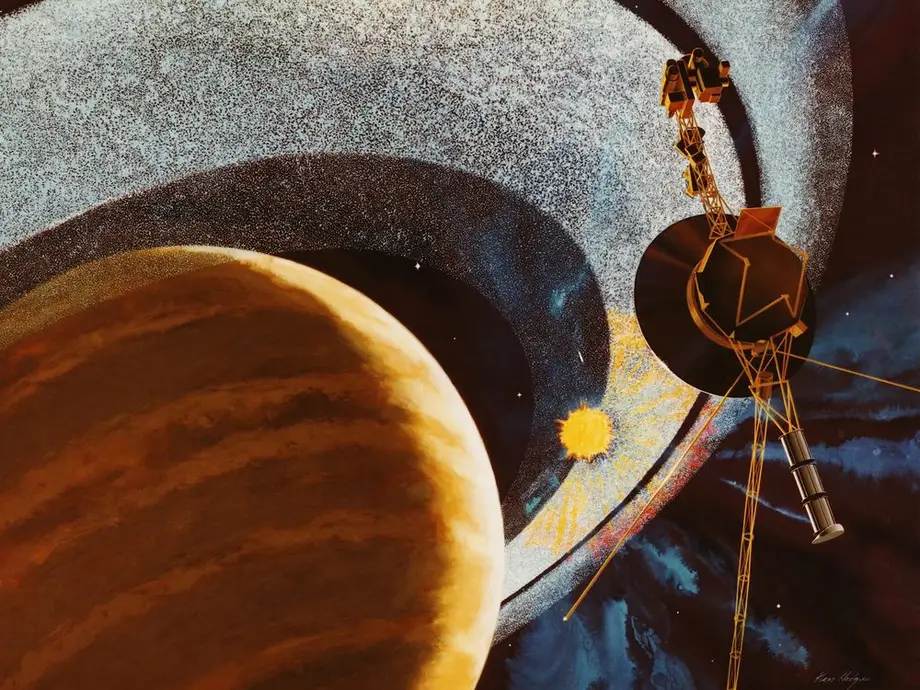
Voyager 1 took a faster trajectory than its twin, hurtling past Jupiter in March 1979 and Saturn in November 1980. During these encounters, the imaging team led by Brad Smith discovered active volcanoes on Jupiter's moon Io, mysterious spokes within Saturn's icy rings, and a thick nitrogen atmosphere shrouding Saturn's largest moon, Titan. A close flyby of Titan bent the path of Voyager 1 upward and out of the plane of the planetary orbits, sending it on a permanent trajectory away from the solar system.
Meanwhile, Voyager 2 visited Jupiter, Saturn, Uranus in 1986, and Neptune in 1989, completing a grand tour of the outer planets. Decades later, both probes crossed the heliopause, the outer boundary of the protective bubble of solar wind and magnetic fields generated by the Sun. Voyager 1 crossed this threshold on August 25, 2012, while Voyager 2 followed in November 2018.
The journey of both spacecraft includes several key historical milestones:
- Summer 1965: Calculations reveal the rare planetary alignment of the outer planets.
- July 1, 1972: NASA officially approves the Voyager programme.
- August 20, 1977: Voyager 2 launches from Kennedy Space Center, Florida.
- September 5, 1977: Voyager 1 launches from Kennedy Space Center, Florida.
- March 5, 1979: Voyager 1 makes its closest approach to Jupiter.
- November 12, 1980: Voyager 1 carries out its flyby of Saturn and Titan.
- February 17, 1998: Voyager 1 becomes the furthest human-made object from Earth.
- August 25, 2012: Voyager 1 enters interstellar space.
- November 18, 2026: Voyager 1 reaches a distance of one light-day from Earth.
Peering Back at the Pale Blue Dot
Before powering down its cameras permanently, Voyager 1 turned back toward the inner solar system on February 14, 1990. The probe captured a series of 64 images that formed the first family portrait of the solar system. This included a shot of Earth requested by astronomer Carl Sagan, who described our home planet as a mote of dust suspended in a sunbeam.
Both spacecraft also carry a message for any potential extraterrestrial civilizations. Each probe holds a gold-plated copper phonograph record containing spoken greetings in 55 languages, natural sounds such as wind and surf, and music.
Power Challenges and the Path Ahead
Powering a spacecraft nearly half a century into its mission requires radioactive decay. Both Voyagers rely on radioisotope thermoelectric generators, which convert heat from decaying plutonium-238 into electricity. This power source loses about 4 watts of capacity each year.
Engineers have progressively shut down nonessential equipment and heating systems to conserve energy. Voyager 1 now operates with only two of its original ten science instruments functioning, namely the magnetometer and the plasma wave instrument. A recent power-saving adjustment nicknamed the Big Bang successfully extended the operational timeline for the remaining instruments.
Scientists study the data returned by these final instruments to understand the interstellar medium, the vast and largely empty space between star systems. Data from Voyager 1 has revealed how solar storms generate shockwaves that travel far beyond the heliosphere, influencing distant regions of space in ways researchers did not anticipate.
Project scientist Linda Spilker emphasized the extraordinary nature of the mission and the dedication required to maintain contact across billions of miles. Linda Spilker stated:
The Earth and Voyager are exactly 24 hours apart at the speed of light. It's a very special moment where Voyager 1 is about 16.1 billion miles away, and we're celebrating that moment because it's the first human-made object to actually reach one light-day distance.
While Voyager 1 continues toward a distant star system known as Gliese 445, its twin remains active further behind and is projected to reach the one-light-day milestone in November 2035. Researchers anticipate that dwindling power supplies will eventually sever communication with Voyager 1 before the end of the decade, but the spacecraft will continue carrying humanity's records into the deep void of space indefinitely.
The Essentials
- Voyager 1 reached a distance of one light-day from Earth on November 18, 2026, at 5:16:07 a.m. EST.
- The spacecraft is traveling at nearly 38,000 miles per hour through interstellar space, located approximately 16.1 billion miles away.
- Radio signals now require a full 24 hours to reach the probe and another 24 hours to return to Earth.
- Only two of the original ten science instruments remain operational as the plutonium power source slowly degrades.
- Voyager 2 is trailing behind and is expected to reach the one light-day mark in November 2035.