A tiny twist changes the light
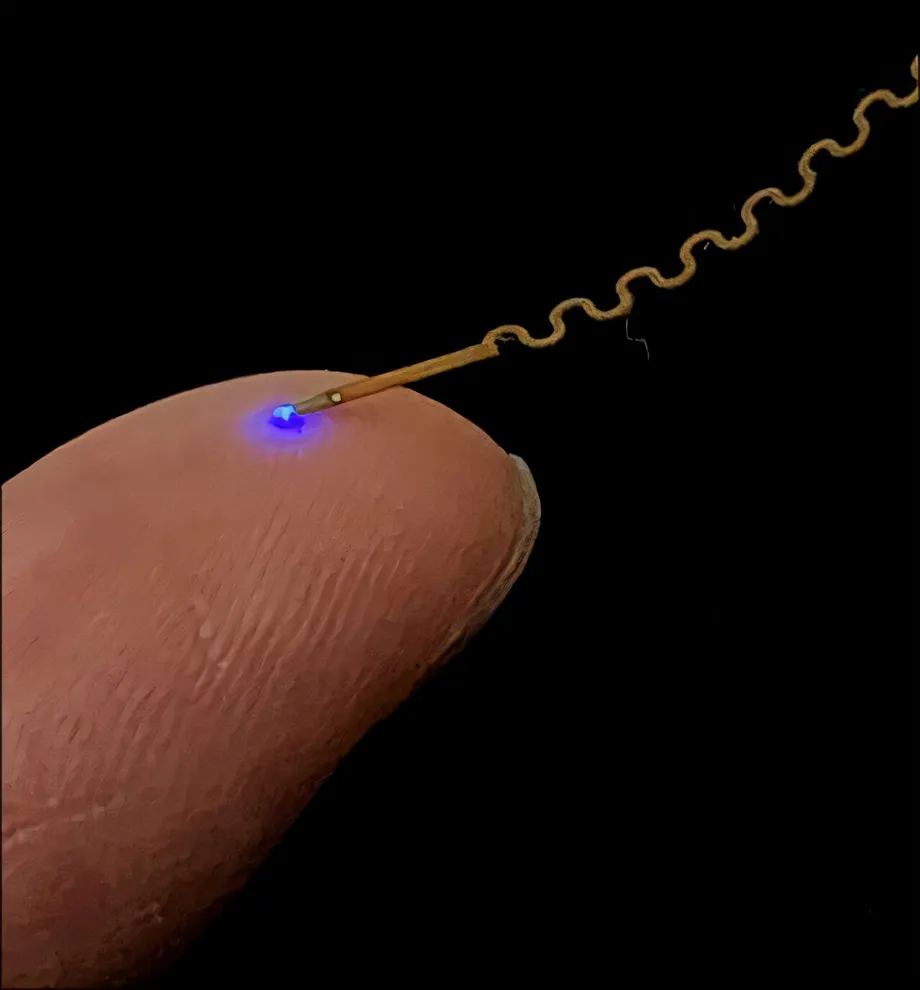
A research team led by Professor Jeongyong Kim at Sungkyunkwan University in South Korea has found a way to tune infrared light by stacking and twisting two extremely thin semiconductor layers. By changing how the layers are rotated against each other, the researchers controlled the light's wavelength and polarization, the direction in which its light waves vibrate.
Contents
The team used rhenium disulfide (ReS₂) and rhenium diselenide (ReSe₂), materials whose optical behavior changes with the direction of their crystal structure. Twisting the layers from 1° to 88° produced robust polarized infrared emission near 1.2 eV across the tested range. Changing the twist and the number of layers also allowed the team to shift the emission energy by about 100 millielectronvolts, or meV.
The work, published in ACS Nano as "Twist-Tunable Interlayer Excitons in Anisotropic ReS₂/ReSe₂ Heterostructures," could help researchers design infrared emitters with adjustable polarization and light detectors that respond to angle. The ACS Nano paper has DOI 10.1021/acsnano.6c11594. The article publication date is not provided. The findings could help researchers design infrared emitters with adjustable polarization and light detectors that respond to angle. Those functions may be useful in vehicle LiDAR, night vision and biosensors, although the findings describe a research platform rather than a finished product.
What happens inside the semiconductor layers?
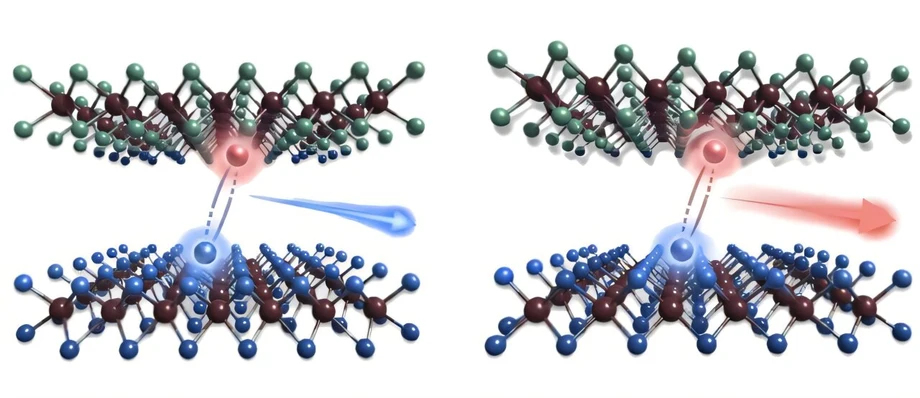
When light reaches a semiconductor, it can give an electron enough energy to move from its usual state. The electron leaves behind an empty place that behaves like a positively charged particle called a hole. The electron and hole can attract each other and bind together, forming an exciton.
In a stack of two atomically thin semiconductors, an electron can sit in one layer while its paired hole sits in the other. This arrangement is called an interlayer exciton. Because the two charges are separated across the layers, these excitons can last tens of times longer than ordinary excitons. The team's account also notes that an external voltage can control them more easily, a useful feature for devices designed to use little power or for quantum computing research.
In practical terms, controlling an exciton means controlling the light it produces. The challenge has been making that light adjustable across a useful range, rather than having it appear only under a few specific conditions.
Why use rhenium compounds?
Many familiar two dimensional semiconductors have optical properties that are nearly the same in different directions. Researchers call this kind of material isotropic. In those materials, interlayer excitons have generally emitted light only at particular twist angles, such as 0° and 60°, and the emission has not provided control over polarization.
ReS₂ and ReSe₂ are anisotropic: their optical properties vary with the direction of the crystal. That directional character gave Kim's team another way to influence the emitted light. Instead of relying on just a few special alignments, the researchers tested layer rotations from 1° through 88° and reported stable infrared emission at almost every angle.
The twist also creates a moiré pattern. This is a larger repeating pattern that appears when two smaller repeating structures overlap at an angle, much like the shifting bands seen when two mesh screens are placed over each other. In this experiment, the pattern came from the way the atomic arrangements in the two semiconductor layers lined up.
How much can the light be tuned?
By adjusting both the rotation and the number of layers, the researchers achieved an energy tuning range of about 100 meV. Energy and wavelength are linked: changing the energy of emitted light changes its wavelength. The adjustment therefore lets researchers shift the infrared emission, including small differences that could matter when matching a source to a particular sensing task.
The lowest-energy interlayer-exciton transition varied nonmonotonically with twist angle, with a total modulation range of about 60 meV. The reported overall energy tunability extended to about 100 meV with multilayer ReS₂ and variation in excitation energy. The team attributed the behavior to moiré-driven band renormalization and changes in interlayer coupling, examined with first-principles calculations and low-frequency Raman spectroscopy, respectively.
Infrared light lies beyond the red end of the visible spectrum, so people cannot see it with their eyes. Devices can detect it, however, and differences in its wavelength can carry information about objects or materials. The reported result gives researchers a way to adjust the output within a single material structure rather than being limited to a fixed emission setting.
The team also found that stacking multiple layers could make the emitted light up to ten times brighter, or an order of magnitude brighter, and allow the polarization direction to be changed. Wavelength control adjusts the light's spectral position; polarization control adjusts the orientation of its waves. Together, those controls let the structure shape more than one property of the infrared signal.
What did the team say the advance means?
Kim, a professor in Sungkyunkwan University's Department of Energy Science and the team leader, described the work as the first demonstration of controlling both properties through interlayer excitons by twisting atomically thin semiconductor layers. He said the result establishes a platform for infrared devices that can select polarization and for detectors that respond to angle.
We have, for the first time in the world, demonstrated a technology that can simultaneously control the wavelength and polarization of infrared light based on interlayer excitons simply by twisting atomically thin semiconductor layers.
Kim also pointed to possible uses in vehicle LiDAR sensors, night vision imaging and biosensors. LiDAR sends out light and measures what returns, helping a system estimate the distance and position of objects. Controllable infrared sources could give designers additional ways to tailor the signal used by such systems, while polarization sensitive detection could help distinguish light arriving in different orientations.
Those uses remain possible applications, not products demonstrated in the reported work. The announcement provides no timetable for commercial devices or details about their eventual size, cost or performance in everyday conditions.
Why the result matters for device design
The research combines several controls in one thin layered structure. A designer could, in principle, choose a twist angle and layer count to set the emitted wavelength, then use the structure's anisotropic properties to set polarization. The brighter emission seen with additional layers could also help when a stronger signal is needed.
That combination may be useful because infrared systems often need to match light to a task. A sensor designed to detect a particular signal may benefit from a source with a carefully selected wavelength. Polarization adds another characteristic that an emitter or detector can use. The study points to this flexibility as a basis for polarization addressable infrared emitters and angle sensitive photodetectors.
The work also builds on the special behavior of interlayer excitons. Their longer lifetimes and response to voltage make them attractive for low power optoelectronics and quantum technology research. The study focuses on controlling their infrared emission; it does not report a working quantum computer or a deployed sensing system.
What remains to be tested?
The reported findings establish control of emission in the researchers' semiconductor structures, but further development would be needed to turn that control into practical equipment. The available announcement does not give figures for operating voltage, production yield, device lifetime or performance outside laboratory conditions. It also does not provide a date for a next research milestone.
For now, the central result is the range of control: stable infrared emission across almost all tested twist angles, an energy tuning span of about 100 meV, and adjustable polarization, with brightness rising by up to a factor of ten in multilayer stacks. The next step toward applications will depend on how well those properties can be built into devices and maintained in real operating settings.
Key Points
A Sungkyunkwan University team led by Jeongyong Kim studied stacked layers of ReS₂ and ReSe₂.
Twisting the layers from 1° to 88° produced stable infrared emission across nearly the full tested range.
Changing twist angle and layer count tuned emission energy by about 100 meV.
Multiple layers increased brightness by up to an order of magnitude and allowed polarization control.
Potential uses include vehicle LiDAR, night vision and biosensors; no commercial timetable was given.