A Singapore story reaches the top of animation's global stage
Singaporean director Ervin Han's animated feature The Violinist won the Cristal for a Feature Film and the SACEM Award for Best Original Soundtrack at the Annecy International Animation Film Festival in June 2026. More than 4,000 entries were submitted across the festival's categories, according to Singapore's Infocomm Media Development Authority (IMDA). The double win was a first for a Singapore produced animated feature at Annecy.
Contents
- A Singapore story reaches the top of animation's global stage
- What story does the film tell?
- How did a short film grow into a feature?
- Why is music central to the film?
- How was the film made across borders?
- What do the awards mean for Singapore?
- What comes next in its awards run?
- A short timeline
- Key Points
The film follows Fei and Kai, childhood friends whose bond is built around music and broken apart by war. Its story moves from 1930s Singapore through the Japanese Occupation and into later decades, using one unfinished piece of music to connect private memories with the history of a changing country.
The recognition has carried into the film's next awards season. The Violinist is nominated for Best Animated Feature, Best Adapted Screenplay and Best Original Film Score at the 63rd Golden Horse Awards in Taipei on Nov. 22. It has also won Best Animated Film at the Asia Pacific Screen Awards.
Han has described The Violinist as a project intended to encourage more stories from Singapore and Southeast Asia to find audiences around the world. Its success offers a striking example of a locally rooted story made through a production network stretching across several countries.
What story does the film tell?
The story begins in a wealthy Peranakan household in 1930s Singapore. Peranakan communities developed from generations of cultural exchange, including Chinese and Malay influences, and the film uses Fei's family and home to place that heritage at the heart of its personal drama.
Fei and Kai are young violinists whose friendship is joined by a promise to perform a sonata together. When Japan invades Southeast Asia, their lives take sharply different paths. Kai leaves music and joins the resistance in Perak, in what is now Malaysia. Fei remains in occupied Singapore and survives the war. Separation, memory and the possibility of reunion drive the story forward.
The historical setting is more than scenery. As a child, Fei grows up surrounded by music and family privilege; war tears apart the routines and relationships that once shaped her life. The film follows how those changes mark people over time, making a national history understandable through the experiences of two individuals.
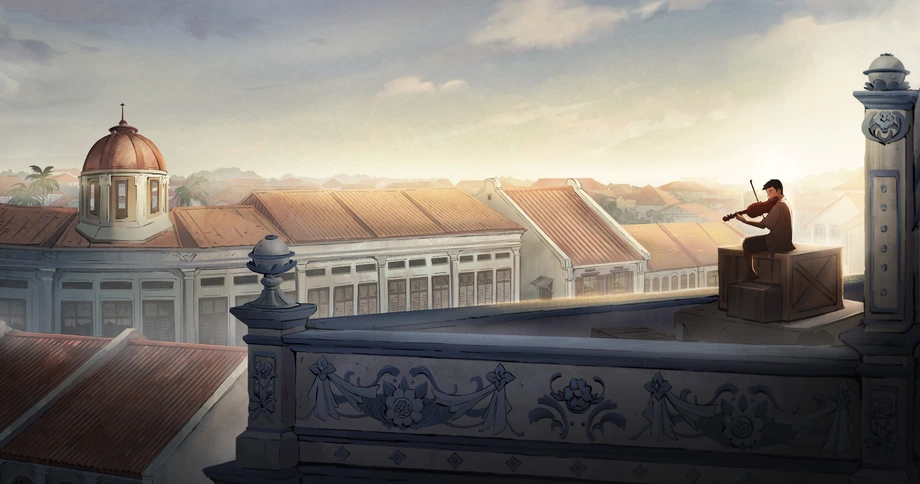
The production team used NUS Baba House, a restored Peranakan shophouse, as a visual and cultural reference for Fei's childhood home. The film's artists also studied Singapore's changing streets and performance spaces, including Victoria Concert Hall. Those details help the animated setting show a place changing across generations rather than treating the past as a single fixed moment.
How did a short film grow into a feature?
The Violinist grew from The Violin, a dialogue free animated short Han made in 2015 for the Singapore Memory Project, which marked the country's 50th anniversary of independence. The short used a violin's journey through different moments in Singapore's past to carry memories without spoken explanation. It later won Best 2D Animated Programme at the 2017 Asian Television Awards.
Han began developing the feature from that idea, then presented it at the Southeast Asia Film Financing Forum in 2017. It was selected for Annecy MIFA Pitches in 2019 and the Tokyo Gap Financing Market in 2023, industry events where film teams present projects to potential funders and partners. Those years of development gave the creators time to build the story and assemble an international production team.
Robot Playground Media announced that the feature had been greenlit for production on Dec. 8, 2023, with Valencia based TV ON Producciones as a co producer. The film was initially planned for release in late 2025. Production later continued into 2026, with the completed film premiering at Annecy in June.
Han has said he wanted the film to share Singapore's past as a human story rather than a history lesson. He described the story during the production announcement as covering 80 years of Singapore's past; later descriptions of the completed film place Fei's life across roughly nine decades, from the 1930s towards the present.
The development and production journey took about a decade and involved more than 400 people, according to accounts from the filmmakers. Work was divided among teams in Singapore, Spain, Malaysia and other countries. The project's production launch announcement identified Singapore's Robot Playground Media and Spain's TV ON Producciones as the first official Singapore Spain animation co production.
Why is music central to the film?
The violin is both an instrument the characters play and the thread that keeps their relationship alive through separation. The sonata they hope to perform together returns as a musical reminder of their promise. In the story, its notes are also part of the plot: the characters write and remember them as their lives pull apart.
Singaporean composer Ricky Ho wrote the score with Spanish composer Isabel Latorre. Singaporean violinist Joy Yong performed the lead violin parts. The soundtrack's Annecy award recognised the music as an essential part of the film's storytelling, not simply accompaniment behind the images.
Ho has described the care that went into the sonata's opening. The composer said he spent two months revising the first four notes of the film's signature piece, Sunset Sonata.
It has to be very special, especially the first few notes. Maybe the first two months I write, put aside, take it back, change some notes. In the end, I find these four notes are the perfect notes for the film.
The animation team also spent 18 months working on scenes of violin playing. Animators used filmed reference and, for some shots, motion capture, a method that records a performer's movements so they can guide an animated figure. The work mattered because viewers can notice when a musician's hands, bow or posture do not look believable.
How was the film made across borders?
Han co directed and co wrote the film with Spanish animation veteran Raúl García. Their official production partnership brought together Singapore's Robot Playground Media, Spain's TV ON Producciones and Italy's Altri Occhi. France tv distribution handles worldwide sales. Animation work was shared across Singapore, Spain and Malaysia, while teams and contributors from other countries also took part.
The production's international structure helped bring together different skills and made it possible to create a story set across a broad sweep of places and time. García's background includes work in Disney's animation department on films such as Beauty and the Beast, Aladdin and The Lion King. The film uses hand drawn 2D animation, with some 3D tools to help plan complex camera movement, depth and large settings.
García has said the story offered a way to show the Second World War from a perspective less familiar to many Western viewers. Singapore's experience of occupation and its aftermath sits at the centre of the film, rather than appearing as a distant side plot.
The film has also been described as Singapore's first animated feature in more than 15 years. That description refers to a feature length production, rather than animation as a whole: Singapore has had animated shorts and other screen work, including Eric Khoo's animated film Tatsumi, which played at Annecy in 2011.
What do the awards mean for Singapore?
The Cristal is Annecy's highest prize for a feature film. The festival's 2026 competition drew more than 4,000 entries across categories, giving the win a scale beyond a local industry milestone. The accompanying SACEM award also singled out the film's original music, matching the role the sonata plays in the story.
IMDA supported the film and has described its success as validation of Singapore's work to develop creative talent and stories for international audiences. Chief Executive Ng Cher Pong congratulated Han and the team after the Annecy win.
This historic win at Annecy validates IMDA's commitment to developing world class talent and creating stories that resonate with global audiences.
Han said the recognition should help other storytellers from Singapore and Southeast Asia imagine their work reaching viewers abroad. In the IMDA statement, he credited artists, animators, musicians and filmmakers from Singapore, Spain, Italy and elsewhere for bringing the film to life.
We hope this recognition not only celebrates The Violinist, but also encourages more stories from Singapore and Southeast Asia to find audiences around the world.
The film's attention has extended beyond Annecy. It opened in Singapore in September and in Spain on Nov. 13, and it has been nominated for three Golden Horse Awards. The results of the Taipei ceremony are due on Nov. 22, 2026.
What comes next in its awards run?
The Golden Horse nominations cover three different parts of the work: animation, writing and music. Best Animated Feature recognises the film as a whole in its category. Best Adapted Screenplay focuses on the story's written form, while Best Original Film Score recognises the music composed for the film.
The team has also taken the film to audiences outside Singapore, including screenings in North America. An Oscar qualifying theatrical run has been reported in Los Angeles. A qualifying run is a cinema engagement intended to meet the Academy's rules for a film to be eligible for consideration; it does not mean the film has been nominated for an Oscar.
Han has spoken cautiously about Oscar possibilities, while saying that the response of Singapore audiences matters deeply to him. For a film that began as a silent short about memory, its awards journey now gives a story about war, separation and music a much wider audience.
A short timeline
2015: Han's short film The Violin is made for the Singapore Memory Project.
2017: The feature project is presented at the Southeast Asia Film Financing Forum; the short wins an Asian Television Award.
2019 and 2023: The project is selected for Annecy MIFA Pitches and the Tokyo Gap Financing Market.
Dec. 8, 2023: Robot Playground Media announces the feature's production greenlight.
June 2026: The Violinist premieres at Annecy and wins the Feature Film Cristal and SACEM soundtrack award.
September and Nov. 13, 2026: The film opens in Singapore and Spain, respectively.
Nov. 22, 2026: The 63rd Golden Horse Awards are scheduled in Taipei, where the film has three nominations.
Key Points
The Violinist won Annecy's 2026 Feature Film Cristal and the SACEM Award for Best Original Soundtrack.
Han and García's film follows violinists Fei and Kai through wartime separation and decades of change in Singapore and Malaya.
The feature grew from Han's 2015 animated short The Violin and took about a decade to make.
Ricky Ho and Isabel Latorre composed the score, with Joy Yong performing the lead violin parts.
The film has three Golden Horse nominations, with the awards scheduled for Nov. 22, 2026.