Building a Quantum-Safe Bridge Between South Korea and Singapore
South Korean telecommunications operator SK Broadband was selected on October 19, 2026, as the overseas site operator for a government-backed initiative to construct an international quantum-safe test network, with a total budget or funding amount allocated by the Ministry of Science and ICT of 198.9 billion won for the Open Quantum Testbed Advancement and Expansion project. The project links Busan in South Korea with Singapore across the 10,500-kilometer Southeast Asia-Japan Cable 2 subsea cable. Led by South Korea Ministry of Science and ICT and the National Information Society Agency, the testbed aims to open in 2027 to validate cross-border data protection against emerging cyber threats.
Contents
As traditional computing gives way to advanced quantum machines, standard encryption protecting global submarine cables faces the risk of rapid decryption. The upcoming test network specifically targets harvest-now, decrypt-later threats, a malicious practice where hackers intercept and store encrypted data today to unlock it once quantum computers mature. By establishing this cross-border testing ground, the initiative seeks to verify the overseas interoperability and reliability of domestically developed quantum security equipment in real-world oceanic conditions.
Understanding Quantum Security Technologies
Quantum key distribution is a method that uses the principles of quantum mechanics to allow two parties to produce a shared, random secret key known only to them. Any eavesdropping on the communication channel alters the state of the photons, instantly alerting the communicating parties and securing the data against interception. This technology provides ultimate security but experiences signal degradation over long distances, making it ideal for shorter terrestrial fiber links.
Post-quantum cryptography relies on mathematical problems that are difficult for both classical and quantum computers to solve, serving as a software-based defense layer suitable for massive distances. The new test network employs a defense-in-depth hybrid architecture tailored to transmission distance, deploying quantum key distribution across shorter terrestrial fiber links in South Korea and Singapore while applying post-quantum cryptography over the long-distance Busan-Singapore subsea segment. This combination creates a robust barrier against sophisticated interception efforts across international waters.
Connecting Global Testbeds and Standardized Interoperability
Building on a 2023 quantum cooperation memorandum of understanding between the National Information Society Agency and Singapore Infocomm Media Development Authority, the project will interconnect South Korean infrastructure with Singapore National Quantum-Safe Network Plus. Operated by telecommunications provider Singtel and quantum technology firm SpeQtral, the Singaporean network will communicate with the South Korean testbed using European Telecommunications Standards Institute key-interworking standards. These standardized protocols ensure that different cryptographic systems can exchange security keys seamlessly across borders.
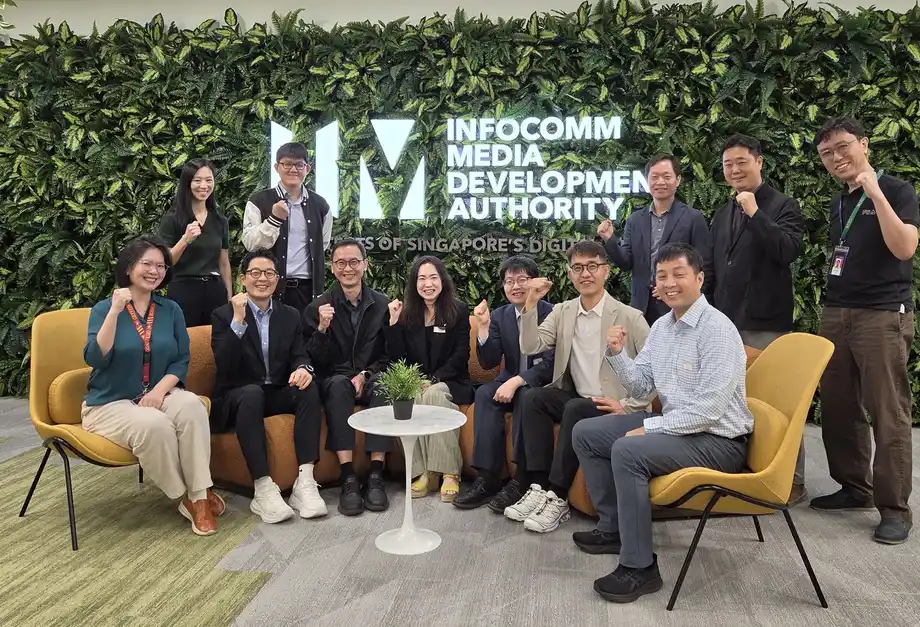
Technical delegations from South Korea have already begun laying the groundwork for physical installations. An SK Broadband delegation recently joined representatives from the National Information Society Agency and IonQ, whose subsidiary ID Quantique supplies quantum key distribution infrastructure for the Singaporean network and collaborates on domestic testbeds, to inspect equipment installation requirements at the Global Switch submarine cable landing facility. During this visit, the team finalized role allocations with the Infocomm Media Development Authority and Singtel, while also meeting with satellite quantum communications provider SpeQtral and the National University of Singapore quantum research center to discuss broader technological cooperation.
Expanding Horizons for Korean Quantum Technologies
The 10,500-kilometer Southeast Asia-Japan Cable 2 submarine cable system became operational in 2025, connecting Singapore, Hong Kong, and Japan via its main trunk, with landing points in South Korea, Taiwan, Vietnam, Cambodia, and Thailand. Integrating quantum defenses directly into this operational undersea route presents unique engineering challenges, including severe signal loss and the physical constraints of underwater repeater stations that amplify light pulses across ocean floors. Testing these systems on an active international route moves quantum security from theoretical laboratories into commercial reality.
Company executives highlighted the broader industrial impact of the cross-border initiative during announcements made in Seoul. Sung Jin-soo, head of SK Broadband Network Center, explained the strategic importance of the undertaking for domestic technology providers seeking international markets.
This overseas quantum security demonstration project with Singapore will not only build a cross-border quantum security network system but also open a path for leading Korean quantum security companies to expand overseas.
Kim Young-hee, head of the Quantum Technology Utilization Center at the National Information Society Agency, noted the significance of achieving Asia first cross-border quantum security network interconnection. Kim emphasized that the collaboration will extend beyond simple technical demonstrations to contribute directly to commercial services and the wider promotion of quantum industrialization.
Global Collaborations and Future Milestones
Beyond the primary Southeast Asia corridor, SK Broadband confirmed that the overseas demonstration program will additionally link with established quantum testbeds in Poland and Bulgaria. These multi-nation connections allow engineers to test South Korean quantum equipment across diverse international telecommunications environments, ensuring global compatibility before commercial rollout.
While planning and site inspections are well underway, certain operational details remain under final coordination, and the official contract value or financial terms agreed upon by SK Broadband for operating the overseas site have not been disclosed. Specific commercial pricing models for end users have not yet been disclosed by participating telecom operators, and exact activation dates for individual European testbed links will be announced following the completion of technical handshakes in 2027. Project leaders continue to coordinate milestone schedules as equipment manufacturing and software integration progress.
The Bottom Line
- SK Broadband will operate an international quantum-safe test network connecting Busan and Singapore over the SJC2 submarine cable by 2027, with the Ministry of Science and ICT allocating a total budget of 198.9 billion won for the Open Quantum Testbed Advancement and Expansion project.
- The project utilizes a hybrid defense architecture combining quantum key distribution for local loops and post-quantum cryptography for the long undersea segment.
- Delegates from South Korea, IonQ, and the National Information Society Agency inspected facilities at a Global Switch data center in Singapore to coordinate with Singtel and IMDA.
- The demonstration initiative will additionally link South Korean quantum testbeds with partner facilities in Poland and Bulgaria.