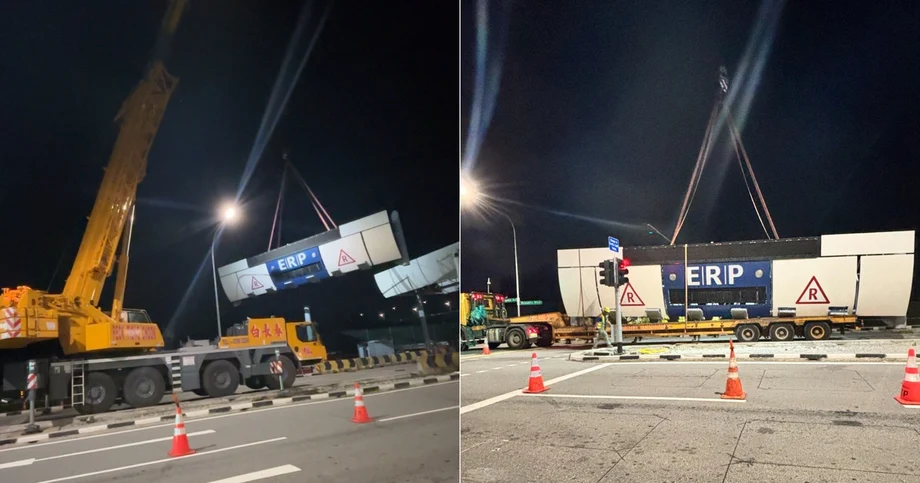
12 gantries removed or modified as the changeover approaches
Singapore has removed or modified 12 of its 95 Electronic Road Pricing (ERP) gantries as of November 18, 2026, ahead of the switch to satellite based charging on January 1, 2027. The Land Transport Authority (LTA) expects the removal and modification programme to be completed by June 2027.
Contents
- 12 gantries removed or modified as the changeover approaches
- Republic Boulevard shows how the gantries come down
- The removal timetable, from October to June
- How ERP 2 identifies a charging location
- Why some gantry frames will stay
- What drivers will see on the road and in the vehicle
- December 31 is also the OBU installation deadline
- A wider role for vehicle location data
- Key Points
The change will replace the familiar overhead charging structures with a combination of satellite positioning, blue road markings, roadside signs and alerts from the On-Board Unit (OBU) inside vehicles. Motorists will still pass through designated ERP charging locations, but the new system, called ERP 2, will identify those crossings without relying on a physical gantry.
Of the 95 existing gantries, 62 are no longer operational. Work on those structures began in October. The remaining 33 will continue collecting charges until December 31, 2026, with removal or modification starting in January 2027.
The two deadlines serve different purposes: January 1 is the change in charging technology, while June is the target for finishing work on the old structures. Some frames will remain in place to carry equipment supporting the new system.
For drivers, the most immediate adjustment will be learning to recognise a charging location without an overhead gantry. LTA is introducing the new road markings and signs at operational gantries before January 1 so motorists can become familiar with them while the existing system is still running.
Republic Boulevard shows how the gantries come down
At Republic Boulevard, removal began at midnight on November 18 and lasted more than four hours. The gantry was cut into three parts, which were transported separately.
The operation involved securing the structure with lifting equipment, cutting its supports and using a crane to lower sections for removal. Road barriers separated the work area from traffic. Dismantling a gantry generally takes about three to four hours, although the Republic Boulevard operation took longer.
Bencoolen Street and Geylang Bahru had their gantries removed on November 13. Work has also reached several locations around the Kallang-Paya Lebar Expressway (KPE), along Dunearn Road and at connections between expressways.
LTA said the schedule would take account of conditions at each site and traffic conditions to minimise inconvenience to motorists. The work is being spread across several months, with inactive structures tackled first and gantries still collecting charges left in service through the end of December.
The removal timetable, from October to June
The first phase covers the 62 inactive gantries, almost two thirds of the existing total. The 33 still operating make up just over one third. This split allows dismantling to proceed while gantry based charging continues at active locations.
The 12 locations recorded as removed or modified by November 18 fall within the first phase. The timetable identifies both individual roads and connecting ramps, showing how widely the work is spread:
- October 2026: Work began on the 62 inactive gantries.
- November 3: Airport Road to KPE southbound.
- November 5: Pan Island Expressway (PIE), in the Changi direction, to KPE northbound.
- November 11: KPE northbound exit to PIE, and Sims Avenue to KPE northbound.
- November 13: Bencoolen Street, Geylang Bahru and the KPE northbound exit to Bartley Road East.
- November 17: KPE southbound exit to PIE in the Tuas direction, Dunearn Road at Wayang Satu Flyover, and Dunearn Road at Whitley Road.
- November 18: Republic Boulevard and the slip road from westbound Marina Coastal Expressway towards Maxwell Road.
- December 31, 2026: The final day of charging through the remaining 33 operational gantries.
- January 1, 2027: Satellite based ERP charging begins, with work on the remaining gantries starting that month.
- June 2027: Target completion of the removal and modification programme.
How ERP 2 identifies a charging location
ERP 2 uses Global Navigation Satellite System (GNSS) technology to determine when a vehicle passes through a charging location. GNSS is the general name for satellite navigation systems that help a receiver work out its position on Earth.
In simple terms, the charging system uses the vehicle's position to recognise that it has crossed a designated point. The overhead structure that once marked and supported that transaction is no longer needed for collecting the charge.
LTA says the technology will allow it to respond more quickly and effectively to changing traffic flows and better support transport planning. The practical change is that charging locations can be identified through positioning technology rather than depending on a large structure above the road.
The transition announcement sets out the new equipment, signs and dates. It does not give a new schedule of ERP rates. Motorists will see the prevailing charge on their OBU as they approach and pass a charging location.
Why some gantry frames will stay
LTA will retain and modify gantry frames at 46 locations to mount roadside equipment. Several of the structures being kept are on expressways.
Some of that equipment will improve location positioning in places where satellite signals may be less reliable. Satellite navigation depends on receiving usable signals, so roadside devices provide extra support where positioning needs assistance.
The retained structures will therefore have a different role. Instead of serving as the physical basis for collecting an ERP charge, they will carry devices supporting ERP 2 and other roadside equipment.
The programme covers both removal and modification because roads have different needs. At some locations the structure can come down completely; at others, keeping the frame provides a place to mount equipment that helps the satellite system operate accurately.
What drivers will see on the road and in the vehicle
Blue oval markings with white ERP lettering will be painted on each lane leading to a charging location. Arterial roads, meaning major roads carrying traffic through an area, and slip roads will have two markings per lane. Expressways will have three, providing more visual cues for motorists travelling at higher speeds.
An ERP Charge Zone sign will mark the start of each charging location. Together, the painted symbols and signs will provide a visible reference on the road as overhead gantries disappear.
The OBU will add a second set of cues inside the vehicle. It will notify the driver before entry, display the current ERP charge and confirm the amount charged after the vehicle passes the location.
Under typical conditions, OBU alerts will appear about 200 metres before an expressway charging point and about 60 metres before a charging point on a major road. Those distances give drivers an advance indication of where charging applies.
LTA is introducing these features before the changeover rather than waiting for the gantries to be removed. During the transition, motorists may therefore see the new blue markings and signs alongside an operational gantry.
December 31 is also the OBU installation deadline
More than 98% of locally registered vehicles have already been fitted with an OBU, according to figures previously released by LTA. Local vehicles must complete installation by December 31, 2026.
That deadline falls on the final day of gantry based charging. For vehicle owners who have yet to complete installation, it is the immediate preparation required before ERP 2 begins on January 1.
The high installation rate means most local vehicles already have the equipment that will deliver charging alerts and transaction information. Drivers will still need to become familiar with how those notifications work alongside the new signs and lane markings.
A wider role for vehicle location data
ERP 2 will primarily support road charging, while also providing functions for traffic management and vehicle enforcement. From January 2027, Singapore's Home Team agencies will be able to use ERP 2 data to assist in preventing, detecting and solving crime.
Senior Minister of State for Home Affairs Goh Pei Ming set out the policy in parliament on November 3. He said Home Team agencies are authorised by law to obtain information from all available sources and expect to use ERP 2 data from January 2027 to prevent, detect and deter crime, and to solve crimes. Access and use will be subject to the same legal and data governance safeguards that apply to other information obtained by the Home Team through the Criminal Procedure Code. Police will retain vehicle-specific data for as long as necessary to complete an investigation or court proceedings.
Senior Minister of State for Transport Sun Xueling said individual-vehicle data is aggregated and anonymised when transferred to LTA's backend system for traffic planning and management. When specific vehicles need to be identified for enforcement, however, LTA can retrieve location data from sensors and systems. This is already being used against serious offences such as illegal cross border taxi services and to detect deregistered vehicles. Other enforcement uses include off-peak cars driven outside permitted hours and vehicles on laid-up and keeping schemes that should not be driven on roads.
Sun said ERP 2 data is subject to existing statutory obligations, including provisions under the Criminal Procedure Code allowing police to require data for criminal investigations. For other authorised purposes, its use and sharing will be governed by applicable public sector data governance requirements, with safeguards for data protection and security and against unauthorised access. Motorists cannot directly access data stored in the OBU; any data it transmits can only be accessed by the government and is stored in a secure environment, she said.
The technology has also featured in discussions about illegal cross border taxi services. In September 2025, officials were considering whether ERP tracking for enforcement could help identify unlawful passenger trips between Singapore and Johor Bahru. Those discussions included the practical gap created by foreign vehicles without OBUs.
The gantry change also closes a chapter lasting nearly three decades. Singapore's first ERP gantries were activated in April 1998, initially on the East Coast Parkway. The fully automated ERP system was introduced across the network in September that year, replacing measures including the Area Licensing Scheme launched in 1975.
Gantries later spread to busy routes including the PIE and Central Expressway. From January 2027, motorists will increasingly identify charging locations through road markings, signs and vehicle alerts, while the last removal and modification work continues towards June.
Key Points
- Satellite based ERP charging starts on January 1, 2027.
- Of 95 existing gantries, 62 are inactive and 33 will keep collecting charges until December 31, 2026.
- By November 18, 12 gantries had been removed or modified.
- The removal and modification programme is expected to finish by June 2027.
- Frames at 46 locations will remain to carry roadside equipment.
- Blue lane markings, ERP Charge Zone signs and OBU alerts will identify charging locations.
- Locally registered vehicles must have an OBU installed by December 31, 2026; more than 98% already do.