A warning before a conversation becomes costly
Singapore's Government Technology Agency (GovTech) and Google DeepMind have developed AntiScam Pango, an app that checks incoming message notifications for signs of fraud, including conversations involving phone numbers that have never been reported as suspicious. The Android beta was unveiled on November 4, 2026, at the STACK Conference at the Sands Expo and Convention Centre. GovTech's official launch announcement, dated November 4, 2026, confirms the beta launch and Lau's announcement at the conference.
Contents
- A warning before a conversation becomes costly
- How Pango follows a suspicious exchange
- What the app reads and where it processes messages
- A model trained around scams targeting Singapore
- Why ScamShield still has a role
- Why the beta is limited to Android
- From an October announcement to public testing
- Keeping people in control of the response
- Key Points
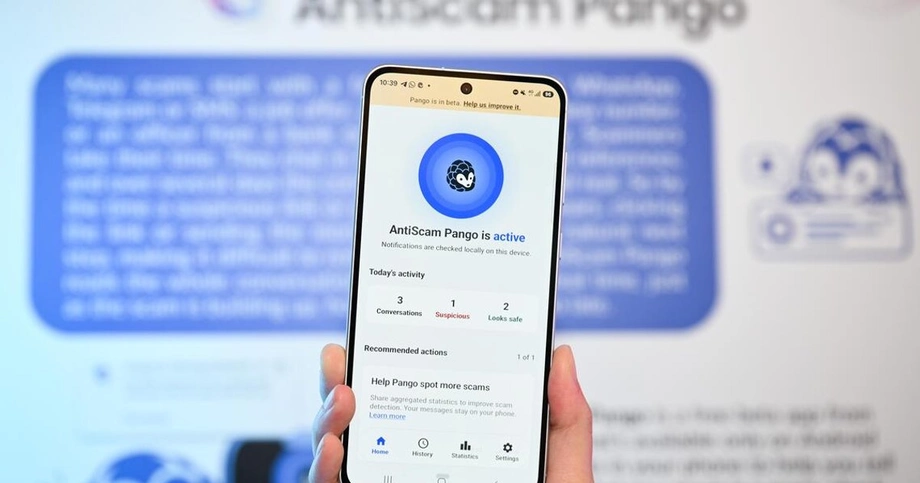
Pango covers WhatsApp, Telegram and SMS. With the user's permission, it analyses notification content on the phone and warns when a conversation shows possible scam tactics. Users receive an explanation of the warning and retain control over whether to reply, report the exchange or check the sender's identity.
Acting Minister for Manpower Jasmin Lau, who is also Senior Minister of State for Digital Development and Information and Minister-in-charge of GovTech, announced the app at the conference. She described its purpose as giving people time to reconsider before taking an action that could expose their money or personal information.
"It checks messages on WhatsApp, Telegram and SMS, flags the ones that look suspicious, and warns you in real time, before you take further actions," said Lau.
The app adds a different kind of protection to Singapore's existing ScamShield service: it examines how a conversation develops, rather than depending only on whether a sender is already known to be risky or whether a user submits a message for checking.
How Pango follows a suspicious exchange
Pango runs in the background after users grant the necessary permissions. It examines notifications displayed by supported messaging services, bringing together successive messages from the same sender to assess the conversation. GovTech's launch announcement says these messages are chained together into a conversation, allowing the app to detect scams that unfold over time.
A scam can begin with ordinary conversation and become suspicious only later. Someone may first try to build trust, then push the recipient to transfer money or reveal personal information. Looking at a sequence of messages gives the model more context than checking a single message in isolation.
The model looks for social engineering, a term for manipulating people into doing something that puts them at risk. In a messaging conversation, the danger may lie in how a sender builds trust or applies pressure, as well as in the words of an individual message.
Pango explains the indicators behind a warning. That gives the user something specific to consider before continuing the exchange. The app does not automatically block the sender or delete messages, so the final decision stays with the person receiving them.
What the app reads and where it processes messages
Pango analyses the content of incoming push notifications after receiving permission. It does not directly open WhatsApp or Telegram and read the chat histories stored inside those apps. This is the route through which it obtains the text it assesses.
GovTech says the analysis happens on the user's phone. Message content is not sent to external servers unless the user chooses to report a suspicious conversation. According to the agency, neither GovTech nor its partners can access users' personal information or private messages through the app during this local analysis.
Lau described that privacy approach during the launch.
"The analysis happens on your phone itself, so your messages stay private," Lau said.
Processing on the phone means the device runs the AI model itself, instead of routinely sending message text to a remote computer for assessment. Reporting is a separate choice: users who decide to submit a suspicious exchange allow its content to leave the device for that purpose.
Messaging services such as WhatsApp use end-to-end encryption to protect messages as they travel between participants. Pango works at the receiving end, examining notifications that the phone can already display, with the user's authorisation.
A model trained around scams targeting Singapore
Google DeepMind's AI model was trained to recognise scam patterns, scenarios and manipulation tactics commonly used against people in Singapore. Its training includes local scam examples and the language scammers use when trying to persuade their targets.
Training data comes from ScamShield, which was developed by GovTech's Open Government Products unit, the police and the National Crime Prevention Council. Another source is an internal AI classifier that evaluates suspicious web links. A classifier is a tool that sorts information into categories, such as whether a link appears connected to fraud.
These inputs bring together information about suspicious communications and potentially dangerous links. Pango uses that training to assess new exchanges, including messages from numbers that have not yet appeared on a list of known scam contacts.
GovTech director of trust and safety Mark Chen said the partnership was intended to combine protection with privacy.
"With AntiScam Pango, we want to show people that they do not have to choose between protection from scams and keeping their personal messages private," said Chen.
Chen also described the technical work behind that goal.
"Our collaboration with Google DeepMind is pushing the boundaries of what small AI models can do to deliver both," he added.
Both remarks appear in GovTech's launch announcement, in which Chen also explained the purpose of public testing.
This beta launch is an important next step, allowing us to learn from real-world use cases and user feedback, so that we can continually improve how we protect Singaporeans against evolving scam tactics.
Why ScamShield still has a role
ScamShield already helps users block calls from blacklisted numbers, filter suspicious SMS messages, and check or report messages, phone numbers and links. Its enhanced app has recorded 1.61 million installations since August 2024, according to GovTech.
Pango adds automatic assessment of incoming conversations across WhatsApp, Telegram and SMS. Its ability to flag a previously unidentified number addresses a practical gap: a recipient can encounter a scammer before anyone has reported that sender.
GovTech encourages people to use both apps during Pango's public beta. Their functions overlap in scam detection, but they act in different ways. ScamShield provides blocking, filtering and checking tools; Pango watches supported notifications for suspicious developments and explains its alerts. The launch announcement recommends using both apps for more comprehensive protection against scams.
For a user, the difference is when help arrives. Submitting a message for checking requires the person to become suspicious first. Pango is designed to raise the warning as the conversation unfolds, potentially prompting a pause before the user replies or acts.
Why the beta is limited to Android
Android users can download the free beta through the Google Play Store. The operating system allows apps to request access to incoming notifications from messaging services, which is the permission Pango needs for its current approach.
GovTech is exploring comparable protection for other operating systems, including Apple's iOS. It is also assessing additional messaging platforms and possible integration with ScamShield. The launch announcement says GovTech will explore opportunities to integrate Pango's capabilities with ScamShield as the product matures. No timetable has been announced for those expansions or the integration.
The public beta gives GovTech a way to collect feedback and improve Pango's ability to recognise suspicious exchanges. Lau encouraged members of the public to try the app and share their experience.
Pango's name comes from the pangolin, which curls up to protect itself when threatened. The intended connection is simple: the app gives people a warning that can help them protect themselves before responding to a suspicious request.
From an October announcement to public testing
The November unveiling followed an announcement about development of the scam detection model during Singapore International Cyber Week in October. The sequence shows how the project moved from a development announcement to an app available for public testing.
- August 2024 onward: ScamShield's enhanced app recorded 1.61 million installations, according to GovTech.
- October 2026: Development of the model that analyses messages on the phone was first announced during Singapore International Cyber Week.
- November 4, 2026: Lau unveiled AntiScam Pango at STACK Conference 2026, with the Android beta available for public use.
The installation figure belongs to ScamShield. Pango is entering its own public testing stage, during which GovTech plans to gather user feedback and refine detection.
Keeping people in control of the response
Pango's warning is designed to create a pause. A recipient can continue the conversation, report it, or independently verify who is contacting them. Because messages remain available, the user can review what prompted the alert before deciding what to do.
The explanation accompanying an alert also has a practical purpose beyond the immediate exchange. By pointing to suspicious behaviour, the app aims to help users recognise manipulation tactics when they encounter similar approaches again.
Lau told the conference that tackling scams requires cooperation between government, businesses and communications platforms. She called on technology companies operating messaging services to contribute their knowledge and work with public agencies on practical measures.
GovTech and Google DeepMind's contribution is a tool positioned at the moment a message reaches a phone. Its usefulness to the public will depend on how effectively it identifies suspicious conversations during testing, while preserving the privacy arrangements GovTech has described.
Key Points
- AntiScam Pango was unveiled in Singapore on November 4, 2026, by Jasmin Lau at STACK Conference.
- The free Android beta analyses WhatsApp, Telegram and SMS notifications with user permission.
- It can warn about suspicious conversations involving numbers that have not previously been reported.
- GovTech says analysis stays on the phone unless the user chooses to report a conversation.
- The app explains warnings but leaves users to decide whether to continue, verify the sender or report the exchange.
- GovTech encourages using Pango alongside ScamShield and is exploring integration, wider platform coverage and protection for iOS.