Bakong begins reaching beyond Cambodia
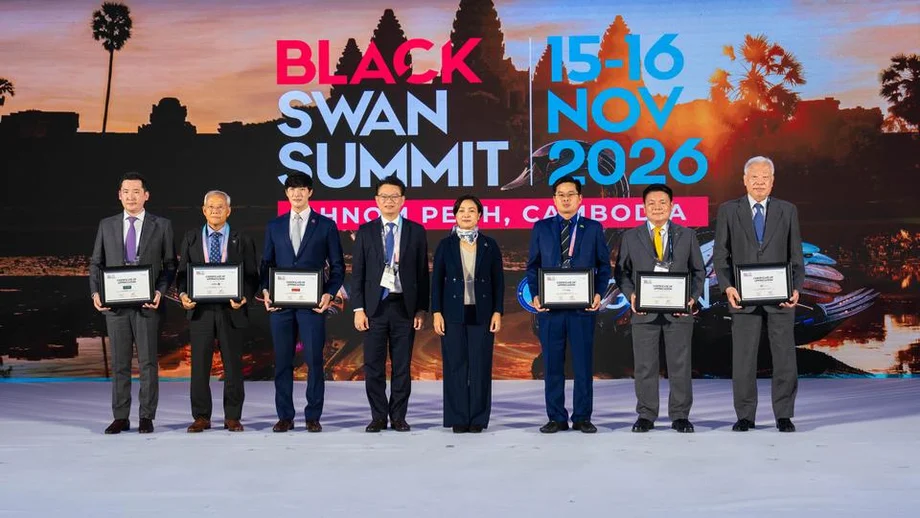
Cambodia is connecting its Bakong payment system to overseas networks through a remittance pilot with Rwanda, two digital finance studies with Japan's SBI Holdings, and virtual bank cards for use abroad. The National Bank of Cambodia (NBC) announced the initiatives at the first Black Swan Summit Cambodia, held in Phnom Penh on November 15 and 16.
Contents
- Bakong begins reaching beyond Cambodia
- What did Cambodia and Japan agree to test?
- How will the Rwanda payment link work?
- Bakong's growth has a national currency dimension
- Virtual cards add a route to overseas payments
- Inclusion means more than opening accounts
- Digital trade documents and trust
- What remains undecided?
- Key Points
The projects aim to let people move money across borders through systems they already use, while exploring whether digital technology can support government bond trading. They are at different stages: the Rwanda link and Japan initiatives are proofs of concept, meaning tests of whether an idea can work in practice. The summit announcements did not set launch dates for those projects.
Bakong already operates on a large scale at home. The NBC said it connects 38 million accounts across banks and financial institutions in a country of about 17 million people, and processed more than 1.3 billion transactions worth US$241.84 billion in 2025. The central bank described that value as about 4.5 times Cambodia's gross domestic product.
The new links extend a system built for domestic payments into international transfers and purchases. For users, the possible change is practical: send money to a wallet or bank account abroad, or use a virtual card when paying overseas, without relying on a separate service for every transaction.
What did Cambodia and Japan agree to test?
SBI Holdings said on November 13 that it had signed two memorandums of understanding with the NBC. One covers a proof of concept for tokenizing Cambodian government bonds. Tokenization means representing an asset, such as a bond, as a digital record that can be transferred and tracked on a network.
The summit announcement said SBI Bank would test the bonds on the Canton Network and examine new ways to trade and settle them. Settlement is the step in which the buyer's payment and the seller's asset are formally exchanged. The study will examine whether the process can work technically and operationally, as well as the security and regulatory questions it raises.
The second study looks at remittances between Japan and Cambodia using JPYSC, a yen stablecoin. A stablecoin is a digital token designed to maintain a steady value against a currency. In the proposed arrangement, it would act as a settlement layer between financial institutions, while recipients in Cambodia would collect money through Bakong wallets. SBI VC Trade would handle JPYSC on the Japanese side.
The planned test is a closed loop that will assess the rules, systems and commercial viability of the transfer process. It is aimed in part at Cambodian workers in Japan who send money home. SBI said that, if the arrangement is put into use, customers would keep the remittance experience they have today. The studies are exploratory, not services currently open to customers.
How will the Rwanda payment link work?
The Cambodia to Rwanda proof of concept connects Bakong with eKash, Rwanda's shared payment platform operated by R-Switch. ACLEDA Bank is the correspondent bank in Cambodia, while I&M Bank (Rwanda) Plc will handle settlement. The initial service lets people in Cambodia send money into bank accounts and digital wallets in Rwanda.
The two countries' central banks also see a possible role for the link in trade, investment and tourism payments. Rwanda's incoming remittances reached US$186.5 million in the first quarter of 2026, up 43.7 percent from a year earlier, according to figures attributed to the National Bank of Rwanda. A separate account of the eKash rollout said its monthly transaction value rose from about US$7 million to more than US$1.5 billion between July and September 2026, after nationwide interoperability became mandatory.
Trade between the two countries is still small. In 2025, Rwanda exported US$2.82 million in goods to Cambodia, mainly mineral ores and metallurgical residues, while its imports from Cambodia were US$27,000. Easier payments could support exchanges between individuals and businesses, though the pilot's first stated use is remittances.
NBC Governor Chea Serey said Cambodia is also working toward a live QR payment link with a payment system in a Francophone African country. Remittances and small scale trade are the first areas being considered. Cambodia has signed a cooperation framework with the Bank of Central African States and an agreement with the Central Bank of Mauritania.
Bakong's growth has a national currency dimension
The NBC's transaction figures show how widely Bakong is used, but the currency mix is also changing. The riel accounted for 17 percent of transactions on the platform in 2020 and 58 percent in 2025. That increase accompanies the country's effort to expand use of its national currency through digital payments.
Cambodia's financial infrastructure has a distinctive history. The country's banking system was dismantled and its currency abolished between 1975 and 1979. The riel was reintroduced on March 20, 1980. The central bank launched Bakong in 2020, building a shared digital payment platform rather than relying only on older bank networks.
For a sense of the platform's scale, the 2025 total of 1.3 billion transactions is more than three times Cambodia's population, though transactions can include repeated payments by the same people and businesses. The 38 million connected accounts likewise are not a count of unique users.
Virtual cards add a route to overseas payments
At the summit, the NBC said Bakong users would be able to create virtual Visa or Mastercard cards in the app for contactless payments abroad. A virtual card stores payment details digitally rather than requiring a physical plastic card, allowing a user to pay with a compatible phone or other device.
A further step followed on November 20. Visa, the NBC and ACLEDA Bank enabled Google Pay for eligible Bakong Virtual Visa cards. Cardholders can add an eligible card to Google Wallet and use Google Pay at merchants that accept contactless payments. The announcement concerns Visa cards; it does not say that the Mastercard option is available through Google Pay.
Google Pay uses Visa tokenization technology, which replaces the card number with a unique digital token for a transaction. That means the actual card number is not shared with the merchant or stored on the device in the same way. The new option connects Bakong to a global card network, while the Rwanda and Japan projects link payment infrastructure or financial institutions directly.
The NBC's summit announcement said more than 5,000 people from 60 countries registered for the event, which was held alongside the 20th Francophonie Summit. The gathering brought together public officials, central bankers, investors and technology leaders to discuss financial connections among Southeast Asia, Africa and other markets.
Inclusion means more than opening accounts
Serey said the NBC's 2026 to 2030 financial inclusion strategy will give greater weight to women and to households' ability to cope with financial shocks. That shifts attention from simply counting new accounts to whether people can keep managing basic needs when income falls or unexpected costs arise.
Speaking as NBC governor, Serey described Bakong's expansion and the policy goal in these words:
Cambodia knows what it means to lose a financial system and rebuild trust in money. Bakong has expanded access and the use of the riel. Now we are connecting it to the world. Sovereignty and openness are not opposites. Inclusion must be measured not just by whether people can pay, but by whether they can withstand shocks.
The summit also addressed how small businesses obtain credit. Industry Minister Hem Vanndy urged lenders to consider cash flow, equipment leasing and loans backed by unpaid invoices, rather than depending only on traditional collateral such as property. That matters for smaller firms that may earn money regularly but lack assets or formal records banks usually request.
Cambodia has about 753,000 micro, small and medium enterprises, employing nearly three million people and contributing around 63 percent of GDP, according to figures presented in connection with the summit. Wing Bank said about 1.7 million customers had received its digital loans by the end of 2025, with roughly US$349 million disbursed. These figures point to the scale of the lending challenge and the use of digital records to assess borrowers.
Digital trade documents and trust
Commerce Minister Cham Nimul called for lower cost trade finance, electronic invoices and digital documents that can be used across different systems. If a business must repeatedly print, certify and send paperwork, a payment connection alone will not remove every obstacle to trading across borders.
Keo Sothie, Secretary of State at the Ministry of Post and Telecommunications, introduced Verify, a platform that lets users check whether a digital document is genuine without contacting the organisation that issued it. He described it as part of Cambodia's digital public infrastructure, alongside digital identification, data exchange and digital payments.
Keo Sothie summed up the separate roles of the systems with the phrase:
Bakong moves money, Verify moves trust.
Those tools address different steps in a transaction. Payments move funds, while trusted digital documents can help people and firms confirm identities, invoices or records. Their usefulness across borders will depend on whether institutions in different countries can recognize and work with them.
What remains undecided?
Cambodia is developing domestic rules for virtual assets at the same time as it tests selected digital finance uses with overseas partners. On September 23, the NBC and the Securities and Exchange Regulator of Cambodia jointly reminded the public that virtual assets are not legal tender and are not guaranteed by the government or central bank.
The regulator had targeted November for a final draft of the Law on the Management of Virtual Assets and Digital Assets, with legislative approval expected by the end of 2026. The available announcements do not give a launch date for the SBI studies or the Rwanda corridor, or say what their final technical and regulatory reviews will recommend. The next stated policy milestone is the expected end of 2026 approval process for the law.
The summit's sequence shows how the work is unfolding:
September 23, 2026: The NBC and securities regulator issue a joint reminder about virtual assets.
November 13: SBI Holdings says it has signed two memorandums of understanding with the NBC.
November 15 and 16: The Black Swan Summit presents the Japan studies, Rwanda payment proof of concept and planned virtual cards.
November 20: Google Pay becomes available for eligible Bakong Virtual Visa cards.
By the end of 2026: Legislative approval of the digital asset law is expected.
The tests will determine whether the proposed connections can meet technical, security, operating and regulatory requirements. For now, the clearest change for consumers is the Google Pay option for eligible Visa cards; the remittance and bond initiatives remain studies or pilots.
Key Points
Bakong processed more than 1.3 billion transactions worth US$241.84 billion in 2025 and connects 38 million accounts.
Cambodia and Rwanda are testing transfers between Bakong and eKash, with payments directed to Rwandan bank accounts and digital wallets.
The NBC and SBI are studying yen stablecoin remittances and tokenized Cambodian government bonds; neither project has a launch date.
Eligible Bakong Virtual Visa cards can be added to Google Wallet for Google Pay. The summit also announced plans for virtual Visa and Mastercard cards.
Cambodia's digital asset law was expected to receive legislative approval by the end of 2026.