Ohio power plans leave a costly mark
SoftBank Group reported a net loss of about ¥1.12 trillion ($7.1 billion) for July through September 2026 after changes to the power supply plan for its Ohio artificial intelligence campus triggered a ¥597.2 billion charge. Financial costs also more than doubled to ¥462 billion, adding pressure as founder Masayoshi Son finances an expanding network of AI investments.
Contents
- Ohio power plans leave a costly mark
- What changed at the Ohio campus?
- Borrowing becomes a larger earnings burden
- OpenAI takes a larger place in the portfolio
- Investment gains offer only partial relief
- The expansion extends beyond Ohio
- Why the 14% share rise came before the loss
- The dates behind the financial reversal
- Key Points
The Tokyo investment group announced its fiscal second quarter results on November 10. Its quarterly loss reversed a ¥2.5022 trillion profit a year earlier, when gains on its OpenAI investment helped lift earnings. The change amounts to a deterioration of roughly ¥3.6 trillion.
The Ohio charge involved payments for equipment and manufacturing capacity at the planned PORTS-Pike Technology Campus in Pike County. The campus is designed for 8 gigawatts of power capacity, putting electricity procurement at the center of its construction plans.
SoftBank's problem reaches beyond a single project. Falling prices for holdings including Arm, Intel and Coupang weighed on results, while a larger debt burden increased financing expenses. OpenAI, meanwhile, accounted for 21% of the equity value of SoftBank's holdings at the end of September, concentrating a substantial part of its investment portfolio in one company.
The loss came despite rising sales. Revenue for April through September increased 13.3% to ¥4.235 trillion, but the group recorded a net loss of ¥768 billion for those six months, against a ¥2.924 trillion profit a year earlier. Investment valuations, project charges and financing costs outweighed the benefit of higher revenue.
What changed at the Ohio campus?
SoftBank revised the procurement plan for equipment that would supply power to PORTS-Pike. Its subsidiary Silver Bands 7, known as SB7, incurred about $2.85 billion in nonrefundable advance payments and another $880 million for contract modifications and settlements. Together, those amounts account for the roughly $3.7 billion charge.
An advance payment reserves equipment or production capacity before delivery. When a buyer changes its plans, a nonrefundable payment can become a loss because the money cannot simply be reclaimed. For SoftBank, revising how the campus would obtain electricity carried a substantial financial cost before the facility began generating returns.
SB7 became eligible for rebates of up to $2.1 billion on future equipment purchases over 10 years. The exact amount was undetermined as of September 30, 2026. The rebates depend on later purchases, so any recovery would take place through future spending rather than an immediate repayment.
Chief Financial Officer Yoshimitsu Goto said PORTS-Pike was not being downsized and denied claims that SoftBank had defaulted on turbine orders. Management described a 20 year agreement with OpenAI for the Ohio project. An agreement of that length gives the development a prospective customer over many years, while construction and power arrangements still require substantial spending.
Borrowing becomes a larger earnings burden
SoftBank raised a record $56.5 billion during the July through September quarter. Borrowing included an $11.87 billion term loan, a $10 billion corporate bond and a corporate bond worth ¥1 trillion. The margin loan secured against Arm shares also increased by $5 billion to about $25 billion.
A margin loan uses shares as security for borrowing. That connects the financing arrangement to the value of the pledged investment, making movements in Arm's share price relevant to both SoftBank's portfolio and its funding position.
Financial costs reached ¥462 billion for the quarter, more than double the level a year earlier. Unlike a charge arising from a particular change to a construction plan, interest expenses can continue across future reporting periods while debt remains outstanding.
Kazuki Sawamura, a strategist at Shinkin Asset Management, identified financing expenses as the greater concern:
We can treat the loss from the review of the AI data center plans as temporary. The more worrying factor is the increase in financial cost,
Sawamura said the ability of SoftBank's investments to generate income and gain value would determine how manageable that burden becomes:
If investment income and the value of its holdings don't grow steadily from here, the interest burden could squeeze earnings and heighten concern about SoftBank's financial health.
SoftBank's credit default swaps reached their highest levels in years. These contracts provide protection against a borrower failing to meet debt obligations; higher prices mean that protection has become more expensive. Its bonds have also become more sensitive to investor concerns about the cost and pace of Son's AI expansion.
OpenAI takes a larger place in the portfolio
SoftBank invested $20 billion in OpenAI during the first six months of its fiscal year and another $10 billion in October. Its cumulative investment stood at $54.6 billion at the end of September, rising to $64.6 billion after the October payment. Its stake was about 13% at the beginning of October.
The timing matters when assessing the results. OpenAI represented 21% of the equity value of SoftBank's holdings at September's end, but there was no change in its valuation affecting earnings for the reporting period. A year earlier, a large gain on the investment had helped produce SoftBank's quarterly profit.
OpenAI subsequently raised about $11 billion at a valuation of $1.25 trillion, after initially seeking $30 billion at a $1.4 trillion valuation. The final fundraising amount was about 37% of the initial target, while the valuation was roughly 11% below the earlier goal.
Investors were also considering an Anthropic valuation as low as $1.1 trillion, compared with a previously discussed $2 trillion. Those negotiations matter to SoftBank because the prices investors accept for major AI companies help shape expectations for the sector in which it has concentrated so much capital.
OpenAI's continued expansion remains central to management's investment case. Goto cited 1.2 billion weekly active users as of September 2026. Turning that usage into sufficient revenue and investment returns is especially consequential for SoftBank because it is funding both the AI developer and infrastructure intended to support its work.
Investment gains offer only partial relief
SoftBank's Vision Fund segment recorded a quarterly loss of ¥81.6 billion, against expectations for a profit. Across the longer April through September period, Vision Fund 1 recorded an investment gain of $2.4 billion and Vision Fund 2 gained around $60 million.
The different periods help explain how positive investment results can sit alongside a quarterly segment loss. Investment gains track changes in the value of holdings, while a segment's final result can also reflect its expenses and other financial items.
ByteDance, the parent company of TikTok, generated an investment gain of $1.3 billion during the quarter. Declines in publicly traded holdings, including Coupang and Grab, worked in the opposite direction. Intel also contributed financial complexity: management described losses on derivatives linked to the chipmaker following a $7.4 billion prepaid forward transaction.
Arm's business continued to grow even as its share price weighed on SoftBank. The chip designer reported record revenue of $1.4 billion for its fiscal second quarter of 2027, an increase of 27%. For SoftBank, revenue growth at a portfolio company and changes in that company's market value can affect the investment picture in different ways.
The expansion extends beyond Ohio
SoftBank's data center plans include Texas and France as well as Ohio. Management described a project with 753 megawatts of capacity in Milam County, Texas, backed by a 15 year agreement with OpenAI. Its French projects total 5 gigawatts, with 3.1 gigawatts targeted by 2031.
A Malaysia initiative involving Grab and PETROS aims for at least 5 gigawatts of AI computing capacity. These plans create several large funding and construction demands at once. Credit analyst Sharon Chen cited $11 billion of data center investment during the first half of the fiscal year when discussing the risk of greater uncertainty.
SoftBank also acquired DigitalBridge Group for $3.1 billion during the reporting period. Its data center developer SB Energy has faced delays to a proposed stock market listing targeting a valuation of $50 billion, potentially extending the wait for another route to outside capital.
Robotics is another major spending area. SoftBank has invested in more than 30 companies working on physical AI, which applies AI to machines that move or act in the real world. They include autonomous driving company Wayve and Swiss developer Gravis Robotics, to which SoftBank committed $200 million in August.
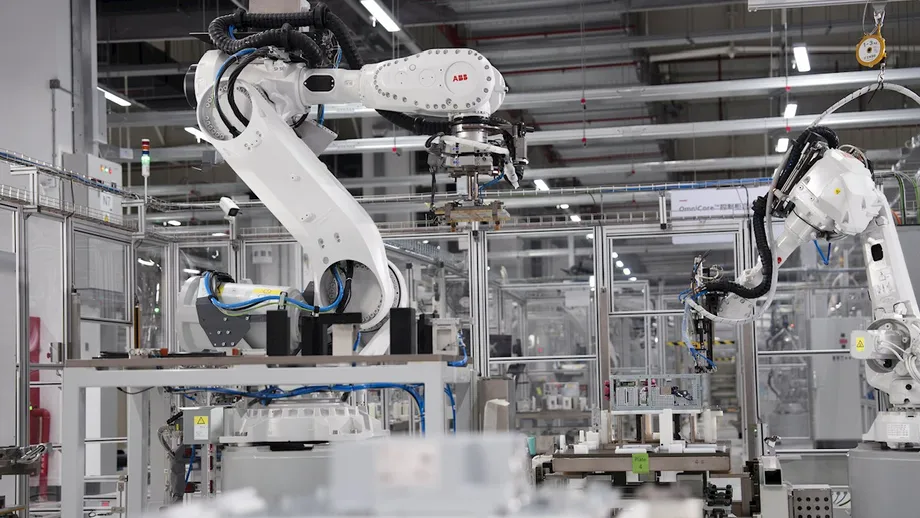
China blocked SoftBank's proposed $5.4 billion acquisition of ABB's robotics unit earlier in November. The decision interrupted one part of Son's expansion while the group was already managing higher financing costs and changes to its infrastructure plans.
Why the 14% share rise came before the loss
SoftBank shares closed at ¥3,872 on November 10, up about 14%. The results were released after the Tokyo market closed, putting the first trading opportunity following the announcement on Wednesday, November 11.
The increase came during a broader recovery in Asian technology shares following a Wall Street rebound and a sharp decline in crude oil prices. Even after that session's gain, SoftBank remained more than 50% below its record high reached in June.
Investors were also assessing political risks following Democratic gains in the US midterm elections, including the prospect of closer scrutiny of AI projects. SoftBank's infrastructure commitments expose it to decisions about construction, electricity and regulation as well as demand for AI services.
Management pointed to ¥5 trillion in cash and a loan to value ratio of 15.9% at September 30, below its internal threshold of 25%. That ratio compares borrowing with the value of the assets supporting it. Falling asset values can push the ratio higher even without an increase in debt.
SoftBank reported net asset value of ¥59.8 trillion at September's end, while management's more recent estimate was ¥44.7 trillion. Net asset value measures the estimated value of holdings after relevant liabilities. The decline illustrates how quickly market movements can change the financial room available for further investments.
The dates behind the financial reversal
SoftBank's announcements span the six months covered by the results, an additional investment in October and the market developments surrounding its November release. Keeping those dates separate explains both the investment totals and the sequence of the share movement.
- April through September 2026: SoftBank invested $20 billion in OpenAI and recorded a net loss of ¥768 billion for the first half of its fiscal year.
- July through September 2026: The group recorded a quarterly loss of about ¥1.12 trillion, including the ¥597.2 billion Ohio project charge.
- September 30, 2026: Cumulative OpenAI investment stood at $54.6 billion, and the company reported ¥5 trillion in cash.
- October 2026: Another $10 billion investment brought SoftBank's cumulative OpenAI commitment to $64.6 billion.
- November 10, 2026: Shares closed about 14% higher before SoftBank released its results after the market closed.
- November 11, 2026: Tokyo trading offered investors their first opportunity to respond to the earnings announcement.
Goto said the investment environment required more restraint alongside continued expansion. His comments pointed to a need to balance new commitments with control over borrowing:
This is not the environment that we can be all offense in terms of investment,
SoftBank's immediate financial task is concrete: fund projects already planned, manage a higher interest bill and preserve enough flexibility while the value of its holdings moves. The Ohio charge has made changes to construction plans costly; the financing figures show why the pace of spending matters across the rest of the portfolio.
Key Points
- SoftBank lost about ¥1.12 trillion ($7.1 billion) in July through September 2026, reversing a large profit a year earlier.
- A revised power supply plan for Ohio's PORTS-Pike campus produced a ¥597.2 billion charge.
- Possible rebates of up to $2.1 billion depend on future equipment purchases over 10 years.
- Quarterly financial costs more than doubled to ¥462 billion as SoftBank raised record financing.
- Cumulative investment in OpenAI reached $64.6 billion following an additional payment in October.
- The 14% share price rise on November 10 occurred before the earnings announcement.