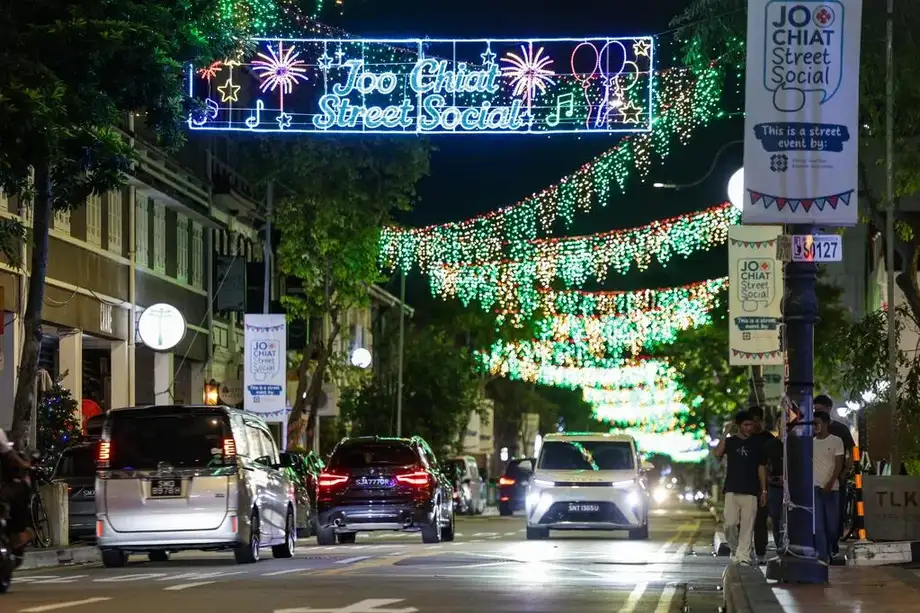
A new way across a busy Katong junction
Five days after Singapore began testing an all direction pedestrian crossing at Joo Chiat Road and East Coast Road, nearby businesses said more people were visiting, with some estimating that foot traffic and sales had risen by 10% to 30%. The three month trial, outside i12 Katong, began on Nov 16. It lets people cross straight or diagonally while traffic in every direction is stopped.
Contents
- A new way across a busy Katong junction
- How the crossing works, and how long people wait
- Shops see a burst of visitors, but will they stay?
- Drivers face detours and a different traffic rhythm
- Safety concerns include older pedestrians and cyclists
- What will determine whether the trial succeeds?
- Shibuya is a model, not a measuring stick
- Singapore has tested similar designs before
- Key dates in the Joo Chiat trial
- What to Know
The design is often called a scramble crossing, after the famous intersection in Tokyo's Shibuya district. At Joo Chiat, it also means drivers can no longer turn right from East Coast Road into Joo Chiat Road. That change is intended to separate people on foot from turning vehicles, but it has brought new routes and waiting times for some motorists.
The Land Transport Authority is monitoring how people use the junction and says it can adjust the arrangement during the trial. Senior Minister of State for Home Affairs and Social and Family Development Goh Pei Ming has urged the authority not to wait until the three months are over if early feedback points to a problem.
How the crossing works, and how long people wait
When the pedestrian signal turns green, people can walk across the junction in any direction, including diagonally. Vehicles in all directions must stop during that crossing phase. The diagonal route can save a person from crossing one road, waiting at another light, then walking around the corner to reach the destination.
On the first day, one on site observation recorded a maximum wait of 2 minutes 5 seconds, while another described a wait of about 2 minutes 15 seconds. The pedestrian phase lasts about 35 seconds. That time has raised concerns among some residents, especially older people who may need longer to cross diagonally.
Preschool teacher Cai Shuxian said the arrangement saves her time on her way to work. Other pedestrians welcomed being able to cross directly rather than wait through two signal cycles. Some people also said they felt more comfortable because vehicles were not moving across their path while they crossed.
Residents have also asked how cyclists and users of personal mobility devices should move through the crossing. Cyclists may cross diagonally at the same time as pedestrians, and people at the junction have already had to avoid one another. No detailed rules for riders at the crossing have been given in the information available so far.
Shops see a burst of visitors, but will they stay?
Joo Chiat businesses described an early increase in visitors, though they cautioned that the crossing's novelty may be drawing people who have come just to see it. Kim Choo owner Edmond Wong estimated that foot traffic and business were up by 25% to 30%, helped by the new crossing and an earlier car free day in the area.
Restaurant operator Tan Kay Chuan estimated that the number of people passing by had grown by at least 10% to 20%. He said the ban on the right turn made the area feel safer for customers and pedestrians, while warning that business could return to its previous level once the new crossing feels less novel.
Little Farms chief executive Julian Stevens said the store was seeing new customers, including visitors from Japan and South Korea, and more people at weekday dinner time. Katong Shopping Centre landlord Boushahri Group chief executive Boushahri said people were coming to take photographs, but it was too early to tell whether that would translate into more sales. Some business owners said weekend visits would give them a better sense of the effect.
The change follows a community event that had already drawn attention to the neighbourhood. On Oct 3, part of Joo Chiat Road between East Coast Road and Dunman Road was closed for a car free day expected to attract about 5,000 people. More than 20 partners and about 90 local businesses took part, with more than 50 activities. It was the first large car free street event in Singapore to move from the city centre into a neighbourhood.
Drivers face detours and a different traffic rhythm
Drivers have given mixed responses. Some said traffic seemed to move more smoothly because pedestrians and turning vehicles no longer compete for space. Katong Joo Chiat Business Association president Wong Ding Xiang said the roads felt less congested after the trial began and that driving through the junction felt safer.
Others find the right turn restriction inconvenient. A driver who regularly travels from East Coast Road to Joo Chiat Road for meals said she would have to turn earlier at Tembeling Road or use the junction near Katong Shopping Centre, which she described as already congested. A long time resident, Jeremy Koh, said he planned to avoid the junction and use Still Road or Marine Parade Road instead.
Some businesses and drivers say their own journeys take longer. Tan said his drive to work had gained about five minutes. Associate Professor Xie Chengxian of the Singapore University of Social Sciences estimated that vehicles could wait an average of five to 10 seconds longer under the new arrangement, while a driver arriving at an unlucky point in the signal cycle might wait 90 to 120 seconds. These are different measures: Tan described his own trip, while Xie gave an estimate of signal delay.
Google Maps has begun suggesting detours that avoid the restricted turn. The Land Transport Authority had told residents and businesses in an October letter that people living nearby could use alternative routes. The diversion is understood not to affect bus routes.
Safety concerns include older pedestrians and cyclists
Goh said the busy junction had seen situations where turning vehicles came close to pedestrians. He explained why the trial was proposed:
Because this area is popular, this intersection is often busy. I have also observed instances where turning vehicles almost hit pedestrians.
The dedicated pedestrian phase removes the need for walkers to judge whether a turning driver has seen them. Samuel Chng, a research assistant professor at the Singapore University of Technology and Design, said a crossing phase of their own takes away one decision people must make in the middle of the road.
Yet a 35 second signal may be difficult for older people or anyone walking slowly, particularly on the longer diagonal route. Some residents have questioned whether that is enough time. The Land Transport Authority says its assessment found the crossing time sufficient, and that it will review the signal during the trial. Whether older people can use a senior concession card to extend crossing time has also been raised as a point to consider, not a confirmed arrangement.
Cyclists create another practical challenge. A student, Fu Wantong, worried that riders crossing diagonally could collide with pedestrians. The issue has also prompted calls for clear guidance and enforcement for cyclists and personal mobility device users. People using the junction have been advised to slow down and watch for others.
What will determine whether the trial succeeds?
Safety is one measure, but convenience for the whole trip matters too. Chng has said that assessments should include how long pedestrians wait across their entire journey, not just the time they spend crossing. A person crossing diagonally may save walking distance, while someone who only needs to cross one arm of the junction could face a longer wait than before.
Associate Professor Ong Ghim Ping Raymond of the National University of Singapore said Joo Chiat was a useful place to test the design because shops, eateries and homes create reasons to cross in several directions. He said success depends on improving safety and convenience for pedestrians while keeping delays and traffic diversions manageable.
A compact junction with many pedestrians may suit the arrangement, but the design will not help every intersection. Where most people cross in one direction, adding a separate all direction phase could make their wait longer without giving them much benefit. The authority's observations over the coming months will show how the balance works at this particular junction.
Shibuya is a model, not a measuring stick
Japan's first multi direction crossing opened in Kumamoto around 1968, before Tokyo's Shibuya crossing followed in 1973. The National Police Agency counts about 1,000 scramble crossings across Japan. Shibuya's junction can be used by as many as 500,000 people on weekends, with pedestrians given roughly 50 seconds to cross on each green signal.
That scale is a world away from Joo Chiat's smaller junction. Shibuya's fame grew alongside a dense transport hub and a district that attracts visitors from around the world. A 2026 Tokyo Metropolitan Government survey found that 60.3% of foreign tourists to Tokyo visited Shibuya. The crossing also serves as a public gathering place, as well as a way to get across the road.
Joo Chiat's trial has already prompted people to stop for photographs, and some visitors have travelled from other parts of Singapore to see it. Still, local businesses and residents have described the early attention as a novelty. The immediate purpose is to make crossing safer and more direct, rather than reproduce Shibuya's tourism role.
Singapore has tested similar designs before
Singapore has tried all direction crossings at other junctions, without making those trials permanent. A six month trial at Orchard Road and Bideford Road in 2006 was discontinued. A separate trial at Cairnhill Road and Orchard Road in 2017 ran on weekends and public holidays; it was not continued after concerns that few people used the diagonal route and road congestion increased.
Those earlier trials show why a three month test needs to consider more than the visual appeal of people crossing from every side. The key questions are whether the design reduces conflicts, whether people can cross within the signal time, and whether nearby roads can handle changed routes.
Key dates in the Joo Chiat trial
Oct 3: A car free day closed part of Joo Chiat Road between East Coast Road and Dunman Road, with about 90 local businesses taking part.
Nov 16: The three month crossing trial began. The new pedestrian arrangement became usable at about 2pm on its first day.
During the trial: The Land Transport Authority will monitor pedestrian and vehicle movements and can make changes before the trial ends.
What to Know
The Joo Chiat Road and East Coast Road crossing lets pedestrians cross diagonally while traffic in every direction stops.
The pedestrian signal lasts about 35 seconds, and recorded waits on the first day were about two minutes.
Some nearby businesses estimated early foot traffic or sales gains of 10% to 30%, while others said it was too soon to judge.
The arrangement bans a right turn from East Coast Road into Joo Chiat Road, leading some drivers to take alternative routes.
The Land Transport Authority is monitoring the three month trial and may adjust it before it ends.