One police number, followed by a government text
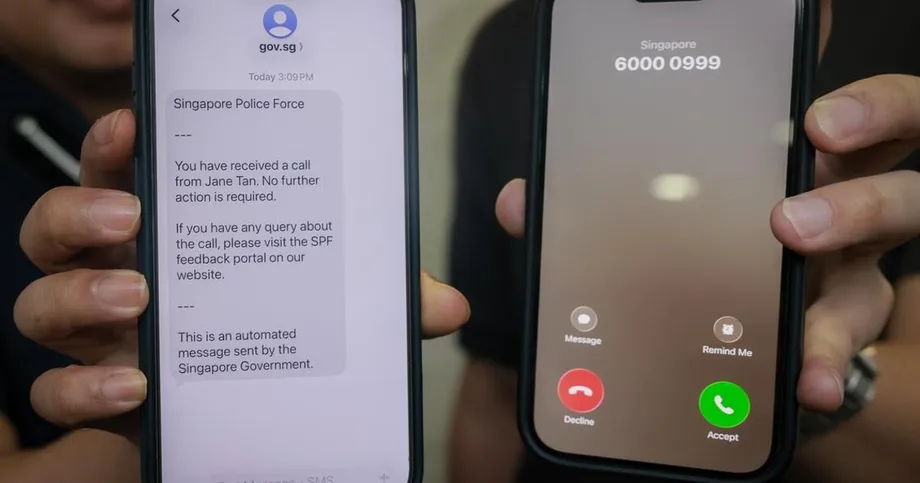
Singapore Police Force (SPF) calls to the public have used a single outgoing number, 6000 0999, since November 2, 2026. Every call, including one that goes unanswered, is followed by a text message from the gov.sg sender ID explaining how to contact the police.
Contents
- One police number, followed by a government text
- How the call and SMS work together
- More police impersonation cases, lower total losses
- What protects the number from imitation?
- How scammers turn a routine call into a threat
- The requests government officials will never make
- A suspected call that left lingering fear
- From government texts to wider caller identification
- Where residents can turn for help
- Key Points
The change follows at least 1,310 reported cases of police impersonation and losses of at least S$53.3 million between January and September 2026. Across scams involving impersonation of Singapore government officials, police recorded at least 3,230 cases and S$142.5 million in losses during those nine months.
SPF is the first government agency to introduce a single dedicated caller ID. Its Single Caller ID announcement, dated November 1, says the system replaces the assortment of office landlines and official mobile numbers previously used to reach the public.
For residents, the practical change is straightforward: a police call should now display one familiar number rather than an unfamiliar officer's number. The accompanying SMS provides a route for further contact. The number is reserved for ordinary telephone calls, not WhatsApp, Telegram or other messaging and conferencing services.
How the call and SMS work together
The text following a police call begins with the Singapore Police Force's full name and ends with a note identifying it as an automated message from the Singapore Government. It usually includes the officer's name and a contact number if a callback is needed.
Calling 6000 0999 does not connect a resident to an officer. It triggers an automated message directing the caller to the SPF Feedback Portal. People with questions can also contact the SPF Feedback Hotline at 1800-358-0000.
Police and Open Government Products (OGP) say an SMS can occasionally arrive late, or fail to arrive because the recipient's number cannot receive text messages. A person may also receive the SMS without seeing a preceding call if the attempted call did not connect, for example because the phone was switched off or outside network coverage.
Residents who are uncertain can end the conversation and verify it independently through official channels. The ScamShield helpline, 1799, operates around the clock and can help people check suspicious communications.
More police impersonation cases, lower total losses
Police impersonation reports rose from at least 1,010 in the first nine months of 2025 to at least 1,310 in the same period of 2026. That is an increase of 300 cases, or about 30%, using the published figures.
Losses moved in the opposite direction, declining from S$61.4 million to S$53.3 million, a reduction of S$8.1 million, or about 13%. Police therefore faced more reported impersonation cases even as the combined amount lost fell.
Within the broader category of government official impersonation, police impersonation accounted for roughly 41% of cases and 37% of losses in January to September 2026, based on the reported totals. SPF remained the government agency most frequently impersonated.
The financial damage helps explain why the new system combines a recognisable telephone number with an accompanying government text. Previously, residents had to assess calls arriving from many different official numbers while scammers tried to make their own calls sound equally convincing.
What protects the number from imitation?
Caller ID spoofing means disguising the number shown on a recipient's phone so that a call appears to come from someone else. Singapore has reserved 6000 0999 for police use and worked with telecommunications providers to block overseas calls that imitate it, including calls displaying +65 6000 0999.
Safeguards also extend to online messaging and conferencing services. A messaging code of practice introduced in August requires major services to prevent unauthorised use of the police number and the gov.sg identity. Lookalike spellings, such as g0v.5g, are also covered.
Failure to comply with the requirements can be a criminal offence under the Online Criminal Harms Act, carrying fines of up to S$1 million. Continued noncompliance after conviction can attract additional fines of up to S$100,000 for each day.
A call displaying 6000 0999 through WhatsApp or another online messaging service is not an SPF call. Police use the number only through the traditional telephone network. Recipients of suspicious calls on those platforms are advised to use the platform's reporting function and contact 1799 for help.
How scammers turn a routine call into a threat
Superintendent Tay Yuanqi, assistant director of SPF's Scam Public Education Office, Cyber Command, has described how impersonators build credibility before demanding money or information. Some begin by pretending to work for a familiar company or financial institution.
The first caller may claim that an unauthorised transaction has occurred or that the recipient's personal data has been misused. The victim is then transferred to someone posing as a government official. The handover makes the exchange feel like a formal process involving several organisations.
Scammers may use genuine officials' names and titles, fake arrest warrants or uniforms. They may accuse a person of money laundering, threaten arrest and present payment as a way to avoid legal consequences. A demand to keep the investigation secret cuts the victim off from relatives, banks or officials who could challenge the story.
Tay urges people who are unsure to end the call and check independently. The safeguards around the new number reduce opportunities for imitation, while scammers can still approach victims through messaging apps and other channels.
The requests government officials will never make
ScamShield's government impersonation advisory, updated on November 2, sets out the warning signs in concrete terms. Government officials will never ask someone over a phone call to transfer money, disclose banking login details, install an app from an unofficial app store or have their call transferred to police.
The advisory also says SPF officers will never ask by phone or text for banking, SingPass or Central Provident Fund information, or direct people to click links leading to bank websites. These are useful checks when a caller claims that urgent action is needed to protect an account or assist an investigation.
Scammers may demand more than a bank transfer. Victims can be told to buy cryptocurrency or hand over cash, gold, luxury watches and other valuables at a meeting. ScamShield describes cases in which people are asked to show identity documents, work permits or bank cards during an app video call, then later discover unauthorised bank transactions.
A caller who knows a person's name or NRIC number should still be checked directly with the agency concerned. NRIC is Singapore's national identity registration system. ScamShield also states that overseas law enforcement agencies cannot require people in Singapore to assist in investigations without Singapore government approval.
A suspected call that left lingering fear
Johnson, a 67-year-old senior operations supervisor who withheld his surname for privacy, received a suspected impersonation call on his landline in April 2026. A man claiming to be a police officer said Johnson's bank account details had surfaced in an overseas money laundering investigation.
Johnson initially thought about trips he had made to India and Malaysia in the second half of 2025 and wondered whether his information had been compromised. He then recalled friends' warnings about similar scams and hung up. The decision ended the conversation, but the accusation stayed with him.
Johnson described the doubt that remained after the call:
I kept thinking about whether I was really in trouble.
For Johnson, the single number provides a clearer basis for responding to a future caller claiming to be police. His experience also shows the role of conversations outside the call: friends had already warned him about this kind of approach, giving him a reason to pause when the accusation arrived.
From government texts to wider caller identification
The police system was developed jointly by SPF, OGP, the Ministry of Digital Development and Information (MDDI), and the Infocomm Media Development Authority. OGP built the calling system; MDDI leads the broader government effort and worked with the telecommunications regulator on number allocation and safeguards.
The rollout follows earlier steps to make government communications easier to recognise:
- July 1, 2024: Government agencies began using the common gov.sg SMS sender ID, with exceptions for National Service call-ups and emergency services.
- 2024: The 24-hour ScamShield helpline, 1799, was introduced.
- November 1, 2026: SPF published its announcement of the single outgoing caller ID.
- November 2, 2026: Police began using 6000 0999, and ScamShield updated its government impersonation guidance.
Other agencies are expected to adopt more recognisable calling arrangements progressively. The intended approach includes numbers sharing a common prefix and a recognisable caller name identifying the agency. No timetable for those wider changes has been announced; authorities are studying operational needs and lessons from the police rollout.
Tay Paul Hong, OGP's lead product manager, explained the purpose of starting with SPF:
This launch with the SPF will help us test the solution in practice and inform how similar approaches could be applied more broadly in future.
Where residents can turn for help
Residents receiving an unexpected police call can pause the conversation, contact SPF through its Feedback Portal or hotline, or call ScamShield at 1799. A request for secrecy should not prevent someone from checking with a trusted person, their bank or the authorities.
Anyone who thinks they have already lost money should contact their bank immediately and make a police report, according to ScamShield. Suspected scam accounts and chat groups can also be reported and blocked.
Deputy Assistant Commissioner Rudy Dzulkarnaen, deputy director of SPF's Service Delivery Department, urged residents to keep checking unexpected approaches:
Despite all these initiatives, we encourage members of the public to remain vigilant when receiving unexpected calls claiming to be from the government, such as Police.
Key Points
- SPF outgoing calls have used 6000 0999 since November 2, 2026, followed by a gov.sg SMS even when unanswered.
- The number is for outgoing telephone calls only, not WhatsApp, Telegram or other messaging services.
- Police impersonation caused at least S$53.3 million in losses across 1,310 reported cases from January to September 2026.
- Government officials will never ask over the phone for money transfers, banking login details or installation of apps from unofficial stores.
- Verify suspicious contact through official channels. Call ScamShield at 1799 or the SPF Feedback Hotline at 1800-358-0000.
- Wider government caller identification measures are planned, with no rollout timetable announced.