One police number as impersonation losses reach S$142.5 million
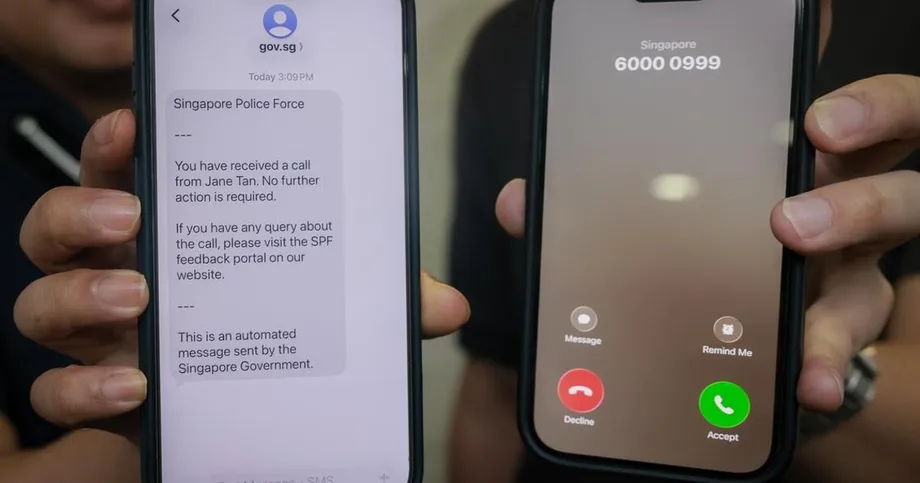
Singapore police will use 6000 0999 for all outgoing calls from Monday, November 2, 2026, giving the public a single number to recognise as authorities tackle scams involving people pretending to be government officials. Every call will be followed by an SMS from the gov.sg sender ID, including when the recipient does not answer.
Contents
- One police number as impersonation losses reach S$142.5 million
- What happens when the police call?
- Why replace individual office and mobile numbers?
- Fewer government impersonation cases, more involving police
- How the number and SMS identity are protected
- WhatsApp and Telegram calls are outside the system
- Requests that government officials will never make
- How the initiative reached its November launch
- Other agencies may share recognisable starting digits
- Key Points
The change follows at least 3,230 reported cases of government official impersonation scams between January and September 2026, with losses of at least S$142.5 million. Police were the most frequently impersonated agency, accounting for at least 1,310 cases and S$53.3 million in losses.
The Singapore Police Force (SPF), Ministry of Digital Development and Information (MDDI), Open Government Products (OGP) and Infocomm Media Development Authority (IMDA) announced the initiative on November 1. SPF will be the first government agency to introduce the dedicated caller ID, with wider changes planned for calls from other agencies.
The number is reserved for police use and will appear on ordinary telephone calls. Police will not use it to contact people through WhatsApp, Telegram or other messaging applications. Recipients seeking further assistance can use the police feedback hotline, 1800-358-0000, or the police feedback portal.
Deputy Assistant Commissioner Rudy Dzulkarnaen, deputy director of the police Service Delivery Department, explained the purpose of the change:
We want members of the public to be able to recognise calls from the police more easily,
Police also urged people to keep checking suspicious requests through official channels. A caller knowing a person's name or NRIC number, the identity card number used in Singapore, is insufficient reason to trust them.
What happens when the police call?
From November 2, people receiving a police call should see 6000 0999 rather than an officer's individual office or official mobile number. The accompanying SMS will explain how to contact the police if further assistance is needed.
The message will usually name the officer who made the call. If that officer needs the recipient to call back, the SMS may also include a contact number. People who miss a call will still receive the message, giving them information about the attempted contact.
6000 0999 is an outgoing caller ID rather than a public enquiry line. Anyone dialling it will hear an automated message directing them to the police feedback portal, rather than being connected to the officer who called.
For residents, the practical change is a more consistent pattern: a call displaying the police number, followed by a message from gov.sg explaining the next contact steps. The feedback hotline and portal remain the channels for questions about a call.
Why replace individual office and mobile numbers?
Government agencies currently make outgoing calls using many numbers, including office landlines and official mobile phones. A resident receiving an unfamiliar number may have difficulty deciding whether it belongs to a genuine officer or someone pretending to be one.
The joint announcement identified that variety of numbers as a weakness scammers exploit. By concentrating police calls under one reserved number, authorities aim to make legitimate contact easier to recognise and check.
The initiative also connects two parts of government communication. Government SMS messages have already been consolidated under the gov.sg sender ID. Police calls will now have a consistent caller ID of their own, with the follow-up SMS providing contact information.
Scammers exploit public trust in government by presenting themselves as officials before asking for money or sensitive information. The new system changes how genuine calls appear, while police guidance gives recipients concrete warning signs to watch for during the conversation.
Fewer government impersonation cases, more involving police
Police figures for January to September 2026 show at least 3,230 government official impersonation cases, compared with 3,380 during the same period in 2025. Reported losses fell from S$182.6 million to S$142.5 million. Using those figures, cases declined by about 4.4 per cent and losses by about 22 per cent.
Police impersonation moved in a different direction. Cases rose from at least 1,010 in the first nine months of 2025 to at least 1,310 in the corresponding period of 2026, an increase of about 30 per cent. Losses nevertheless fell from S$61.4 million to S$53.3 million, a decrease of about 13 per cent.
Police impersonation therefore accounted for roughly 41 per cent of all government official impersonation cases in January to September 2026, calculated from 1,310 out of 3,230 cases. It also accounted for about 37 per cent of losses in that category, using S$53.3 million out of S$142.5 million.
The police annual scam and cybercrime brief published in February recorded a broader decline in scam and cybercrime cases, from 55,810 in 2024 to 41,974 in 2025. Government official impersonation cases, however, rose from 1,504 to 3,363, while losses increased from S$151.3 million to S$242.9 million.
The historical case totals contain an inconsistency: the 3,380 government official impersonation cases cited for January to September 2025 exceed the 3,363 cases recorded for the whole of 2025 in the annual brief. No explanation was given for that difference.
The annual brief put average losses per government official impersonation case in 2025 at more than S$72,000 and said most victims were aged 65 and above. Those figures show why making official contact easier to identify matters even as total scam and cybercrime cases fall.
How the number and SMS identity are protected
Authorities have introduced safeguards to reduce the risk of scammers copying or misusing 6000 0999. The number is reserved for police use, so other individuals and organisations in Singapore cannot use it to make telephone calls.
Telecommunications protections also block overseas calls that disguise themselves as Singapore numbers. This deception is called spoofing: a caller makes the number shown on a recipient's screen look like a different number.
Under those safeguards, an international call attempting to display +65 6000 0999 would be blocked from reaching the public in Singapore. The protection addresses attempts to imitate the police number from overseas.
The gov.sg SMS identity has separate protections. A system with several layers of checks detects attempts to copy the sender name, including lookalike spellings such as g0v.5g, and prevents those messages from reaching recipients.
Telephone networks, SMS systems and messaging applications each have a role in protecting the new arrangement. The telephone safeguards target copied caller IDs, while SMS protections target fake sender names. Messaging services face requirements covering misuse of both identities.
WhatsApp and Telegram calls are outside the system
Police will not use 6000 0999 on WhatsApp, Telegram or other online messaging and conferencing services. A call displaying that number through one of those services is not a police call, authorities said.
A messaging Code of Practice issued by police in August requires major services covered by the rules, including WhatsApp and Telegram, to take measures against scams. These include making it harder for unknown contacts to engage users.
The services must also prevent the use and spoofing of the police number and gov.sg identity on their platforms for calls or messages. Authorities advised anyone encountering such misuse to report it through the platform's reporting function and to the ScamShield helpline at 1799.
Failure by a covered service to comply can be a criminal offence under the Online Criminal Harms Act, carrying fines of up to S$1 million. Continued noncompliance after conviction can attract a further fine of up to S$100,000 a day.
Requests that government officials will never make
Police have set out specific requests that should alert recipients to a scam. Government officials will never ask people over the telephone to transfer money or hand over valuables, including luxury watches, gold or cryptocurrency.
Officials will also never ask for banking login credentials or tell people to install mobile applications from unofficial app stores. Those requests can put a person's money, accounts or device at risk.
A caller offering to transfer the conversation to the police is another warning sign identified by authorities. Government officials will not ask to transfer a person's call to the police.
Someone who knows a recipient's personal details may sound convincing. Police nevertheless advise people to verify the caller directly with the agency or organisation concerned through its official channels, rather than relying on the caller's knowledge of their identity.
The ScamShield helpline, 1799, operates 24 hours a day and can help people check whether a phone number is legitimate. Questions about police calls can also go to the police feedback hotline at 1800-358-0000 or the feedback portal.
How the initiative reached its November launch
The dedicated number follows several months of work involving policing, government technology and telecommunications agencies. Ministers had described plans for more recognisable government calls before the November announcement.
- February 2026: Minister of State for Home Affairs Goh Pei Ming announced that police were working with OGP and IMDA on a single, easily recognisable number for police calls.
- July 7, 2026: In a reply to a parliamentary question filed by Jalan Besar GRC MP Shawn Loh, Minister for Digital Development and Information Josephine Teo said agencies were developing numbers with a common prefix, with police piloting the initiative that year.
- August 2026: Police issued the messaging Code of Practice addressing scam risks on major messaging and conferencing services.
- November 1, 2026: SPF, MDDI, OGP and IMDA announced the dedicated police caller ID and accompanying SMS arrangement.
- November 2, 2026: Police outgoing calls switch to 6000 0999.
The launch brings the police pilot into public use while work continues on arrangements for other government agencies.
Other agencies may share recognisable starting digits
MDDI said the government's intention is to make legitimate calls easier to recognise without requiring people to memorise a separate number for every agency. Numbers used by different agencies are expected to begin with a common set of digits.
A shared prefix would give recipients a familiar starting pattern when a government agency calls. Future plans also include displaying a recognisable caller name identifying the agency alongside its number.
The agencies are studying implementation arrangements that account for different operational and service needs, as well as lessons from the police launch. No rollout dates were given for other agencies or for the planned caller names.
For now, the immediate change concerns police calls: 6000 0999 for outgoing telephone contact, a follow-up SMS from gov.sg, and existing official channels for verification and further assistance.
Key Points
- Singapore police will use 6000 0999 for all outgoing calls from November 2, 2026.
- Each call will be followed by a gov.sg SMS, including when the call goes unanswered.
- The number does not connect incoming callers to an officer and will not be used on WhatsApp or Telegram.
- Government official impersonation scams caused at least S$142.5 million in losses from January to September 2026.
- Police impersonation accounted for at least 1,310 cases and S$53.3 million in losses during that period.
- Government officials will never ask by phone for money, valuables, banking login details or installation of apps from unofficial stores.
- For checks, call ScamShield on 1799 or contact the police feedback hotline on 1800-358-0000.