A new port finger, and a wider economic plan
Singapore began building the third and largest extension of Tuas Port on Nov 20, adding nearly 400 hectares of reclaimed land, 21 deepwater berths and an 8.6 kilometre wharf to the country's main container port. The new section, known as Finger Three, is designed for the world's largest container ships. Its first operations are scheduled to begin in 2028, with all 21 berths expected to be ready by the mid-2030s.
Contents
The expansion is one part of a much larger plan. When Tuas Port is complete in the 2040s, Singapore intends to move all its container operations to one site. The finished port is planned to have 66 berths and handle up to 65 million twenty-foot equivalent units, or TEUs, of container traffic each year.
A TEU is a standard way to describe container capacity. One TEU represents the space occupied by a standard 20-foot shipping container, so the measure lets ports compare the amount of cargo they handle even when containers come in different sizes.
Transport Minister Jeffrey Siow said at the ceremony that the new berths would help Singapore handle the largest ships for at least the next decade. He also said the goal was to improve the service and value offered to shipping lines and cargo owners, not simply to build more space for containers.
That distinction matters to Singapore, an island nation that imports almost all its food, energy and supplies. Sea links connect it to more than 600 ports worldwide and support more than 140,000 jobs, according to Siow. The port is therefore both a transport facility and part of the infrastructure that keeps goods moving into the country and Singapore's wider economy working.
What will Finger Three add?
The new port section covers nearly 400 hectares, roughly the area of 560 football fields. Its planned 8.6 kilometres of wharf will have water deep enough for very large container ships, with a depth of 23 metres. A wharf is the edge of a port where vessels berth so cargo can be loaded or unloaded.
Finger Three is the largest of Tuas Port's four development stages by wharf length. Reclamation work for it began in March 2018 and was completed on Nov 10. The construction launch on Nov 20 marks the start of the next stage of development on the reclaimed land.
When complete, the full port will cover 1,337 hectares. The name "finger" describes the port's layout, with long sections extending into the sea and berths arranged along their edges. That design gives ships access to multiple loading points while allowing the port to be developed in stages.
Tuas Port currently has 15 operating berths and is expected to reach 18 by 2027. It has handled 25 million TEUs since opening in 2022. PSA Singapore, the terminal operator, handled 44.5 million TEUs across its Singapore operations in 2025. The first figure is Tuas Port's cumulative traffic since it opened; the second is one year of activity across the company's Singapore operations.
How Singapore's container terminals will move
The expansion is tied to a major reshaping of Singapore's port system. PSA expects to move operations at Tanjong Pagar, Keppel and Brani terminals to Tuas by 2027. Pasir Panjang Terminal is due to remain open longer, with its operations planned to transfer to Tuas by the 2040s.
Concentrating container activity at one port is intended to bring ships, cargo handling and related services together at a single location. The change will take place over many years, as new sections of Tuas become ready and existing terminals continue working until their operations can move.
The timeline stretches back more than a decade. The plan to consolidate Singapore's container operations at Tuas was first proposed in 2012. Reclamation for the port's first phase began in February 2015 and ended in November 2021. Tuas Port opened in 2022, and the work on Finger Three is the latest stage in the four phase development.
- 2012: The plan to bring container operations together at Tuas was first proposed.
- February 2015 to November 2021: Reclamation for the first phase took place.
- 2022: Tuas Port opened and began handling container traffic.
- Nov 10: Reclamation for Finger Three was completed.
- Nov 20: Construction on the expansion began.
- 2027: Operations at Tanjong Pagar, Keppel and Brani are expected to move to Tuas, while the port is due to reach 18 operating berths.
- 2028: Finger Three is scheduled to begin operations.
- Mid-2030s: All 21 berths in Finger Three are expected to be operating.
- 2040s: Tuas Port is scheduled to be completed, with container operations transferred from Pasir Panjang.
From port operator to supply chain hub
Singapore's plan goes beyond transferring cargo between ships and land. PSA's Supply Chain Hub @ Tuas is intended to place logistics and warehousing beside the port, giving businesses a nearby place to store, process, combine and distribute goods to regional markets.
For a cargo owner, such as a company moving products for sale, a port with these services can do more than receive a container and put it onto another ship. Goods can be stored or prepared close to the dock, then sent onward as needed. Siow said the aim was to help customers manage cargo quickly and to give shipping lines a reliable place to make up for delays elsewhere on their routes.
PSA International Group Chairman Peter Voser said the expansion would help connect ships, terminals, warehouses, manufacturers and markets. He described the work as laying the foundations for a more integrated port ecosystem.
We are not simply adding capacity, we are laying the foundations for a more integrated port ecosystem that delivers greater value for our customers, partners and the wider supply chain.
PSA International Group Chief Executive Ong Kim Pong described the company's approach as a "node to network" strategy. In plain terms, that means linking individual ports and logistics sites with business partners so cargo and information can move across a connected system, rather than treating each facility as a separate stop.
The government also wants more maritime companies to base regional or global headquarters in Singapore. Siow said the target includes businesses in ship financing, insurance and data. Having more of those companies in the city could bring commercial decisions and transactions related to shipping closer to the port and its customers.
What will automation change?
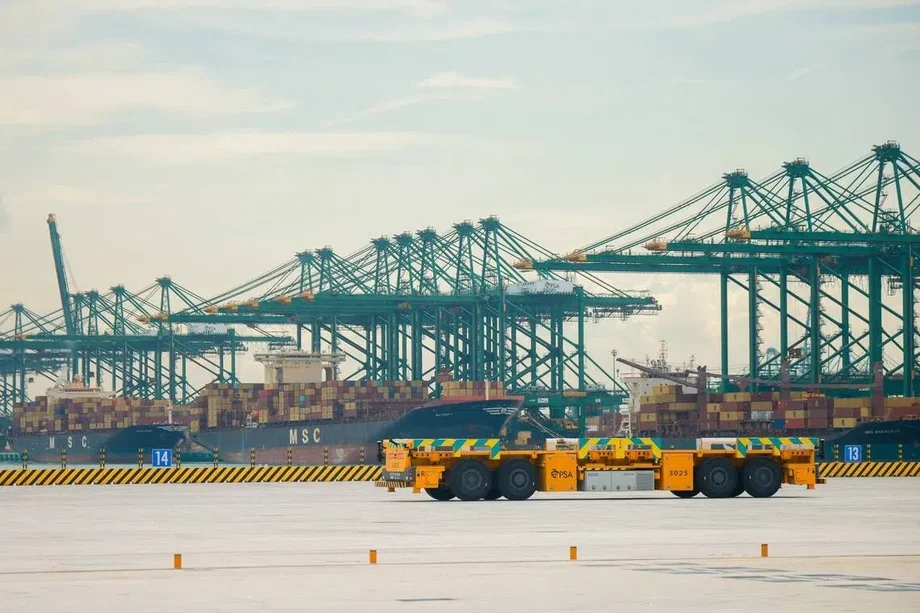
PSA plans to expand its fleet to close to 1,000 autonomous Intelligent Guided Vehicles, or IGVs, as the new phase is completed. These vehicles carry containers around the terminal. About 30 are undergoing trials.
Earlier automated vehicles followed set routes. The new IGVs are designed to calculate their routes as they move and adjust to traffic in real time. They will share the terminal with vehicles driven by people, so the system must coordinate automated and human operated traffic safely.
Siow said Singapore also wants to use artificial intelligence, digital twins, autonomous systems and live data to make the port operate as one connected system. A digital twin is a computer model of a real place or process. It can help operators see how activity is unfolding and assess changes to operations using current data.
PSA is also testing drones that carry urgent spare parts, fuel samples, fresh food and other supplies from shore to ships at anchorages. These are places where vessels wait outside the port. The trials could provide another way to deliver small, time sensitive items to ships without sending a supply boat for every trip.
Automation is being presented as a way to improve how quickly and reliably cargo moves. It will also change the tasks carried out by port workers, making training a central part of the government's next maritime plan.
Workers, clean fuels and the 2027 plan
Singapore's next Maritime Singapore Master Plan is due to be launched in April 2027. Siow said the government has been consulting businesses, industry groups, unions, workers and young people. The plan will focus on expanding capacity, using technology and innovation, and investing in workers.
Siow said workers would need training to keep pace as port systems change. He said the government and unions would work with employees so they could adapt, with the stated aims of better pay and safer workplaces. The plan's success, he said, should also be measured by the jobs and opportunities created for Singaporeans.
The government is also working on cleaner fuels for ships. Its measures include expanding the supply of liquefied natural gas, licensing new suppliers of liquefied natural gas and methanol, conducting live trials, and developing safety standards for fuels such as ammonia. These steps matter because ships need fuel, and changing to alternatives requires safe ways to supply and use them at ports.
The master plan is being prepared as other maritime centres invest in their ports, technology and services. Siow said Singapore must plan ahead as competition grows. The government's economic strategy also calls for attracting more maritime company headquarters, with the goal of making Singapore a place where decisions about global trade are managed as well as a place where containers are transferred.
How big is the ambition?
When the four phases are complete in the 2040s, Tuas is planned to have 66 mega berths and capacity for 65 million TEUs a year. That capacity will put all of Singapore's container operations at one port, supported by automated equipment and nearby logistics services.
The numbers describe a physical expansion, but the government and PSA are also aiming to connect the port with businesses that help move, finance, insure and manage cargo. For shipping companies, the intended benefit is a combination of deep berths for large vessels, faster cargo handling and access to services around the port. For Singapore, the project is part of a strategy to retain shipping activity and build jobs beyond the docks.
Siow said Singapore wants to remain the port of choice for global shipping and to become a place where global maritime trade is managed and shaped. The next major milestone for that broader strategy is the Maritime Singapore Master Plan, scheduled for April 2027. Tuas Port's expansion will continue in stages, with the first new operations expected in 2028.
Key Points
- Construction on Tuas Port's Finger Three began on Nov 20, on nearly 400 hectares of reclaimed land.
- The extension will have 21 berths, water depth of 23 metres and 8.6 kilometres of wharf. Operations are scheduled to start in 2028.
- The complete port is planned to have 66 berths and handle 65 million TEUs annually when finished in the 2040s.
- PSA expects to move Tanjong Pagar, Keppel and Brani operations to Tuas by 2027, with Pasir Panjang operations to follow by the 2040s.
- Plans include close to 1,000 autonomous guided vehicles, shore to ship drone trials, a supply chain hub and more worker training.
- Singapore's next Maritime Singapore Master Plan is due in April 2027 and will focus on capacity, technology and people.