More Buyers Compete After Income Limits Rise
Singapore's November 2026 Build-To-Order housing exercise received 35,603 applications for 7,964 flats by 5pm on November 11, with Toa Payoh Hillside and Tengah's Plantation Dew drawing the strongest demand for four-room flats among families buying for the first time. Their application rates reached 6.7 and 5.3 respectively.
Contents
- More Buyers Compete After Income Limits Rise
- What HDB's Application Rates Mean
- Why Toa Payoh Hillside Drew So Many Families
- Prime and Plus Buyers Accept Longer Commitments
- Tengah Combines Lower Prices With More Choice
- Singles Face the Tightest Competition in Tengah
- Bayshore Attracts Buyers Seeking Coastal Access
- Sembawang Offers a Shorter Wait and Lower Demand
- Care Apartments Rebound as Eligibility Widens
- Booking and the Next Launch Follow in 2027
- Key Points
Across the launch, there were about 4.5 applicants per flat, the highest application rate since August 2022, when it reached 7.8, according to Huttons Asia senior director of data analytics Lee Sze Teck. Application numbers were also the highest since October 2024, when 35,678 people applied for 8,573 flats.
The November launch was the first under higher monthly household income ceilings of S$16,000 for families and S$8,000 for singles, up from S$14,000 and S$7,000. The change widened access to new flats sold by the Housing and Development Board (HDB).
National Development Minister Chee Hong Tat said the wider eligibility helped explain the increase. Describing interest in the launch, he said:
We are seeing strong interest in the flats offered,
Demand nevertheless varied sharply by location and household type. Singles faced particularly strong competition for smaller flats, while families applying for four-room and five-room homes at Sembawang Anchor encountered application rates below one.
The 5pm figures were a snapshot before applications closed at 11.59pm on November 11. HDB scheduled its final update for 2pm on November 12. For buyers, the most useful number was therefore the application rate for their own household category and chosen flat type, rather than the launch's headline average.
What HDB's Application Rates Mean
HDB's application rate tables show both application totals and competition within household categories. Those categories matter because flats are divided among seniors, families buying for the first time, singles buying for the first time and families buying again.
Toa Payoh Hillside illustrates the difference. Its 584 four-room flats received 5,980 applications, equivalent to about 10.2 applications per flat across all applicants. The rate for families buying for the first time was 6.7, while the rate for families buying again was 42.7, reflecting the smaller supply reserved for that group.
HDB reserves at least 90% of three-room and larger Plus and Prime flats for families buying for the first time. For Standard projects, that minimum is 80% for three-room flats and 90% for four-room and larger flats.
Two-room flexi flats have a different allocation. Seniors receive at least 40% of the supply, or a minimum of 100 units per project, whichever is higher. The remaining supply is divided among other eligible applicants, with up to 65% of that balance allocated to singles buying for the first time.
The median application rate for families buying three-room or larger flats for the first time was 2.6, compared with 1.4 in June and 0.9 in February. A median is the middle value: half the listed category rates are above it and half below.
HDB also says that, on average, about 20% of applications come from people still waiting to book flats from previous launches. It can issue queue numbers to more applicants than there are homes, potentially up to twice the supply, because some people ahead in the queue may withdraw.
Why Toa Payoh Hillside Drew So Many Families
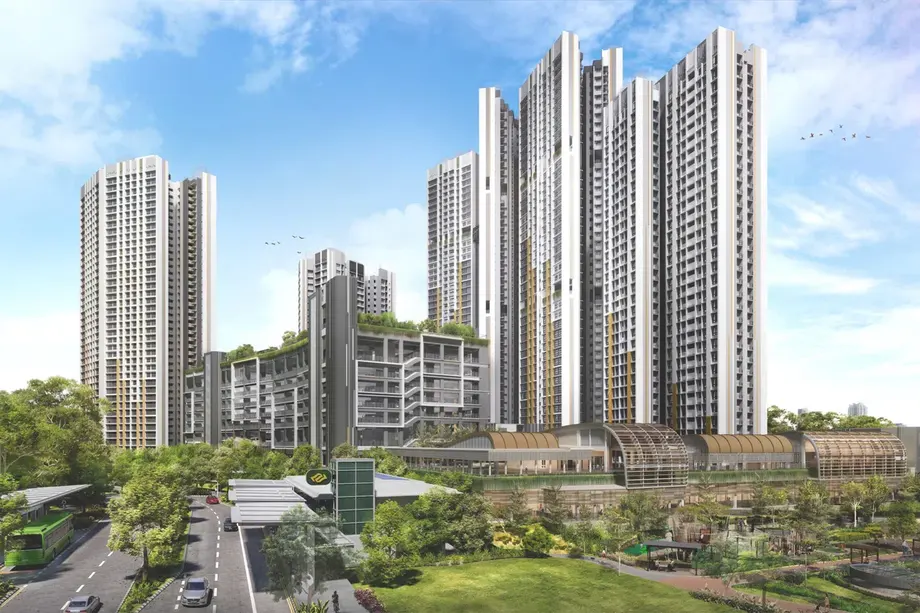
Toa Payoh Hillside, the launch's only Prime project, combined a location beside Caldecott MRT station with access to established schools and neighbourhood services. Its four-room flats, measuring 90 to 93 square metres, had indicative prices of S$558,000 to S$832,000 before grants.
Christine Sun, chief researcher and strategist at Realion (OrangeTee & ETC) Group, pointed to nearby CHIJ Primary and Secondary schools and the area's amenities as reasons for the strong demand. Lee also highlighted unusual features in some flats.
Lee, who leads data analytics at Huttons Asia, described the balconies and views available in parts of the development:
Some of the four-room flats will have a balcony which is very rare and units on the higher floors will have unblocked views of MacRitchie Reservoir,
Future facilities add to the location's appeal. The nearby Toa Payoh Integrated Development is expected to open by 2030, bringing sports facilities, a polyclinic, a library and a town park.
ERA key executive officer Eugene Lim said nearby resale units had sold for S$820,000 to S$1.2 million. The new project's lower starting price gives buyers a less expensive entry into the neighbourhood, alongside a construction wait and tighter conditions on a future sale.
Prime and Plus Buyers Accept Longer Commitments
Toa Payoh Hillside buyers face a minimum occupation period of 10 years and an 11% subsidy recovery rate when they resell. The minimum occupation period is the time owners must live in their flat before they can sell it.
Subsidy recovery means returning a specified share of the resale price to HDB. Prime and Plus homes receive additional subsidies for their desirable locations, with stricter resale conditions attached. The two Bayshore Plus projects in this launch have a subsidy recovery rate of 9% and the same minimum occupation period of 10 years.
Standard flats, including Plantation Dew and Sembawang Anchor, have a minimum occupation period of five years and no subsidy recovery on resale. Buyers choosing between these projects are therefore weighing the purchase price and location against how long they must remain in the home and what they will return to HDB later.
The demand follows the introduction of the new housing classification framework, which replaced the previous distinction between mature and non-mature estates for new BTO launches. November's figures show strong interest in both a Prime project in an established town and a Standard project in a newer one.
Tengah Combines Lower Prices With More Choice
Plantation Dew's 168 four-room flats received 1,191 applications, or about 7.1 applicants per flat across all household categories. Its application rate of 5.3 among families buying for the first time placed it behind only Toa Payoh Hillside for that flat type. Five-room and three-generation flats had a rate of 3.8 for the same applicant group.
PropNex chief executive Kelvin Fong attributed the response to relatively affordable prices and the range of homes, including white flats offered without internal partition walls. Such layouts allow buyers more freedom to decide how to divide their living space.
Fong also pointed to demand accumulated since Tengah's previous BTO launch in October 2023. Plantation Edge I and II had recorded an application rate of 2.3 at that launch.
SRI head of research and data analytics Mohan Sandrasegeran said completed homes and new amenities were changing how prospective buyers viewed Tengah. He cited Plantation Plaza and Parc Point, alongside the upcoming Jurong Region Line and the planned relocation of ACS (Primary) to Tengah in 2030.
The combination gives families concrete reasons to consider the town: shops and services becoming available, future rail connections and a planned primary school. Those attractions sit alongside the shorter occupation requirement attached to Standard flats.
Singles Face the Tightest Competition in Tengah
Plantation Dew's 178 two-room flexi flats attracted 1,619 applications across eligible groups. Among singles buying for the first time, the application rate reached 18.2, the highest in the launch and more than twice the median of 8.2 for singles.
The indicative price range for its Type 1 two-room flexi flats was S$44,000 to S$166,000, depending on lease length. Lease length affects how long the buyer can occupy the home and helps explain the wide price range. Fong said these were the most affordable two-room flexi flats in the exercise.
HDB offered 2,899 two-room flexi flats across the November launch, about 36% of the total supply of 7,964. Even with more than a third of the homes in this category, the median application rate for singles rose from 7.8 in June and 7.3 in February.
Competition extended beyond Tengah. Singles buying for the first time recorded application rates of 8.9 at Chencharu Acres in Yishun, 8.4 at Merpati Meadow in Geylang and 7.9 at Toa Payoh Hillside. Sembawang Anchor's rate was lower, at 3.5.
Families had a different spread of choices. Chencharu Acres recorded rates of 2.3, 2.6 and 2.7 for families buying three-room, four-room and five-room flats for the first time. Merpati Meadow's four-room rate for the same group was 2.3.
Bayshore Attracts Buyers Seeking Coastal Access
Bayshore Oasis and Bayshore Sails, both Plus projects in Bedok, received a combined 10,293 applications for 2,492 flats across all flat types, the largest combined applicant total in the launch. The developments are on Bayshore Drive near Bayshore MRT station.
Their four-room flats had a reported application rate of 3.1 among families buying for the first time. The combined four-room tally was reported as 5,213 applications for 1,165 flats; HDB's reproduced table instead lists 5,521 applications and an incomplete supply entry of 116. The precise four-room total needs clarification.
Sun cited proximity to the MRT station and East Coast Park, with sea views available from some units. Lee also pointed to a future mall at Bedok South MRT station. Fong said the combined response reflected interest in the Bayshore precinct and waterfront living.
Families buying again faced particularly strong competition for Bayshore Sails' three-room flats. HDB listed 718 applications across household groups for 90 units, with a category rate of 54.9 among families buying again. The small allocation for that group made competition much greater than the total applications divided by total flats would suggest.
Sembawang Offers a Shorter Wait and Lower Demand
Sembawang Anchor had the shortest estimated waiting time in the November exercise, at under three years. Its four-room and five-room flats nevertheless received fewer applications from families buying for the first time than the supply allocated to that group.
HDB's tables put those category rates at 0.7 for four-room flats and 0.3 for five-room flats. The three-room rate was 1.0. Families seeking larger homes therefore faced much less competition here than at Toa Payoh or Tengah.
Sun pointed to earlier supply in the area, where almost 4,000 flats had been launched across the February and June exercises. Some households wanting to live there may already have applied before November.
Lee cited limited nearby amenities and the distance to rail transport. Sembawang MRT station is about a walk of 15 to 20 minutes away, with a bus journey of about 10 minutes also cited. Buyers choosing the project would gain a shorter construction wait while accepting a less direct connection to the MRT.
Care Apartments Rebound as Eligibility Widens
Toa Payoh Hillside's 256 Community Care Apartments received 509 applications, producing an application rate of 2.0. That was higher than the rates of 0.7 and 0.9 at earlier projects in Sengkang and Geylang.
The government lowered the minimum eligible age from 65 to 55 in July, making the November project the first launch under the expanded age rule. Reduced basic service package fees also lowered the ongoing cost of this housing option, which combines a home with care services.
Lee and Sun pointed to Toa Payoh's older population, the location beside Caldecott MRT station and the possibility of owners selling older flats to move into smaller homes. Fong said the application rate was the highest since the pilot project, Harmony Village @ Bukit Batok, drew 4.2 applicants per unit in 2021.
The response brought together a wider pool of eligible applicants, lower service fees and an established location. For older residents considering a move, those changes affect both access to an apartment and the regular cost of living there.
Booking and the Next Launch Follow in 2027
Applicants receiving a queue number for November can expect flat selection appointments at HDB Hub in Toa Payoh between March and June 2027. HDB launched 23,928 new flats during 2026.
The next exercise is planned for February 2027, with about 4,300 BTO flats in Bishan, Tampines, Tengah and Toa Payoh. A concurrent Sale of Balance Flats exercise will offer about 5,000 homes that are completed or under construction.
The February launch plans include homes in Bishan with waiting times under three years and Community Care Apartments in one of two Tampines projects. Prospective applicants needing an HDB Flat Eligibility letter should submit all required documents by December 15, 2026.
The key dates connect the policy changes, November applications and the next opportunities to buy:
- July 2026: The minimum age for Community Care Apartments was lowered from 65 to 55.
- August 2026: Higher BTO income ceilings were announced for families and singles.
- November 4 to 11, 2026: Applications ran for the first BTO exercise under the higher income ceilings.
- November 12, 2026, at 2pm: HDB scheduled the final application update.
- December 15, 2026: Document submission deadline for prospective February applicants needing an eligibility letter.
- February 2027: About 4,300 BTO flats and 5,000 balance flats are expected.
- March to June 2027: Flat booking appointments are expected for November applicants receiving queue numbers.
Key Points
- November's launch received 35,603 applications for 7,964 flats by 5pm on November 11.
- Toa Payoh Hillside and Plantation Dew led four-room demand among families buying for the first time, with rates of 6.7 and 5.3.
- Plantation Dew had the highest application rate for singles buying for the first time, at 18.2.
- Sembawang Anchor's four-room and five-room flats had category rates below one for families buying for the first time.
- Toa Payoh's Community Care Apartments attracted 509 applications for 256 homes after eligibility widened to people aged 55 and above.
- The February 2027 exercises are expected to offer about 9,300 BTO and balance flats combined.