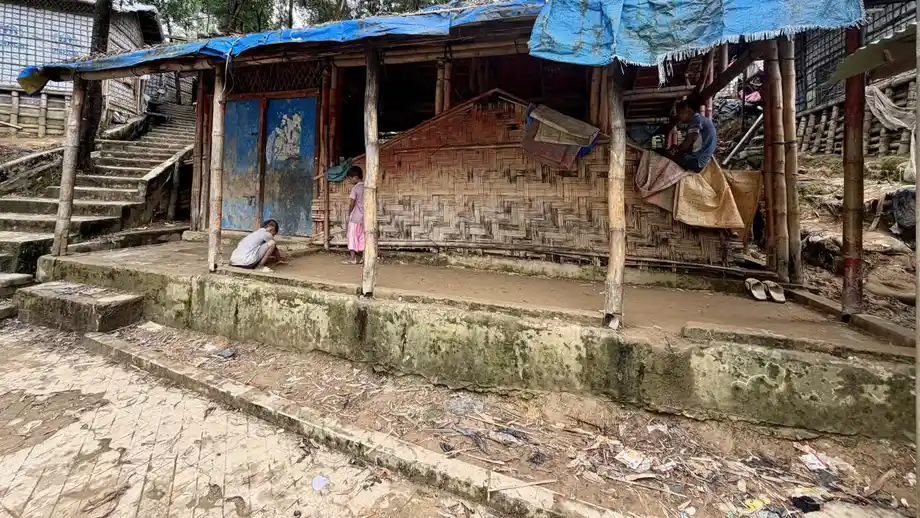
Half a million children, a shrinking education budget
Education programmes serving 312,000 Rohingya children in Bangladesh face renewed closures after donors pledged only $36 million of a reduced $53 million funding request for 2026 by mid October, according to Human Rights Watch. About 500,000 children in the refugee camps are of school age, while population growth and new arrivals fleeing atrocities in Myanmar have added roughly 90,000 children needing schooling this year.
Contents
- Half a million children, a shrinking education budget
- How the funding cuts reached classrooms
- What children encounter when centres remain open
- A World Bank package offers support through 2027
- Refugee teachers have built another route to learning
- Permission to teach is different from recognised qualifications
- Language and culture matter inside the classroom
- Years of temporary schooling have lasting costs
- What would change children's daily lives?
- Key Points
The crisis extends beyond keeping classrooms open. Children are sharing textbooks, teachers lack basic supplies, and schools established by Rohingya refugees themselves struggle to obtain legal recognition and direct financial support. Humanitarian learning centres closed for months during funding cuts in 2025, interrupting education for children whose schooling has already been repeatedly disrupted by displacement.
Human Rights Watch is urging donors to fund education programmes fully, Bangladesh to remove remaining restrictions, and United Nations agencies to work with a community school network serving up to 30,000 students.
Bill Van Esveld, associate children's rights director at Human Rights Watch, called for action on both funding and government policy:
Bangladesh should accelerate steps to end bans on education for refugees, and humanitarian agencies should work with the Rohingya-led schools.
Bangladesh has recently permitted a small group of children to take an internationally recognised primary examination and approved a community organisation's proposed school for 240 students. Those openings offer practical examples of change, but most children still depend on an aid system struggling to provide even pencils, notebooks and usable classrooms.
How the funding cuts reached classrooms
UNICEF documented an early stage of the disruption in its June 2025 statement. The agency said funding shortages had forced the termination of implementing partners' contracts involving 1,179 personnel from Bangladeshi host communities working in kindergarten, grade 1 and grade 2 education.
The affected activities included English, science, social science and drawing. Whether other Rohingya and Bangladeshi workers could return after the Eid break through June 29 depended on securing new funding. The cuts therefore affected both refugee children's lessons and paid work for people living around the camps.
Humanitarian education groups coordinated by UNICEF received $29 million against a $72 million request for 2025, according to Human Rights Watch. That covered about 40 percent of the requested budget and left a $43 million shortfall. Providers laid off teachers, cancelled an early education programme and reduced teacher training and other activities.
For 2026, agencies lowered their request by $19 million, from $72 million to $53 million. Pledges of $36 million by mid October covered about 68 percent of that smaller request, leaving $17 million unfunded. The 2025 figure records money received, while the 2026 figure records pledges, which are promises of support.
The United States had previously financed half the Rohingya education budget before halting its funding in 2025. Human Rights Watch says humanitarian education funding worldwide has fallen by 20 percent since 2023, placing the camps' shortages within a wider retreat in assistance.
What children encounter when centres remain open
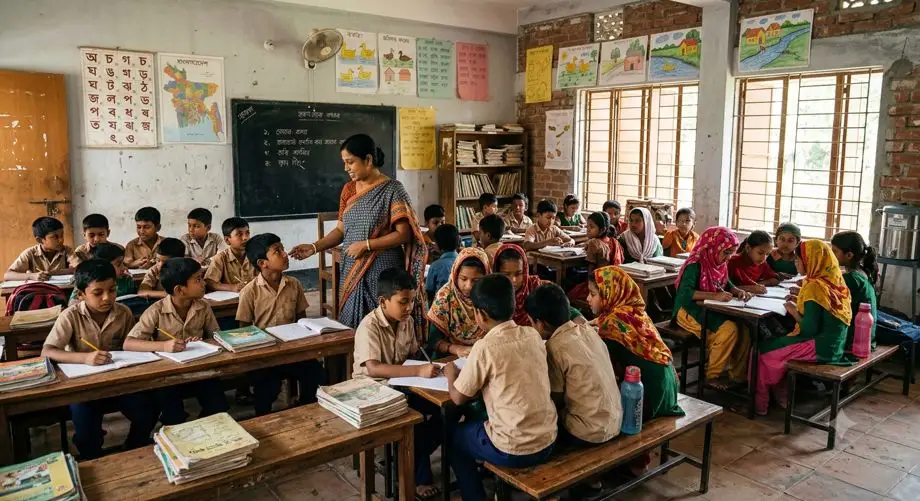
A grade 1 instructor told Human Rights Watch that his classroom had no whiteboard, markers, desks or benches. Children shared textbooks, pens and exercise books. A grade 3 instructor described three students using one set of textbooks.
Learning centres divide students into two daily shifts instead of teaching one class throughout the school day. This helps providers reach more children with limited space and staff, but restricts the time available to each group.
A humanitarian education official told Human Rights Watch in October 2026 that shortages extended from textbooks to repairs. Learning centres damaged by mudslides and other climate events remained without funding for restoration.
The current conditions echo problems documented years earlier. Human Rights Watch's 2019 education report, based on interviews with 163 Rohingya refugees, including more than 100 children, found that only about 1,600 of 3,000 learning centres had nearby bathrooms or drinking water as of August that year. None of the centres researchers visited had electricity, desks or chairs.
A World Bank package offers support through 2027
Bangladesh approved a separate procurement package on February 3, 2026, to provide education services through UNICEF at a cost of Tk203.87 crore, equivalent to $18.45 million at the project's exchange rate. The package targets 256,490 Rohingya students.
The services cover education before primary school and primary education in Cox's Bazar, Bandarban and Bhasan Char, the island settlement in Noakhali. The agreement provides for the World Bank to disburse the full $18.45 million directly to UNICEF.
Plans call for recruiting 4,106 volunteer teachers during the first 12 months and another 3,700 during the following six months, with payments set under the project framework. The wider project received approval from the Executive Committee of the National Economic Council on May 28, 2024, and has an implementation period running from July 1, 2024, to June 30, 2027.
The package supports instruction in the Myanmar language. World Bank assistance and funding provided or pledged by Education Cannot Wait offer resources, but humanitarian officials say education services still face a shortage. The procurement package has its own scope and implementation period, alongside the annual humanitarian education appeal.
Refugee teachers have built another route to learning
Rohingya teachers established the Examination Board of Rohingya Refugees in 2025 after a year of volunteer outreach across the camps. Its network now includes more than 125 community schools serving up to 30,000 students.
The board is developing standardised examinations using the Myanmar curriculum and working to improve teaching quality. Its leaders and teachers have offered to collaborate with UNICEF and humanitarian organisations on examinations, teaching and checks on educational standards.
Parents have expressed strong support for these schools. In a 2025 Justice For All Burma Task Force survey of 1,000 women, 720 mothers gave an opinion on school types. Of those respondents, 77 percent considered community schools better than learning centres operated by nongovernmental organisations.
Community schools nevertheless operate with severe limits. Many charge small fees to cover costs, making attendance harder for families with little money. Refugees also donate space inside their small shelters for use as classrooms.
Eight community school teachers interviewed by Human Rights Watch sought official status, recognised educational certificates, a route into higher education and cooperation with humanitarian agencies. An unnamed teacher described the burden of maintaining standards without institutional support:
We are spending money to ensure education quality, as if we were a government, but we are not a government, we are simply refugees.
Permission to teach is different from recognised qualifications
Bangladesh's former Awami League government, removed from power in 2024, barred Rohingya children from certified education and higher education, both in the camps and through Bangladesh's school system. It permitted humanitarian learning programmes while prohibiting community schools, demolishing several and threatening teachers with relocation to Bhasan Char, according to Human Rights Watch.
The current government took two new steps in October 2026. A few dozen Rohingya primary pupils were allowed to sit an internationally recognised primary examination with support from the UN refugee agency, UNHCR. Bangladesh also approved a Rohingya organisation's plan to build a primary school for 240 students.
The Rohingya Centre UK, established by members of the diaspora, plans to teach 10 subjects from 9 a.m. to 3 p.m. It is also training teachers from other community schools in the new curriculum. Its project is formally being implemented through a registered Bangladeshi organisation because community schools lack the legal status needed to receive foreign funding directly.
Human Rights Watch says Bangladesh has still not accredited a curriculum for Rohingya children. Accreditation means official acceptance of a programme's educational standards. Children also need recognised certificates that allow them to move into further study. Permission to use a curriculum and access to recognised qualifications are separate decisions.
The October approvals open opportunities for a limited number of pupils. A broader timetable for recognising community schools, certifying their education and enabling access to higher education has not been announced.
Language and culture matter inside the classroom
In Ukhiya's Camp 4, a community learning centre supported by Human Concern combines reading and writing with Rohingya language, songs and culture. Children learn Rohingya, Burmese and English alongside mathematics and science. Traditional rhymes and stories, known as kissa, help pass on a culture often preserved through speech rather than formal schooling.
Language is a practical education issue. Rohingya children's mother tongue is Rohingya, rather than Burmese. Research conducted in Kutupalong and published in the International Journal of Educational Research Open in 2022 identified difficulties understanding Burmese and English instruction, alongside weak teaching quality, gaps in teacher training and a lack of formal recognition.
Camp 4 housed about 46,000 people within approximately 1.16 square kilometres in May 2026, according to UNHCR figures. With shelters tightly packed and little room for outdoor play, the centre provides children with space for games and creative activities as well as lessons.
Its teacher, Mohammed Ikram, completed higher secondary education in Myanmar before fleeing in 2017. Teaching at the centre has allowed him to return to an ambition interrupted by displacement. Among his pupils, 11 year old Jahanara Khatun hopes to become an English teacher, while Mohammed Ayas, also 11, especially enjoys drawing animals.
The centre runs two shifts lasting three hours each on working days. With Human Concern's financial support, it is adding a classroom and recruiting another teacher. Plans also include using the space after children's lessons to teach women traditional nakshikantha embroidery.
Years of temporary schooling have lasting costs
Bangladesh's 2019 informal education guidelines were built around an expectation that refugees would return to Myanmar within two years. At that time, the government had approved only the first two informal learning levels, and there was no route to certified education. Human Rights Watch found that fewer than 4 percent of Rohingya children aged 14 and older attended learning centres.
By November 2026, nine years had passed since the mass flight from Myanmar in 2017. Bangladesh renewed its appeal for Chinese help on November 4, when Prime Minister Tarique Rahman asked Beijing to assist in resolving the crisis involving around 1.3 million displaced people. No timetable for a refugee return was announced.
Key dates show how education policy, financial support and the wider refugee crisis have developed:
- August 2017: Mass atrocities in Myanmar forced hundreds of thousands of Rohingya into Bangladesh.
- December 2019: Human Rights Watch documented restrictions on formal education and very low attendance among older children.
- June 3, 2025: UNICEF announced contract terminations affecting 1,179 personnel amid funding shortages.
- February 3, 2026: Bangladesh approved the $18.45 million UNICEF education services package.
- October 2026: Bangladesh permitted a small group of pupils to take an internationally recognised examination and approved a proposed community school.
- June 30, 2027: The implementation period ends for the wider project supporting the UNICEF procurement package.
Human Rights Watch also says the International Court of Justice is due to deliver judgment on November 19, 2026, in Gambia's case alleging that Myanmar's atrocities against the Rohingya during the 2016 and 2017 military operations violated the Genocide Convention.
What would change children's daily lives?
Donor funding would allow providers to retain teachers, supply learning materials and repair damaged centres. Official status for community schools would give refugee educators a more stable basis for operating, while recognised certificates would help pupils progress beyond their current classes.
Human Rights Watch argues that Bangladesh must provide access to quality education without discrimination based on refugee status. The Inter-Agency Network for Education in Emergencies' Minimum Standards also call for community leadership and participation in designing and delivering education programmes.
The two education networks bring different strengths and needs. Humanitarian programmes reach hundreds of thousands of children, while community schools offer teaching capacity and experience valued by many parents. Cooperation on teacher training, examinations and learning standards is a concrete proposal already being offered by refugee educators.
For children, the immediate priorities are simpler: a classroom that opens regularly, a teacher with enough materials, lessons they can understand and qualifications that let them continue studying.
Key Points
- Humanitarian education programmes enrol 312,000 of approximately 500,000 children of school age in the camps.
- Donors had pledged $36 million against a $53 million education request for 2026 by mid October.
- A network of more than 125 community schools serves up to 30,000 students but lacks broad legal recognition.
- Bangladesh approved a $18.45 million UNICEF education package targeting 256,490 Rohingya pupils.
- October approvals expanded examination and schooling opportunities for a small number of children.
- Teachers are seeking stable funding, official school status, recognised certificates and access to further education.