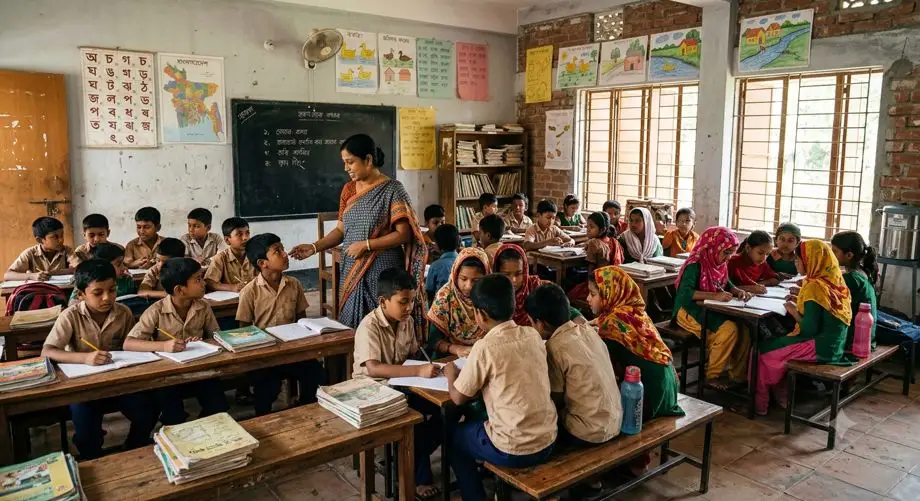
New financing puts basic classroom skills first
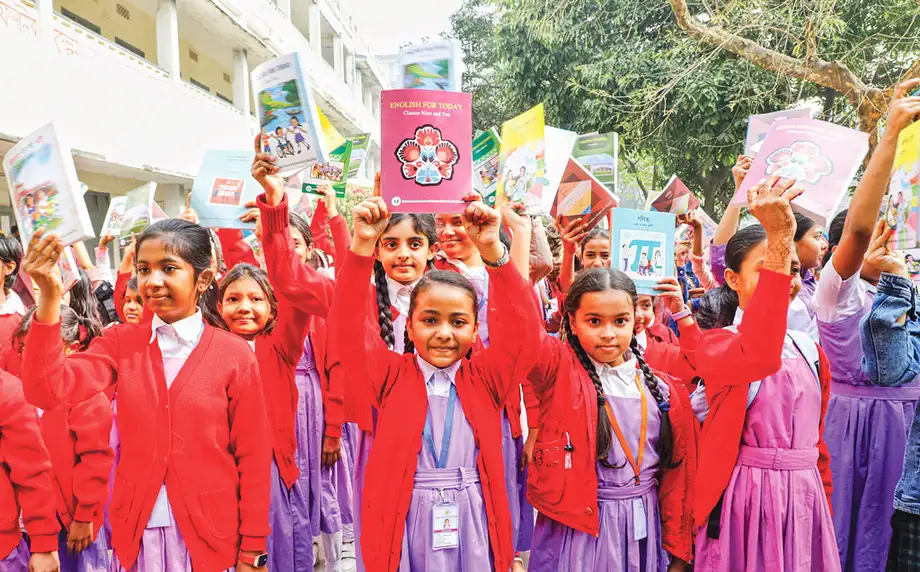
The World Bank has approved $300 million to improve education for 26 million children in Bangladesh, targeting reading, writing and mathematics from pre-primary through Grade 5. The programme will provide teaching materials, structured lesson plans and teacher training, with extra lessons for children falling behind and leadership training for headteachers in 90 percent of government primary schools.
Contents
- New financing puts basic classroom skills first
- What the official programme documents set out
- Why school attendance is no longer enough
- What will change in lessons?
- Extra help will target children and districts falling behind
- Preparing younger children for primary school
- Headteachers and school budgets are part of the plan
- How the loan fits wider government spending
- Employment expectations need more detail
- Key Points
The World Bank Group's Board of Executive Directors approved the financing on Friday for the Learning Enhancement and Acceleration in Primary Education Program. It will support the government's Fifth Primary Education Development Programme, connecting international financing with Bangladesh's broader effort to improve its primary schools.
The central problem is what children learn after entering school. Bangladesh has achieved almost universal access to primary education, yet the World Bank says about half of children aged 10 cannot read and understand a simple text suitable for their age. The programme seeks to close that gap between attending lessons and mastering essential skills.
The financing comes from the International Development Association (IDA), the World Bank Group institution that supports lower income countries. It has a repayment term of 25 years, including a grace period of five years. At an exchange rate of Tk 124.50 to the dollar, the $300 million equals Tk 3,735 crore. One crore is 10 million.
What the official programme documents set out
The World Bank's Program Information Document, dated 10 February 2026, records the proposal at concept stage, when preparation was authorised to continue. It listed proposed appraisal and approval dates of 3 May and 13 August 2026 respectively. Its financing table put the programme cost at $3 billion, with $300 million in World Bank financing, a $2 billion government contribution and a $705 million financing gap, including a separate $5 million investment project financing component.
The document said the Fifth Primary Education Development Programme, or PEDP5, was expected to begin in July 2026 and run for five years. Its core beneficiary group included 10.6 million children enrolled in government primary schools.
The programme's Environmental and Social System Assessment describes LEAP-BD as a strategically focused $3 billion subset of PEDP5. It puts PEDP5's estimated total cost at approximately $4.09 billion, or BDT 5,168.9 billion, and its duration at July 2026 to June 2031, while LEAP-BD runs from 2026 to 2030.
The assessment specifies that the $300 million IDA support comprises a $295 million Program-for-Results instrument and $5 million in Investment Project Financing, against a programme boundary of approximately $1.49 billion. Program-for-Results financing links funding to results. Its scope excludes mass teacher recruitment and salaries, student stipends and infrastructure construction, but includes capital spending on expanding, upgrading and maintaining water, sanitation and hygiene facilities.
The three results areas receive $120 million for foundational literacy and numeracy and teaching practice through structured pedagogy, $120 million for more equitable learning outcomes in government primary schools, and $55 million for stronger school leadership and education financing. The disbursement-linked indicators allocate $120 million to improved foundational literacy and numeracy, $60 million to quality pre-primary education for school readiness, $60 million to learning acceleration and resilience, $30 million to instructional leadership and school governance, and $25 million to budget alignment and execution.
Why school attendance is no longer enough
Bangladesh operates one of the world's largest primary education systems. More than 20 million children attend government schools, schools run by nongovernmental organisations, kindergartens and madrasas. Expanding access across that system has brought nearly all children into primary schooling, according to the World Bank.
Reading comprehension remains a major weakness. The World Bank puts the share of children aged 10 who cannot understand a simple text at about 50 percent in Bangladesh, compared with 42 percent in Malaysia and 47 percent in Brazil. Both comparison countries are in the upper middle income group.
Bangladesh's figure is eight percentage points above Malaysia's and three above Brazil's. Put simply, the Bangladesh estimate means roughly one child in every two has difficulty understanding basic written material at an age when reading is becoming essential for learning other subjects.
Jean Pesme, the World Bank's division director for Bangladesh and Bhutan, connected better primary schooling with children's future employment prospects:
Quality primary education is one of the building blocks for a globally competitive workforce.
Pesme said the World Bank Group had spent two decades helping Bangladesh bring nearly all children to school. The new financing shifts attention toward helping those children learn more effectively and continue their education.
What will change in lessons?
The programme will introduce a foundational literacy and numeracy package. Literacy means the ability to read and write; numeracy means understanding numbers and using basic mathematics. The aim is for children to develop these abilities at the level expected for their grade.
Teachers will receive teaching materials, structured lesson plans and training. A structured lesson plan sets out what a lesson should cover and how to teach it, giving teachers a clearer sequence for introducing skills and helping pupils practise them.
Government primary school teachers will also receive support to improve how they deliver these lessons. The programme combines classroom resources with professional training, addressing both what teachers use and how they teach.
For pupils, the intended change is practical: lessons that help them understand written words, express themselves in writing and work with numbers before they move to more demanding schoolwork. The focus on skills appropriate to each grade gives the initiative a learning goal beyond simply keeping children enrolled.
Extra help will target children and districts falling behind
Children who have not mastered expected skills will receive remedial learning support. Remedial learning means additional teaching that helps a pupil catch up on something they have not yet understood, rather than continuing through the curriculum with the same gaps.
The programme will give priority to districts with the weakest educational outcomes. This connects support for individual children with a geographical focus on places where learning difficulties are greatest.
Tashmina Rahman, the World Bank's senior education specialist and team leader for the programme, explained how that support fits the initiative's employment and education goals:
Strong foundational learning is a critical step towards the accumulation of skills for better jobs. To ensure that no children are left behind, the programme will support remedial learning for children who are falling behind, with a focus on districts that lag the furthest.
The combination of regular classroom improvements and additional teaching addresses two needs at once. Children entering lessons should receive stronger instruction, while pupils already struggling should have a chance to recover missing skills.
Preparing younger children for primary school
Pre-primary education in government primary schools is another specific focus. The programme aims to improve its quality so that children begin formal primary lessons with a stronger learning foundation.
School readiness means being prepared to take part in classroom learning. Early language, communication and number skills help children understand instructions and begin the reading and mathematics work that follows.
The programme's reach from pre-primary through Grade 5 links preparation for school with the skills children need as they progress. Earlier support and later catch-up teaching serve different stages of the same task: helping children keep pace with their education.
Headteachers and school budgets are part of the plan
Headteachers in 90 percent of government primary schools are to receive leadership training. That is equivalent to reaching nine out of every 10 schools in that category, making school leadership a broad part of the programme rather than a small trial.
The initiative will also strengthen school management systems, promote more accountable use of education budgets and encourage greater use of data in decisions. These measures connect classroom improvements with the people and systems responsible for running schools.
Learning data can help identify where pupils need support, while spending information can help school managers track how resources are used. Those functions matter to a programme that is directing additional assistance toward districts with weaker results.
The plan therefore works at several levels: pupils receive learning support, teachers receive materials and training, and headteachers receive help with leadership. Budget accountability and information are intended to support those changes across the school system.
How the loan fits wider government spending
The government reportedly approved the Fifth Primary Education Development Programme at an Executive Committee of the National Economic Council meeting on 4 November 2026, chaired by Prime Minister Tarique Rahman. The estimated cost was Tk 41,090.48 crore, comprising Tk 33,203.23 crore in government funds and an expected Tk 7,887.25 crore in foreign loans and grants. The programme will run from July 2026 to June 2031. The new international financing supports the Fifth Primary Education Development Programme alongside that wider government commitment.
The reported allocations include 25.2 percent for free uniforms, bags, attire, shoes and socks for 1,06,17,962 government primary school students; 5.9 percent for the One Teacher, One Tab initiative, including 3,83,513 tablets and 20,000 interactive panel projectors; 26.4 percent for 15,641 need-based classrooms, 1,500 wash blocks and 10,000 boundary walls; and 7.6 percent for training covering 3.1 lakh teachers, officials and staff.
Detailed spending proposals put uniforms and student supplies at Tk 10,065.21 crore and devices, interactive panels and ICT equipment at Tk 1,183.46 crore. Some 20,000 government primary schools are to receive interactive panels, Wi-Fi and internet connectivity. Infrastructure plans also include 20 district primary education offices, 125 upazila primary education offices and 100 resource training centre buildings.
Under the One Child, One Tree initiative, 10,617,982 students are each to plant a tree. The proposed allocation is Tk 53.09 crore, including Tk 27.27 crore in government funding and Tk 25.81 crore in project assistance.
The revised development project proposal was to incorporate the Planning Commission's observations and be resubmitted within two weeks. The commission called for cuts to the Tk 436 crore consultancy allocation, a shift of routine operational costs to the revenue budget within two years, and completion reports for PEDP-3 and PEDP-4. Development partners including the World Bank, Asian Development Bank, European Union, UNICEF and UNESCO were expected to contribute, although financing discussions and agreements had yet to be finalised. An economic analysis put the programme's Economic Internal Rate of Return at 17.3 percent and its Benefit-Cost Ratio at 2.7.
The financing places improvements to teaching within a broader push involving school facilities and resources:
- On 4 November 2026, the government reportedly approved Tk 41,090.48 crore for PEDP-5, including classrooms, digital equipment, uniforms and training.
- On Friday, the World Bank board approved $300 million for the Learning Enhancement and Acceleration in Primary Education Program.
- The IDA financing carries a repayment term of 25 years, including a grace period of five years.
The loan provides financing over a long period rather than a grant. A grace period delays scheduled repayment of the principal, meaning the amount borrowed, under the loan's terms. Bangladesh will still have a repayment obligation.
Employment expectations need more detail
The programme announcement also gives an estimate of 843,000 more and better paid jobs, describing them as employment in government primary schools. It does not explain how that figure is calculated or how it divides between additional positions and improved pay for existing workers.
Children's future employment is a second part of the programme's stated purpose. Stronger reading, writing and mathematics skills are intended to help them continue learning and build the abilities needed for work later in life.
For families, the most immediate promised benefits are closer to the classroom: better prepared teachers, stronger early education and additional help when a child falls behind. The programme's central task is to turn Bangladesh's success in getting children into school into stronger learning while they are there.
Key Points
- The World Bank approved $300 million to improve learning for 26 million children from pre-primary through Grade 5.
- About 50 percent of children aged 10 in Bangladesh cannot read and understand a simple text suitable for their age, according to the World Bank.
- The programme will provide teaching materials, structured lesson plans, teacher training and additional lessons for struggling pupils.
- Districts with the weakest educational outcomes will receive priority for remedial learning support.
- Headteachers in 90 percent of government primary schools are to receive leadership training.
- The IDA loan has a repayment term of 25 years, including a grace period of five years.
- Official programme documents specify $295 million in results-based financing and a $5 million investment project financing component; mass teacher recruitment, salaries, stipends and infrastructure construction are outside the results-based scope, while water, sanitation and hygiene facility work is included.
- The government reportedly approved PEDP-5 on 4 November 2026 at an estimated Tk 41,090.48 crore, including Tk 33,203.23 crore in government funds and Tk 7,887.25 crore in expected foreign loans and grants.