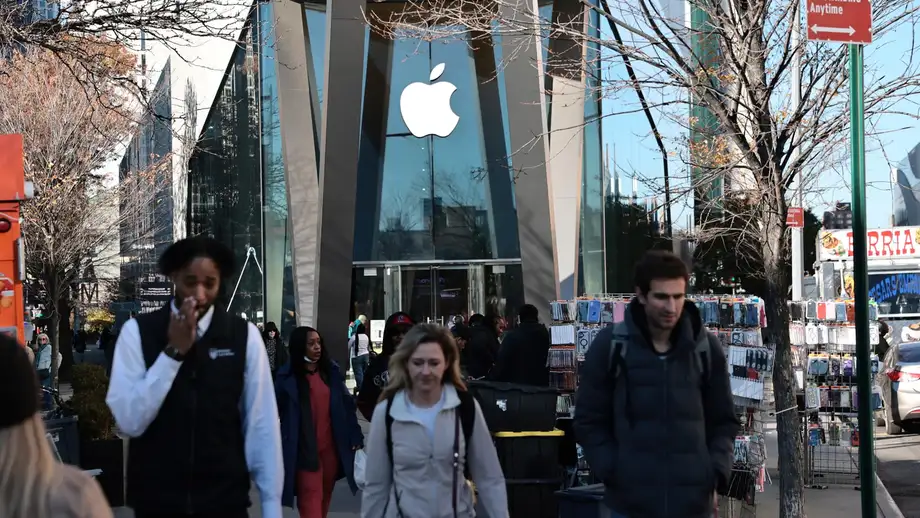
Apple services return after disruption reaches phones and stores
Apple restored services after an internal update caused outages on November 17, 2026, disrupting access to iCloud, purchases and some retail store operations. The company ruled out a cyberattack. Its later System Status update marked the listed incidents as resolved, including an interruption to iCloud web applications lasting four hours and 30 minutes.
Contents
- Apple services return after disruption reaches phones and stores
- What Apple's official status page recorded
- Why customer complaints looked broader than the final list
- Stores, schools and businesses also lost access
- Four business days of technology disruption
- Other Tuesday incidents had different scopes
- Officials reject a coordinated attack as lawmakers seek answers
- Recovery brings the focus back to keeping services running
- Key Points
Customers reported trouble signing in, accessing email, sending messages and completing payments. Inside Apple stores in New York and Chicago, employees said internal software stopped working for more than an hour, preventing them from completing purchases or making appointments.
An Apple spokesperson attributed the disruption to an update and described the recovery while work was still underway:
Many of our systems are back up and running after an internal update caused some outages this morning. We're working to get the remaining systems online as soon as possible.
Downdetector recorded about 2,300 reports of Apple Pay problems in the United States at around 12:20 p.m. Eastern Time and roughly 1,800 reports of iCloud trouble at its peak. Reports began climbing before noon and tapered off during the afternoon.
Apple's outage came after several days of disruption across email, aviation and banking. Microsoft, the Federal Aviation Administration, JPMorgan Chase and United Airlines had experienced problems before Tuesday's interruptions at Apple and the National Security Agency. Companies and officials attributed the incidents to technical faults, updates or maintenance rather than cyberattacks.
For customers, the immediate effects were concrete: a payment that would not complete, an account that would not open or a store appointment that employees could not arrange. Apple's recovery also varied by service, with some functions returning hours before others.
What Apple's official status page recorded
Apple's System Status page, carrying a final update dated November 17 at 11:34 p.m. CEST, listed resolved incidents across consumer, business and education services. Apple Pay, iCloud Account & Sign In, Apple Music and iOS Device Activation were shown as available in that later snapshot.
The page recorded iCloud Mail performance problems from 5:45 p.m. to 7:25 p.m., a period of one hour and 40 minutes. Problems with iCloud Web Apps, which customers access through iCloud.com, ran from 5:45 p.m. to 10:15 p.m., lasting four hours and 30 minutes. These are the times displayed on the status page.
Apple listed App Store and Volume Purchase Program outages from 5:45 p.m. to 9 p.m., lasting three hours and 15 minutes. The Volume Purchase Program also had an overlapping incident involving intermittent problems from 6:11 p.m. to 10 p.m.
AppleCare on Device was unavailable from 5:15 p.m. to 9:39 p.m. Apple said all users were affected by that incident and that AppleCare purchases were temporarily unavailable. Apple Business, Apple School Manager and Schoolwork each had issues from 7:40 p.m. to 11 p.m.
The status descriptions give a more precise picture than a single label such as an Apple outage. Some services were slow, some were intermittently unavailable and others could not complete purchases. Most of the resolved entries said some users were affected, while the AppleCare purchase outage was listed as affecting all users.
Why customer complaints looked broader than the final list
Customers reported problems with Apple Pay, Apple Support, iCloud and account verification on Downdetector and social platforms. Some people posting on Reddit said they could not activate new iPhones. Others described failed attempts to sign in using their Apple account details.
Earlier status updates listed iCloud Account & Sign In problems as affecting all users, alongside issues with the App Store, AppleCare on Device and Apple Music. Later updates added services used by businesses and schools. The final page showed the account sign in service as available.
Downdetector counts submissions from people reporting trouble. Its figures are useful for showing when complaints rise and fall, but they are not a count of every affected customer. Apple's status page describes the service incidents the company has identified. Together, they show both the customer experience and Apple's changing account of the recovery.
Apple did not publish a total number of affected customers or explain which part of the internal update failed. That leaves the scale of the disruption and the detailed technical cause unknown, even though the company identified the update as the trigger.
Stores, schools and businesses also lost access
Apple's retail disruption extended the incident beyond applications on a phone. Employees at stores in New York and Chicago said unavailable internal programs prevented purchases and appointments. Customers could therefore encounter trouble even when seeking help or trying to buy a product in person.
AppleCare's interruption affected the ability to purchase coverage through a device. The App Store and Volume Purchase Program incidents affected another kind of transaction: obtaining applications or making purchases through Apple's software distribution systems.
Apple School Manager and Schoolwork serve education users, while Apple Business supports business functions. Their status entries said the services might have been slow or unavailable. Schools and employers using those systems faced a different disruption from a consumer unable to open email, but all depended on Apple restoring the affected services.
Account access can also make an outage feel wider than a single failed application. An Apple account is used to enter several services. When that access is interrupted, customers may encounter password requests or unsuccessful sign in attempts across more than one part of their device experience.
Four business days of technology disruption
Apple's problems followed a sequence of separate failures across essential services. The interruptions affected different organisations and systems, with explanations ranging from an old software defect to a network equipment upgrade.
- November 12: Microsoft services, including Outlook, suffered disruption. Microsoft later said a software bug had gone undetected since July.
- November 13: An FAA communications network failure prompted a nationwide ground stop, temporarily holding departing flights.
- November 16: JPMorgan Chase experienced transaction and service delays. United Airlines also briefly delayed departing flights following a technology problem.
- November 17: Apple experienced outages after an internal update. The NSA reported disruption during scheduled maintenance, while several other companies addressed narrower service problems.
The FAA cited a router upgrade in southern Arkansas, overseen by contractor L3Harris Technologies, as a factor that overwhelmed its telecommunications network. The agency was still examining the root cause. A router directs information between parts of a network, so a problem with its operation can interrupt communications far beyond the equipment itself.
JPMorgan attributed longer service times to a software bug in hardware systems operated on its own premises. By Monday evening, a Chase spokesperson said transactions were processing normally again. Customers at Bank of America and other financial institutions also reported problems involving deposits and Zelle transfers.
Other Tuesday incidents had different scopes
The NSA attributed its disruption to scheduled routine maintenance. Its internal communications network, NSANet, experienced a partial outage. A US official said some internal systems were affected while capabilities critical to its mission remained operational.
Marriott said it resolved a technical issue affecting sign in on its website and app. Guests had reported problems involving reservations and check ins. The company, which operates 10,200 properties with more than 1.8 million rooms, said its review found no indication that the disruption involved cybersecurity.
Google took a different position on reports of Gmail access trouble. While users submitted complaints, a spokesperson said the company was not seeing evidence of a broad Gmail service disruption. Charles Schwab acknowledged a brief problem loading its website and said it had been resolved by noon Eastern Time.
The practical scale therefore varied substantially: an airline departure delay, an internal agency network interruption and a brief webpage loading problem affected people in different ways. Each organisation issued its own explanation or assessment.
Officials reject a coordinated attack as lawmakers seek answers
Director of National Intelligence Jay Clayton said officials had examined whether malicious activity connected the recent incidents. He rejected the suggestion of a coordinated operation:
This is not cyberattack, and this is not a coordinated effort by a nation state. We've looked very closely.
Apple likewise said its outage was not caused by a cyberattack. JPMorgan said it had no evidence of a cyber related incident, while the NSA pointed to maintenance and Marriott described a technical sign in problem.
Lawmakers nevertheless sought more information about reliability and government oversight. Senator Mark Warner of Virginia used the incidents to argue for an artificial intelligence safety bill. House Minority Leader Hakeem Jeffries said it was too premature to conclude malicious activity was involved and called for a congressional briefing.
President Donald Trump took a more dismissive position when asked about the outages during a trip to the Philippines, describing them as part of life. No date for the congressional briefing sought by Jeffries was announced.
Recovery brings the focus back to keeping services running
Apple's explanation places an ordinary operational task, an internal update, at the centre of an interruption that reached customers, stores, schools and businesses. Updates change the software or configuration that systems use. A fault during that process can leave services unable to communicate or complete requests until the problem is corrected.
Microsoft's account of a bug present since July and the FAA's account of a router upgrade show different technical routes to disruption. Organisations must repair defects and maintain equipment while keeping services available to the people relying on them.
Sam Rubin, senior vice president of consulting and threat intelligence at Palo Alto Networks' Unit 42, said businesses should prioritise their most exploitable systems while preparing to operate through failures. He described continuity as a practical requirement:
You need to think about how you continue to operate in the face of one of your IT systems going down.
For Apple customers, the later status update brought the immediate recovery into focus: the listed incidents were resolved and the affected services had returned to availability. The remaining unanswered issue is the detailed explanation of how the update caused failures across so many different functions.
Key Points
- Apple attributed the November 17 outages to an internal update and ruled out a cyberattack.
- The later official status page marked the listed incidents as resolved.
- iCloud web application problems lasted four hours and 30 minutes; App Store problems lasted three hours and 15 minutes.
- Apple stores in New York and Chicago reported being unable to complete purchases or arrange appointments.
- Downdetector recorded thousands of complaints, but Apple did not publish a total customer impact figure.
- Recent aviation, banking and email disruptions had separate technical explanations. Lawmakers called for more information.