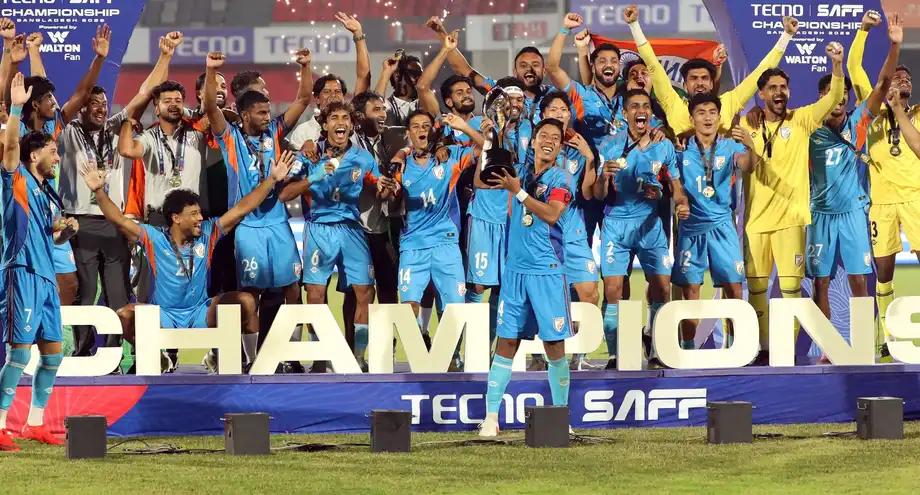
Mandi's late header completes India's comeback
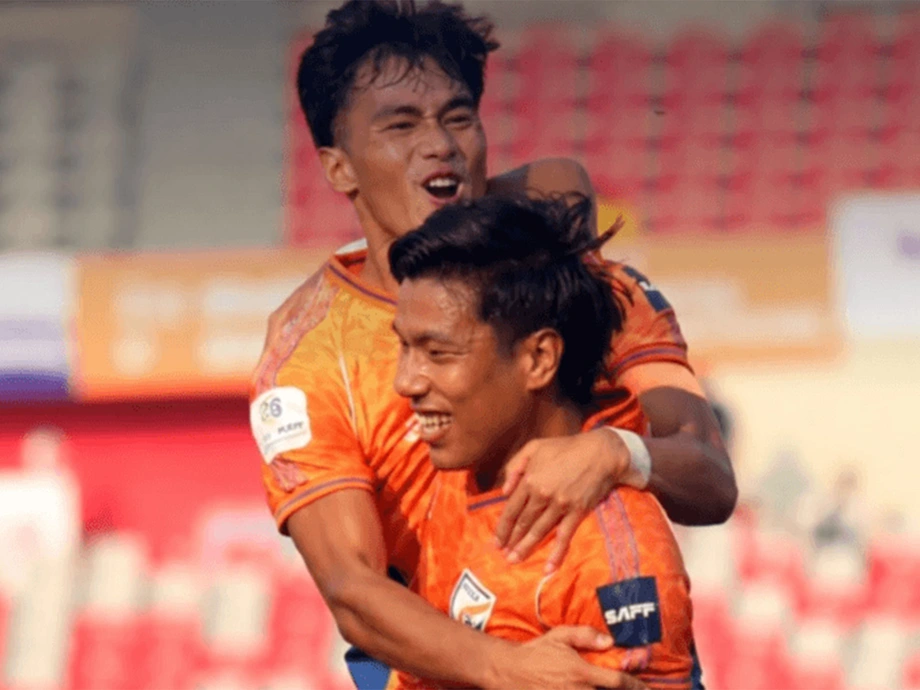
India won their 10th SAFF Championship on Tuesday, November 17, 2026, beating Pakistan 2-1 at the National Stadium in Dhaka after trailing at halftime. Sandip Mandi headed the winning goal in the 88th minute, completing a comeback that secured India's third consecutive title and denied Pakistan a trophy in their first final.
Contents
- Mandi's late header completes India's comeback
- Pakistan's pressure brings a deserved lead
- Moosa changes the midfield before the red card
- A dismissal and a free kick transform the final
- Rabeeh supplies the corner, Mandi finds the winner
- How the teams reached the title match
- A reduced Indian squad finishes unbeaten
- A tenth crown for India, a first final for Pakistan
- Key Points
Alamgir Ghazi had put Pakistan ahead in first half stoppage time. India responded through Suhail Ahmed Bhat shortly after Pakistan defender Junaid Shah was dismissed for a dangerous challenge on Brison Fernandes, before Mandi settled the match with two minutes of normal time remaining.
The Asian Football Confederation's official match account records Shah's dismissal in the 59th minute and Bhat's equaliser two minutes later. India then pushed forward against Pakistan's remaining 10 players and found the goal that extended their regional record.
Coach Naushad Moosa achieved the victory with a squad disrupted by injuries and competing international commitments. India's senior players were also involved in friendlies in New Zealand, leaving the group in Bangladesh to navigate the regional tournament with fewer options.
For Pakistan coach Nolberto Solano, the defeat ended a campaign that had already taken his country further than ever before in the competition. Around 10,000 spectators attended the final, despite hosts Bangladesh having been eliminated in the semifinals.
Pakistan's pressure brings a deserved lead
Pakistan began with greater attacking purpose. In the opening 30 minutes, they registered nine attempts, including two on target. India managed two attempts in that period, neither of which required a save. Pakistan therefore produced more than four times as many shots during the opening half hour.
Solano arranged his team in a 5-4-1 formation, with five defenders, four midfielders and one forward. The shape gave Pakistan defensive cover while allowing their players on the flanks to advance. Haris Zeb and Ali Akbar Khan helped stretch India's defence, creating space for attacks through the middle.
India goalkeeper Arsh Anwer Shaikh made an important early save from McKeal Abdullah, while Khaiminthang Lhungdim intervened to stop another effort towards an exposed goal. Pakistan goalkeeper Yousuf Butt also had to respond as India began creating chances around the 34th minute.
Pakistan finally scored in the first minute of added time before the interval. Shah delivered a low cross that took a deflection off Lhungdim and reached Ghazi inside the penalty area. Ghazi curled his right footed shot into the far corner, giving Pakistan a 1-0 lead that reflected their stronger first half.
Moosa changes the midfield before the red card
Moosa had retained the starting side that beat Bhutan 2-1 in the semifinal. At halftime in the final, however, he replaced Manglenthang Kipgen with Macarton Nickson to give India a stronger presence in midfield.
Nickson helped carry the ball forward, allowing India to spend more time closer to Pakistan's penalty area. Ricky Shabong and Abhishek Suryavanshi now had a teammate who could receive their passes and advance under pressure, bringing Fernandes and P.V. Vishnu into more dangerous positions.
Vishnu struck the near post in the 51st minute as India began to threaten more regularly. The improvement had started while Pakistan still had all 11 players on the pitch, making Moosa's halftime adjustment an important part of the comeback.
India had entered the final without scoring a second half goal during the tournament. They were also facing a deficit for the first time in the competition. Winning required them to solve both problems in the same half.
A dismissal and a free kick transform the final
Shah's challenge on Fernandes brought the decisive disciplinary intervention. After a Video Assistant Referee review, the referee showed the Pakistan defender a straight red card. VAR allows officials to use video footage to review incidents such as potential dismissals.
Pakistan had to play the remainder of the match with 10 players. Losing Shah also removed the player whose delivery had helped create their opening goal, reducing their options as India increased the pressure.
India equalised from the resulting free kick. Lhungdim sent the ball into the penalty area, Nickson got a touch and Bhat finished with the inside of his foot. The AFC places the goal two minutes after the 59th minute dismissal.
Bhat's goal was his fourth of the tournament, earning him the leading scorer distinction. He had already scored twice against Pakistan in the group stage, making the final equaliser his third goal against the same opponents during the competition.
Solano responded with substitutions as Pakistan tried to reorganise, including withdrawing Ghazi. Butt kept his team in the contest with another save from Vishnu in the 67th minute, but Pakistan increasingly had to defend close to their own goal.
Rabeeh supplies the corner, Mandi finds the winner
Moosa introduced Abdul Rabeeh and Irfan Yadwad in the second half to give India fresh attacking options on the wings. Against a defence covering the pitch with one fewer player, their task was to keep moving forward and make Pakistan's defenders turn towards their own goal.
Rabeeh delivered the corner that decided the final. In the 88th minute, Mandi met the ball with a header that bounced towards goal and beat Butt, whose handling contributed to Pakistan conceding. India led for the first time in the match.
Pakistan pushed players forward in search of an equaliser during five minutes of added time. Butt joined a late attacking corner, leaving his own goal unguarded. India broke away, but a recovery tackle stopped Lhungdim from adding a third goal.
India held their 2-1 advantage until the final whistle. Mandi, who had spent much of the opening half dealing with Pakistan's attacks, finished the evening as the scorer of the championship's decisive goal.
How the teams reached the title match
The final was the second meeting between the teams in 12 days. India won their November 5 group opener 3-2 after scoring three times before halftime. Pakistan scored twice in stoppage time, but could not complete a recovery.
India subsequently beat Maldives 1-0, finished top of Group B and defeated Bhutan 2-1 in the semifinal. Pakistan secured their first appearance in a SAFF final by beating hosts Bangladesh 1-0 through a late goal from Abdul Samad Arshad.
- November 5: India beat Pakistan 3-2 in their opening group match.
- Before the final: India defeated Bhutan 2-1 in the semifinals, while Pakistan eliminated Bangladesh 1-0.
- November 17, first half stoppage time: Ghazi put Pakistan ahead in the final.
- 59th minute: Shah was dismissed following a VAR review.
- Two minutes later, according to the AFC: Bhat equalised for India.
- 88th minute: Mandi headed India's winning goal from Rabeeh's corner.
Pakistan's final lineup was stronger than the side available for the opening meeting. Players based in Europe, including Abdullah Iqbal and Arshad, added options after the first match fell outside the FIFA international window, the period set aside for national team fixtures.
A reduced Indian squad finishes unbeaten
India's preparations were complicated by changes to an initial squad of 28. Bijoy Varghese, Muhammad Suhail and Liston Colaco were withdrawn to travel to New Zealand, while injuries to Ronney Kharbudon and Suresh Singh Wangjam further reduced Moosa's options.
India had only 20 players available for the tournament, including three goalkeepers. That left 17 outfield players, those who play outside the goalkeeper position, for the coach to select from and use as substitutes.
Player availability also shifted around the opening match because it took place outside the international window. Moosa therefore had to manage both a limited squad and changes in personnel during the competition.
India still completed an unbeaten campaign. Their four victories brought eight goals scored and four conceded, with every match decided by a single goal. The final continued that pattern: India found enough to win without ever having a comfortable margin.
A tenth crown for India, a first final for Pakistan
India have now won 10 of the 15 SAFF Championships held, equivalent to two thirds of all editions. The Dhaka victory also completed their first sequence of three consecutive titles, adding another measure of consistency to their record.
Bhat's finishing, Nickson's influence from the bench and the combination of Rabeeh and Mandi for the winner gave Moosa contributions from across his squad. India's success rested on both the players who started and those introduced when the match required a different approach.
Pakistan's first final in the tournament's 33 year history ended with disappointment after a strong opening half. Their wait for another major trophy continues, with their previous major success dating to the South Asian Games gold medal in 1991.
Solano's team nevertheless left Dhaka having beaten the hosts and reached a stage Pakistan had never previously reached. The final turned on their inability to preserve a lead after Shah's dismissal, while India converted their stronger second half into another championship.
Key Points
- India beat Pakistan 2-1 in Dhaka on November 17, 2026, to win a record 10th SAFF Championship.
- The victory secured India's third consecutive title and completed an unbeaten campaign.
- Alamgir Ghazi gave Pakistan the lead in first half stoppage time.
- Junaid Shah's dismissal left Pakistan with 10 players before Suhail Ahmed Bhat equalised.
- Sandip Mandi headed the winner in the 88th minute from Abdul Rabeeh's corner.
- Bhat finished as the tournament's leading scorer with four goals.
- Pakistan were playing in their first SAFF Championship final after eliminating Bangladesh.