Ship structures and medicines drive an exceptional October
Singapore's non-oil domestic exports jumped 79.8% in October 2026 from a year earlier, with ship and boat structures alone adding S$4.8 billion to shipments. Pharmaceuticals surged 253.1%, while exports to the United States more than tripled, according to figures released by Enterprise Singapore on November 17.
Contents
- Ship structures and medicines drive an exceptional October
- What the export figures measure
- Why ship structures made such a large difference
- AI demand supports chips, computers and storage
- US and China purchases accelerate sharply
- Three major markets move in the opposite direction
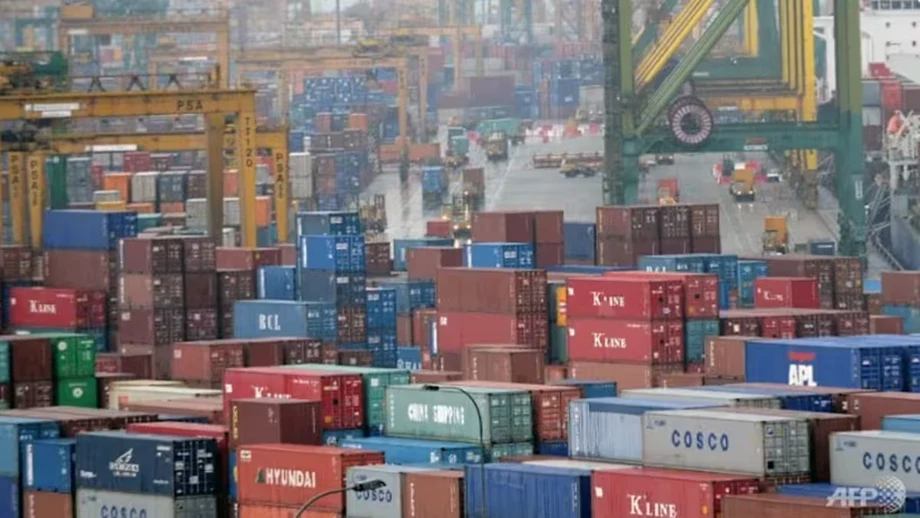
- Re-exports rise as Singapore's trading role expands
- New US chip rules bring uncertainty after the surge
- How the trade surge and policy changes unfolded
- Key Points
The increase exceeded the 37.7% growth forecast in an economist poll and accelerated from September's revised 68.3% expansion. October marked the 14th consecutive month of growth, taking the increase in non-oil domestic exports for the first 10 months of 2026 to 33.6%.
Non-electronic products led the acceleration, although electronics continued to grow strongly on demand related to artificial intelligence. The result brought together several distinct drivers: large vessel structure shipments, a sharp rise in medicines, and continued purchases of chips, computers and data storage products.
Singapore's merchandise trade surplus also widened to S$19.3 billion from S$9.03 billion in September. That was more than double the previous month's surplus and above a market forecast of S$7.90 billion.
The strong October figures arrived alongside a new concern for the electronics sector. US restrictions announced on November 16 will require licences for certain advanced semiconductor shipments to Singapore and four other countries. Singapore's authorities said the following day that they were studying the measure and discussing its scope with companies and US officials.
What the export figures measure
Non-oil domestic exports, usually shortened to NODX, cover goods produced in Singapore or substantially transformed there before being shipped overseas, excluding oil. They are tracked separately from re-exports, which are goods brought into Singapore and then sent abroad without substantial transformation.
October's 79.8% rise means the value of NODX was about 1.8 times its level in October 2025. The comparison is with the same month a year earlier, rather than with September 2026.
The growth rate accelerated by 11.5 percentage points from September. Beneath that headline, the two main product groups moved differently: non-electronic exports grew faster, while electronics continued expanding at a slower rate than in September.
Non-electronic NODX rose 81.9%, up from 54.1%. Electronic NODX increased 73.9%, compared with September's 107.6%. Those changes put ship structures, pharmaceuticals and specialised machinery at the centre of October's faster growth, alongside a still substantial contribution from technology products.
Why ship structures made such a large difference
Ship and boat structures contributed the largest increase within non-electronic exports, rising by S$4.8 billion from a year earlier. Such deliveries can vary sharply from month to month because a large shipment can add a substantial amount to the total when it leaves Singapore.
Enterprise Singapore explained why it did not publish a percentage growth rate for this category:
as the exceptionally high percentage growth reflects a low base effect in the same period last year
A low base means the starting figure was unusually small. When a large shipment is compared with that small starting point, the resulting percentage increase can be exceptionally high. Here, the S$4.8 billion increase gives readers a concrete measure of the category's contribution.
Pharmaceutical exports rose 253.1%, meaning their value was more than three and a half times the level recorded in October 2025. Specialised machinery shipments increased 57.3%. Together with vessel structures, these products explain why non-electronic exports accelerated even as electronics growth eased.
AI demand supports chips, computers and storage
Enterprise Singapore attributed continued electronics growth to sustained demand related to artificial intelligence. Electronic NODX rose 73.9%, with disk media products, integrated circuits and personal computers leading the increase.
Disk media products recorded the fastest percentage growth among those three categories, rising 189.6% and adding S$1.1 billion compared with October 2025. These products are used to store digital information, an essential part of computing systems that handle large amounts of data.
Integrated circuits, commonly called chips, increased 53.1%, adding S$1.2 billion. Personal computer exports grew 81%, an increase of S$700 million. Combined, the three categories added S$3 billion from a year earlier, compared with the S$4.8 billion increase from ship and boat structures.
The comparison helps explain the balance of October's expansion. Technology demand remained a major source of growth, while the large contribution from vessel structures helped push the headline export rate higher. Within electronics, chips delivered a larger dollar increase than disk media products despite their lower percentage growth rate.
US and China purchases accelerate sharply
The United States, Singapore's largest single export market, recorded a 214.6% increase in NODX, up from 73.2% in September. Pharmaceuticals, disk media products and personal computers drove the rise. October shipments to the US were more than three times their value a year earlier.
Exports to China increased 144.9%, compared with 36.9% in September. The main supporting products were non-monetary gold, specialised machinery and integrated circuits. Non-monetary gold refers to gold traded as a commodity rather than held as part of official monetary reserves.
The European Union also recorded much faster growth. NODX to the bloc rose 90.8%, compared with 11.1% in September. Taiwan's increase eased to 79.3% from 96.9%, although electronic NODX to Taiwan rose 149%.
These markets show how different products supported different trade routes. Medicines and computing products drove the US increase, while China's growth included gold and machinery as well as chips. Taiwan's electronics trade grew faster than its total NODX.
Three major markets move in the opposite direction
Seven of Singapore's 10 largest NODX markets recorded growth in October. India, Indonesia and Thailand were the exceptions, showing that the sharp headline increase was uneven across destinations.
Exports to India fell 35.8%, following a 5.7% decline in September. Non-electronic shipments to India dropped 51.9%, accounting for much of the weakness in that market.
NODX to Indonesia declined 19%, while shipments to Thailand fell 7.9%. Both markets had recorded growth in September, so October represented a reversal.
Singapore's exporters therefore faced different conditions depending on what they sold and where their customers were located. Strong expansion in the US, China and other growing markets outweighed the declines in these three destinations.
Re-exports rise as Singapore's trading role expands
Non-oil re-exports, known as NORX, increased 48.1% in October, close to September's 47.8% rise. This measure captures another part of Singapore's trade activity: moving goods made elsewhere through its ports, airports and distribution networks to overseas buyers.
Electronic re-exports grew 69.1%. Integrated circuits rose 73.1%, while personal computer parts increased 358.9% and other computer peripherals rose 250.6%. Computer peripherals are devices that work with computers, such as equipment used for input, output or storage.
Non-electronic re-exports grew 15%, slowing from 22% in September. Specialised machinery, works of art and pharmaceuticals were among the main contributors.
Total merchandise trade, which covers goods imported and exported, increased 50.7%, almost matching September's 50.8% expansion. Total exports rose 55.8%, while imports increased 44.9%. Exports exceeding imports produced October's S$19.3 billion merchandise trade surplus.
New US chip rules bring uncertainty after the surge
The October results captured strong technology demand before the latest US semiconductor restrictions were announced. Under the measures unveiled on November 16, licences will be required to export, re-export or transfer advanced semiconductors to Singapore, Indonesia, Malaysia, Thailand and Brazil.
The US identified those countries as places where advanced chips face a higher risk of being diverted to China. The rules bring the movement of covered chips, including some transactions beyond their initial export, under a licensing process.
Standard Chartered economists Edward Lee and Jonathan Koh said the measures could also affect access to computing power through data centres:
Within the new measures, compute access to some countries, including China, from data centres that are using covered items may also face restrictions,
Computing access means using processing capacity housed in a data centre, potentially from another country, rather than buying and operating the chips directly. That makes the rules relevant to businesses renting computing services as well as those trading physical semiconductors.
OCBC group research chief economist Selena Ling said the financial effect was still difficult to calculate:
At this juncture, the impact is difficult to quantify, but higher compliance costs are likely, with heightened uncertainty in the interim period.
Ling said most AI computing capacity physically located in Singapore was operated by large US cloud companies and tenants sharing data centre facilities that would likely qualify for an exemption. She identified greater exposure among cloud providers outside the US specialising in AI computing, trading and distribution intermediaries, and capacity rented to clients linked to China.
How the trade surge and policy changes unfolded
The timing separates the strong trade performance from the new licensing issue. October's shipments had already taken place when the US announced its measures in November.
- September 2026: NODX grew a revised 68.3% from a year earlier, while the merchandise trade surplus reached S$9.03 billion.
- October 2026: NODX growth accelerated to 79.8%, and the merchandise trade surplus widened to S$19.3 billion.
- November 16, 2026: The US announced new licensing requirements covering advanced semiconductor shipments to Singapore and four other countries.
- November 17, 2026: Enterprise Singapore released the October trade figures. Singapore's authorities said they were studying the US measure and engaging affected companies and US authorities.
Singapore's immediate task is to clarify how the licensing requirements will apply while businesses assess their exposure. For exporters, October delivered a large increase in sales across several industries; for chip traders and computing providers, November introduced new compliance work and uncertainty about some transactions.
Key Points
- Singapore's October NODX rose 79.8%, exceeding the 37.7% economist forecast and marking a 14th consecutive month of growth.
- Ship and boat structures added S$4.8 billion, while pharmaceutical exports increased 253.1%.
- Electronics grew 73.9%, supported by demand related to AI and higher shipments of storage products, chips and computers.
- NODX to the US rose 214.6% and to China 144.9%; shipments to India, Indonesia and Thailand declined.
- Non-oil re-exports increased 48.1%, and the merchandise trade surplus widened to S$19.3 billion.
- New US chip licensing requirements prompted Singapore to consult companies and US authorities about their scope and implementation.