RM40.3 billion in projects moves into implementation
The Johor-Singapore Special Economic Zone recorded RM88.83 billion, about US$21.8 billion, in approved investments between January 2025 and June 2026, with RM40.3 billion already implemented, according to a joint ministerial statement issued on November 2, 2026.
Contents
- RM40.3 billion in projects moves into implementation
- What the investment and employment figures mean
- A large zone with 11 investment sectors
- A new committee with a wider remit
- December master plan follows an earlier delay
- Rail, taxis and ferries are part of the investment plan
- Budget measures focus on industry, utilities and finance
- Business support and a forum in early 2027
- The dates shaping the next phase
- Key Points
The figures put about 45% of approved investment into implementation as Malaysia and Singapore prepare to launch the zone's master plan in December. The approved projects carry 28,755 potential employment opportunities, including 12,796 jobs associated with projects already implemented.
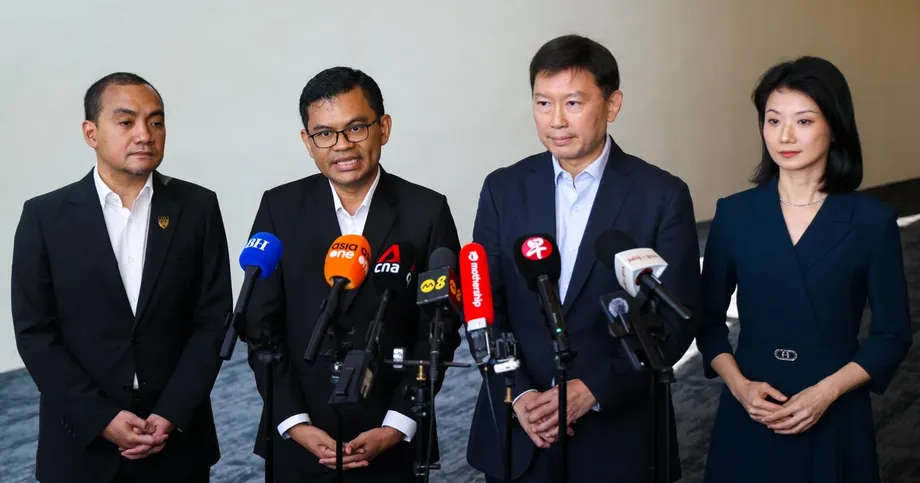
Singapore's Minister for National Development Chee Hong Tat and Malaysia's Minister of Economy Akmal Nasrullah Mohd Nasir cochaired the inaugural Johor-Singapore Cooperation Ministerial Committee meeting at Gardens by the Bay in Singapore. Johor Chief Minister Onn Hafiz Ghazi and Singapore's Senior Minister of State for Transport and National Development Sun Xueling also attended.
The investment figures cover projects under the Malaysian Investment Development Authority, the agency responsible for promoting and supporting investment. They provide a measure of progress before several milestones: the master plan's expected December launch, a joint investment forum by the first quarter of 2027 and the expected start of passenger services on the Johor Bahru-Singapore Rapid Transit System Link in February 2027.
What the investment and employment figures mean
RM48.53 billion separates the total value of approved investments from the RM40.3 billion reported as implemented. Calculated from the ministerial figures, about 55% of the approved value remained outside the implemented category at the reporting point.
An investment approval gives a proposed project permission to proceed through the relevant government process. Implementation is the next practical step, when the approved investment is being carried out. The committee's figures therefore track both the pipeline of approved projects and progress in putting those projects into effect.
The employment figures follow a similar pattern. The 12,796 jobs associated with implemented projects account for about 44.5% of the 28,755 potential jobs attached to all approvals. Another 15,959 potential positions are associated with the remaining approved projects.
The zone has a separate target of creating 20,000 skilled jobs during its first five years. The latest announcement counts potential employment across approved projects, while that target specifically concerns skilled positions. The statement did not provide a breakdown showing how many of the 28,755 potential jobs fall into the skilled category.
Akmal, Malaysia's economy minister, said the priority was to turn the zone's investment prospects into practical results for both countries.
"The real challenge and the commitment by both of us, both countries, is to deliver this prospect with a really good outcome," he said.
A large zone with 11 investment sectors
Malaysia and Singapore signed the special economic zone agreement in January 2025, following an initial proposal in July 2023. The zone spans 3,571 square kilometres and comprises nine flagship areas, each intended to serve different economic activities.
The two governments are promoting investment across 11 sectors: manufacturing, logistics, food security, tourism, energy, the digital economy, the green economy, financial services, business services, education and healthcare. Their investment promotion efforts cover both Singapore companies expanding into Johor and businesses from other countries.
The breadth of that list explains why the cooperation extends beyond attracting factories or approving individual developments. Manufacturing and logistics depend on the movement of goods; education and other services depend on workers and customers being able to travel; digital and industrial businesses need suitable infrastructure and utilities.
Chee said investors were coming from Singapore as well as other parts of the world. He linked that interest to cooperation between the two national governments and between Singapore and Johor.
A new committee with a wider remit
The Johor-Singapore Cooperation Ministerial Committee, known as the JSCMC, replaces the Joint Ministerial Committee for Iskandar Malaysia, which was established in 2007. The change was agreed in November 2025 to reflect the wider scope of cooperation.
The new committee provides strategic direction and oversees priority initiatives under the economic zone. Its membership brings together officials responsible for economic policy, investment, industry, transport and Johor's state administration, allowing issues that cross several government responsibilities to be considered together.
Malaysia's representatives include its economy minister, minister of investment, trade and industry, and Johor's chief minister. Singapore's membership includes its national development minister, minister for energy, trade and industry with responsibility for energy and industry, and transport minister. Both countries can propose further representatives when needed.
A JS-SEZ Joint Working Committee and its working groups handle the detailed work of putting the zone into operation. At the November meeting, ministers reviewed progress on targeted investment missions, engagement with businesses, implementation of investments, transport connections and talent development.
For companies, the practical value of this structure lies in coordinating decisions that involve more than one authority. A project may need investment approval, infrastructure, utility connections and arrangements for moving staff or goods, all of which sit within the committee's broader remit.
December master plan follows an earlier delay
The JS-SEZ master plan and investment blueprint are expected to be launched at the Malaysia-Singapore Leaders' Retreat in December 2026. The annual meeting, its 13th edition, is scheduled to take place in Malaysia.
Singapore Prime Minister Lawrence Wong and Malaysian Prime Minister Anwar Ibrahim are expected to jointly announce the plans. The launch had initially been scheduled for March 2026 before moving to the end of the year.
Chee described the blueprint as the zone's vision for the medium and longer term. Government agencies are working through measures covering talent development, movement of people and goods, trade, investment, transport and connectivity.
The master plan will give those separate efforts a common direction. Akmal said both governments hoped its release would build stronger investment momentum in 2027, while work to develop and implement individual initiatives would continue beyond the launch.
The investment figures also show that approvals and implementation have been progressing ahead of the blueprint. The next stage is to connect that existing activity with the longer development programme being prepared by both governments.
Rail, taxis and ferries are part of the investment plan
The Johor Bahru-Singapore Rapid Transit System Link is expected to begin passenger operations in February 2027, according to the ministers' update. The rail connection forms part of a wider effort to improve travel between Singapore and Johor.
Chee also cited improvements to cross-border taxi services announced in December 2025. Discussions on further improvements to ferry services are continuing, adding another transport option to the committee's work.
People and goods feature separately in the zone's priorities because they require different arrangements. Passenger rail and taxi services help people travel, while businesses moving products across the border also need coordinated trade and freight procedures.
For workers, better transport can make jobs on the other side of the border more accessible. For employers, reliable connections matter when recruiting staff and organising operations across Singapore and Johor. The committee is pursuing transport improvements alongside talent development rather than treating recruitment and travel as unrelated tasks.
Chee said the new ministerial platform allowed agencies from both countries, including Johor's state government, to discuss these connected areas of cooperation.
Budget measures focus on industry, utilities and finance
Malaysia's Budget 2027, tabled in October 2026, includes several initiatives supporting the economic zone. Ministers highlighted Nexus Sedenak, an integrated industrial and supply chain hub in Kulai, Johor, alongside improvements to infrastructure and transport.
The measures also cover support for strategic investments and stronger financial services in Forest City. Together, they address different parts of the zone's development, from industrial activity and the movement of supplies to the financial services businesses need.
The joint working committee presented plans for coordinating infrastructure and utilities with expected investment needs. This means planning the services that projects require alongside the developments themselves, rather than considering each investment in isolation.
The ministerial statement said infrastructure and utility development should be aligned with the zone's development plans and anticipated demand. That work becomes increasingly relevant as more of the RM88.83 billion in approved investment moves into implementation.
Business support and a forum in early 2027
Singapore's JS-SEZ Project Office and Malaysia's Invest Malaysia Facilitation Centre in Johor are supporting companies exploring opportunities in the zone. Ministers welcomed investments from Singapore and companies based there that Singapore had referred to the Johor centre.
These offices provide channels for businesses to engage the authorities involved in the zone. Their role sits alongside the committee's work on the institutional, regulatory and operating arrangements needed to put the agreement into practice.
Both governments agreed to hold the third JS-SEZ Joint Investment Forum in Malaysia by the first quarter of 2027. The forum will form part of their joint promotion efforts, following the expected publication of the master plan.
Akmal also said the partnership could be showcased during Singapore's ASEAN chairmanship in 2027. He presented the cooperation as an example of how neighbouring economies could work together on regional investment and activity across their border.
Chee, Singapore's national development minister, described the approved projects and associated employment as an opening stage in the zone's development.
This is really the beginning of many more to come.
The dates shaping the next phase
The zone's development now links an investment programme already under way with several planned policy, transport and business events. The main dates are:
- July 2023: The Johor-Singapore Special Economic Zone was first proposed.
- January 2025: Malaysia and Singapore signed the zone agreement.
- November 2025: Both countries agreed to replace the Iskandar Malaysia ministerial committee with the broader JSCMC.
- January 2025 to June 2026: Investments approved under the Malaysian Investment Development Authority reached RM88.83 billion.
- November 2, 2026: The inaugural JSCMC meeting reviewed implementation and announced the latest figures.
- December 2026: The master plan and investment blueprint are expected at the Leaders' Retreat in Malaysia.
- February 2027: RTS Link passenger services are expected to begin.
- By the first quarter of 2027: Malaysia is to host the third joint investment forum.
The December blueprint will set the broader direction, while the rail opening and investment forum are expected to support travel and business engagement early in 2027. Alongside those events, the committee will continue overseeing the detailed work on investment implementation, skills, infrastructure and movement across the border.
Key Points
- The zone recorded RM88.83 billion in approved investments from January 2025 through June 2026.
- RM40.3 billion, about 45% of the approved value, had been implemented.
- Approved projects carry 28,755 potential jobs, including 12,796 associated with implemented projects.
- The zone covers 3,571 square kilometres, with nine flagship areas and 11 investment sectors.
- The master plan is expected in December 2026 after an earlier March launch schedule.
- RTS Link passenger operations are expected in February 2027, with a joint investment forum due by the first quarter.
- Budget 2027 support includes Nexus Sedenak in Kulai, infrastructure improvements and financial services in Forest City.