A new compensation option for displaced owners
Property owners affected by renovation projects in Tashkent may be offered apartments in New Tashkent worth up to 1.5 times the assessed value of their existing properties under Presidential Decree No. PF-243, dated November 10, 2026. The arrangement covers renovation projects involving Toshkent Invest Kompaniyasi JSC, a company under the capital's city administration.
Contents
- A new compensation option for displaced owners
- How the value ceiling and floor area work
- Moving to New Tashkent is an additional choice
- Which neighbourhoods are covered?
- What protections does the renovation law provide?
- How the rules developed
- Utility debts and credit balances move too
- Who finances and manages the projects?
- What awaits households in New Tashkent?
- Key Points
Clause 10 provides for compensation through apartments in housing developments being built by the company in New Tashkent. The Tashkent city administration's information service also described possible offers ranging from the floor area of an owner's current home to 150% of that area, with the final package agreed individually.
For a household living in 50 square metres, the administration illustrated the option of a replacement apartment measuring up to 75 square metres. An owner with 70 square metres could be offered one apartment of up to 105 square metres, or two apartments measuring 45 and 60 square metres.
Owners and city representatives would negotiate the size, number of apartments and other compensation conditions. Independent organisations would help prepare proposals, taking account of the property and the owners' needs. The mechanism may cover both individuals and legal entities whose buildings fall within the relevant renovation areas.
How the value ceiling and floor area work
The decree's financial ceiling and the administration's examples measure different things. Assessed value is an estimate of what a property is worth in money. Floor area measures the space inside it. Apartments of the same size can have different values because of their location, condition and other characteristics.
A ceiling of 1.5 times the assessed value allows a compensation offer worth up to 50% more than that valuation. The floor area examples also show a possible increase of 50%: 25 additional square metres for a home of 50 square metres, or 35 additional square metres for one of 70 square metres.
The actual offer depends on the valuation and the agreement reached with the owner. Every homeowner's entitlement will therefore be settled through the individual compensation process, rather than by adding 50% to the existing apartment's area automatically.
The Tashkent city administration explained how it would consider individual proposals:
"Each case is considered individually, taking into account the characteristics of the property and the needs of its owners," the administration said.
The option of two apartments could matter to a family that wants separate homes for different generations. In the administration's example, the proposed apartments of 45 and 60 square metres add up to 105 square metres. Their combined value and the other terms would still form part of the negotiation.
Moving to New Tashkent is an additional choice
The city administration presents relocation to New Tashkent as another compensation option. Some households may favour additional living space or separate apartments. Others may place greater value on staying near their existing jobs, schools, relatives and neighbourhood services.
Tashkent Mayor Shavkat Umurzakov said in an August interview that residents affected by renovation could choose a new apartment in the same district, with an area no smaller than their previous home. The city's renovation procedures also call for proposals for replacement housing near the owner's current place of residence.
Umurzakov linked the right to housing with access to schools, kindergartens, green spaces and recreation areas. For a family deciding whether to move, those services shape daily life alongside the size of the apartment itself.
The mayor said the city planned to relocate 12,000 to 15,000 people into new homes each year through a programme intended for residents of older buildings with poor living conditions. That annual target concerns people, while the compensation examples concern individual properties and households.
Which neighbourhoods are covered?
Procedures approved by Umurzakov on August 25 cover designated areas in three districts: Jarkurgon mahalla in Yashnabad, A. Fitrat mahalla in Mirabad and Khonobodtepa mahalla in Sergeli. A mahalla is a local neighbourhood community.
The framework identifies parts of these neighbourhoods for comprehensive development. Investment companies operating under the city administration, including Tashkent Invest, are responsible for coordinating projects, identifying affected owners and negotiating compensation and relocation arrangements.
Special headquarters are to be established in the affected mahallas to explain the projects and assist residents with compensation issues. District administrations will notify owners about contacting them. Tashkent's Main Department of Internal Affairs and the Mahalla Association will help establish contact with owners who cannot initially be located.
The procedures require compensation agreements to be notarized. This gives the agreed terms a formal legal record, making the description of the replacement property and the conditions of the move important parts of the process.
What protections does the renovation law provide?
Uzbekistan's urban renovation law sets rules for the process from the initial proposal through compensation and the completion of new properties. Its provisions include open discussions with residents, consent from 80% of owners, temporary housing, investor participation and the resolution of disputes through courts.
The law also prohibits pressure on residents who disagree with renovation proposals. In simple terms, the framework combines a collective consent requirement with rules governing how individual owners are treated and how disagreements are handled.
The city administration says the New Tashkent option keeps three existing principles in place: protection of owners' rights, transparent procedures and agreement on compensation terms. Those principles put the negotiation itself at the centre of the offer, including the valuation, the replacement apartments and the arrangements for relocation.
Temporary housing is particularly relevant when residents must leave before a replacement apartment is available. The announcement gives no general timetable for handing over the New Tashkent compensation apartments or details of temporary accommodation for individual households.
How the rules developed
The New Tashkent compensation mechanism follows a series of national and municipal decisions. The Legislative Chamber passed the renovation law in September 2025, and the Senate approved it in April 2026. It came into force in October 2026.
The main milestones are:
- September 9, 2025: The Legislative Chamber passed the urban renovation law.
- February 2026: Presidential measures established a broader framework for comprehensive development projects.
- April 7, 2026: The Senate approved the renovation law.
- August 25, 2026: The Tashkent mayor approved procedures covering designated areas in three districts.
- October 2026: The renovation law came into force.
- November 10, 2026: Presidential Decree No. PF-243 introduced the New Tashkent compensation provision.
- March 1, 2028: The special regulatory sandbox for comprehensive development projects is scheduled to end.
A regulatory sandbox allows projects to operate under a defined set of special rules for a limited period. Here, the March 2028 date marks the duration of that special framework. Each household's relocation arrangements remain a matter for its compensation agreement.
Utility debts and credit balances move too
Residents moving under the approved procedures will carry their utility account positions to their new apartments. Outstanding payments for electricity, gas, water, heating and waste collection will transfer to the new payment accounts.
Existing overpayments and account balances will transfer as well. A household that has paid ahead therefore keeps that credit, while a household with unpaid bills remains responsible for the outstanding amount.
For owners comparing compensation offers, these account transfers are a separate practical issue from apartment size and property valuation. Recording both debts and credits accurately will determine the starting position of the household's utility accounts after relocation.
Who finances and manages the projects?
The Reconstruction and Development Fund is to provide $20 million for each comprehensive development project. The financing carries annual interest of 5% over five years, including a grace period of two years. These are terms for financing the development projects; residents' compensation is handled through the agreements negotiated with owners.
Tashkent Invest and other investment companies under the city administration will coordinate implementation. Their responsibilities bring together property identification, replacement housing proposals and compensation negotiations, alongside the neighbourhood headquarters intended to help residents through the process.
Umurzakov said the city had previously planned to turn renovation projects over to private companies because the administration lacked the capacity to implement them independently. He later described that approach as a mistake and explained his concern about the incentives involved:
"In the private sector, whether you like it or not, there will always be an incentive to buy cheaper and relocate residents to a cheaper location. We do not have that," Umurzakov said.
The mayor's comments explain the city's preference for a stronger municipal role. The renovation law still provides for investor participation, while the approved procedures assign coordination and negotiations to companies operating under the administration.
What awaits households in New Tashkent?
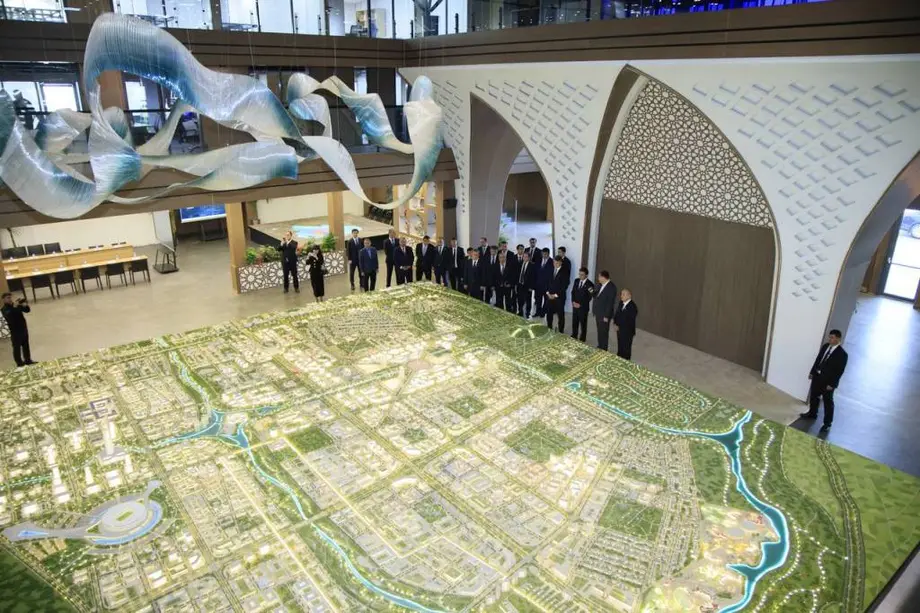
New Tashkent is already receiving housing and public facilities. At an October 12, 2026 ceremony, President Shavkat Mirziyoyev attended the opening of seven facilities valued at $1 billion and the launch of ten more projects worth $2.5 billion.
The development's first completed neighbourhoods include nearly 7,000 apartments in the first phase of Sharq Bahori, alongside landscaped courtyards and playgrounds. That housing development covers 95 hectares and is planned to contain almost 15,000 homes.
The wider city project covers about 20,000 hectares. Its first phase spans 6,000 hectares and is designed for 600,000 residents, with projects worth $50 billion planned. Completed housing, new construction and the longer development programme are progressing on different schedules, so the location and readiness of a particular replacement apartment will matter to each relocating household.
New Tashkent is also preparing to establish its own administrative structure, with a separate city administration planned under a presidential decree. As residents arrive, the city will need to manage both the construction programme and the everyday services that make a neighbourhood workable.
Key Points
- Decree No. PF-243, dated November 10, 2026, allows New Tashkent apartments worth up to 1.5 times the assessed value of affected properties.
- The city illustrated possible floor areas of up to 150% of an existing home, with each offer negotiated individually.
- Owners may discuss one replacement apartment or multiple apartments, depending on their circumstances and the agreement.
- Renovation procedures cover designated areas in Yashnabad, Mirabad and Sergeli, with notarized compensation agreements.
- The renovation law includes resident discussions, consent from 80% of owners, temporary housing and a ban on pressure against dissenting residents.
- Utility debts, overpayments and balances transfer to residents' new apartment accounts.
- The special framework for comprehensive development projects runs through March 1, 2028.