A record financing deal for solar power in Pursat
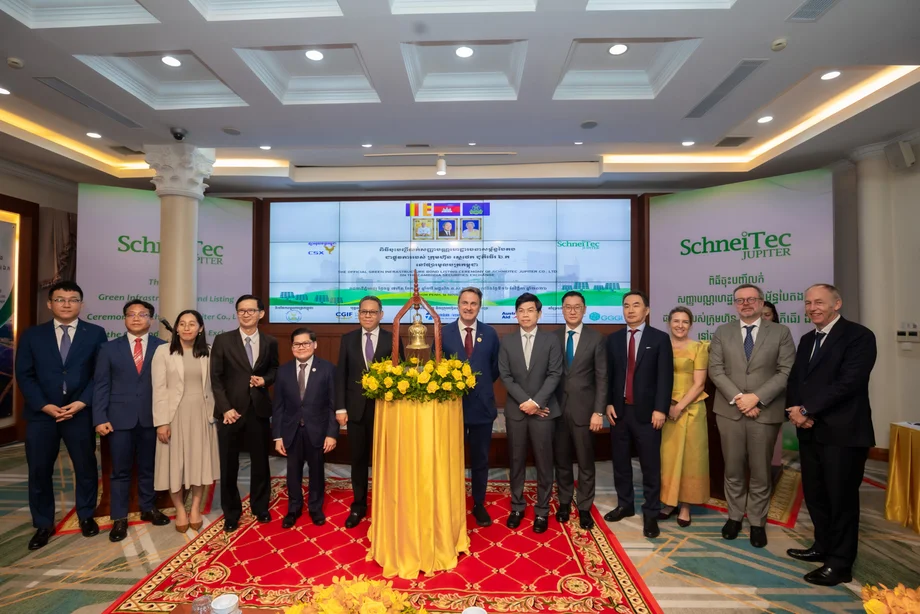
SchneiTec Jupiter listed a $99 million green infrastructure project bond on the Cambodia Securities Exchange on November 16, 2026, to refinance investment in a solar power plant in Krakor district, Pursat province. The issuance, described at the ceremony as Cambodia's largest infrastructure bond to date, forms part of a $150 million financing package.
Contents
- A record financing deal for solar power in Pursat
- What the $99 million will finance
- How the plant fits into Chheu Tom
- The July 2025 rules behind the listing
- A second green bond for SchneiTec Group
- Luxembourg supports preparation for sustainable finance
- Energy security is a central government goal
- From regulation to a record listing
- Cambodia wants a wider market for infrastructure funding
- Key Points
The Cambodian owned company is financing a plant with a generating capacity of 350 megawatts (MW), expected to produce electricity equivalent to the needs of more than 200,000 Cambodian households. The facility belongs to the 930 MW Chheu Tom Solar Complex, described at the listing as Southeast Asia's largest solar power development.
The transaction brings together a domestic energy developer, Cambodia's securities regulator and exchange, Australian support for infrastructure financing rules, and a sustainable bond programme backed by Luxembourg. Together, those efforts have created a route for private investment to support a major electricity project through Cambodia's capital market.
Two different financing figures need explaining. The listing announcement puts the bond at $99 million within a $150 million package. CAPRED, the Cambodia Australia Partnership for Resilient Economic Development, describes an estimated $150 million infrastructure bond in its energy financing statement. The statement gives no breakdown reconciling that estimate with the amount listed.
What the $99 million will finance
SchneiTec Jupiter is a special purpose company, meaning a business established for a particular project or activity. The bond proceeds will refinance investment in the solar farm. In plain language, refinancing means replacing financing already used for an investment with a new source of money.
The listed bond accounts for 66% of the stated $150 million package: $99 million divided by $150 million. That leaves $51 million elsewhere in the package. The composition of that balance, the bond's interest rate and repayment date, the plant's operating timetable, and the method used to calculate the household electricity estimate were not specified in the announcements.
A bond is a loan made by investors to an issuer, which agrees to repay under set terms. Listing it on an exchange brings that financing into the securities market. For SchneiTec Jupiter, the transaction provides a way to refinance a large infrastructure investment through investors rather than relying solely on other sources of funding.
Heng Socheat, chief executive of SchneiTec Jupiter, said the transaction connects financing with investment in electricity infrastructure and Cambodia's economic goals.
This bond demonstrates how innovative financing can unlock investment in major clean energy infrastructure, while contributing to Cambodia's energy security and sustainable economic growth,
How the plant fits into Chheu Tom
The 350 MW plant represents about 37.6% of the Chheu Tom Solar Complex's stated 930 MW capacity. That makes the facility being refinanced a substantial part of the wider development, while the complex's total capacity is roughly 2.7 times that of this individual plant.
Megawatts measure how much power a plant can produce at a given moment. The amount of electricity generated across a day or year also depends on operating conditions, including sunshine. The estimate of more than 200,000 households expresses the expected scale of production in terms that are easier to picture.
Pursat province is therefore central to both sides of the transaction: it hosts the physical electricity project, while the exchange listing connects that investment to Cambodia's financial market. The immediate financial change is the refinancing of investment in a major domestic source of solar electricity.
The July 2025 rules behind the listing
Cambodia introduced the Prakas on the Offering of Infrastructure Debt Securities in July 2025. A prakas is a ministerial regulation. This one established a framework allowing public and private companies to raise financing over longer periods for eligible infrastructure projects.
Australia provided technical assistance to the Securities and Exchange Regulator of Cambodia (SERC) through CAPRED to develop the regulation. CAPRED says the Ministry of Economy and Finance approved the Infrastructure Bond Prakas with Australian support, with the aim of generating domestic financing for critical infrastructure.
Australia is also helping cover part of the issuance costs for early companies using the framework, including SchneiTec. That support addresses a practical expense of entering the securities market: companies must prepare an issuance and meet the relevant regulatory and listing requirements before raising money.
Derek Yip, Australia's ambassador to Cambodia, said the Australian government had contributed to both the rules and the transaction, and encouraged wider participation.
Australia is pleased to have worked with SERC to develop the regulatory framework for infrastructure bonds, and to have contributed to this record bond issuance. We encourage more businesses and investors to follow,
A second green bond for SchneiTec Group
SchneiTec Jupiter's issuance follows a $50 million bond listed the previous year by SchneiTec Dynamic, another company within SchneiTec Group. That earlier transaction received technical assistance from the Cambodia Sustainable Bond Accelerator.
The new $99 million issuance is $49 million larger, or 98% above the earlier $50 million bond. Together, the two listed amounts total $149 million. The comparison shows how quickly the scale of the group's use of sustainable bonds has grown between the two transactions.
Both bonds were structured to align with the International Capital Market Association's Green Bond Principles and the ASEAN Capital Markets Forum's ASEAN Green Bond Standards. These frameworks guide how issuers identify environmentally beneficial uses for money raised and communicate about that funding.
S&P Global Ratings gave both bonds a "Dark Green" assessment under its Shades of Green methodology. That assessment concerns the environmental qualities of the financing. Investors also need to consider the issuer's financial position and the terms governing repayment when deciding whether to buy a bond.
Luxembourg supports preparation for sustainable finance
Luxembourg's Global Trust Fund for Sustainable Finance Instruments supports the Cambodia Sustainable Bond Accelerator, with technical assistance delivered through the Global Green Growth Institute (GGGI). The Jupiter listing builds on that programme's earlier work.
Australia's contribution and Luxembourg's support address different parts of the same financing process. Australian assistance helped develop the infrastructure bond framework and supports some issuance costs. The accelerator brings technical assistance for sustainable bond preparation. The transaction combines those efforts around a specific solar investment.
Xavier Bettel, Luxembourg's deputy prime minister and minister responsible for development cooperation and humanitarian affairs, said cooperation through GGGI was connecting Cambodia's clean energy ambitions with financing. He also expressed hope that other businesses and investors would participate.
We hope this issuance will give more businesses and investors the confidence to participate in this growing market,
Energy security is a central government goal
Hean Sahib, a secretary of state at the Ministry of Economy and Finance and chairman of the Cambodia Securities Exchange, linked the listing to the government's goal of increasing renewable energy's share of national electricity generation. He said that policy aims to reduce reliance on fossil fuels and energy imports while strengthening energy security.
CAPRED's statement places the solar investment against disruption in global energy markets and supply chains. Australia's stated objective is to help Cambodia build greater resilience over time and reduce its reliance on imported fuels.
For Cambodia, the practical connection is between producing more electricity domestically and reducing exposure to supplies purchased abroad. Solar generation uses a resource available within the country, while financing arrangements determine how companies pay for the equipment and infrastructure needed to produce that electricity.
Sou Socheat, SERC's director general, said the listing contributes to phase one of the government's Pentagonal Strategy and Cambodia Vision 2050 through renewable electricity production and reduced dependence on electricity imports. He also described green bonds as another financing option for companies and a new investment opportunity for investors.
From regulation to a record listing
The transaction developed through several stages rather than a single announcement. The sequence connects the creation of financing rules, an earlier bond within SchneiTec Group and the latest issuance.
- July 2025: Cambodia introduced the Prakas on the Offering of Infrastructure Debt Securities, developed with Australian technical assistance through CAPRED.
- 2025: SchneiTec Dynamic listed a $50 million bond with technical assistance from the Cambodia Sustainable Bond Accelerator.
- November 16, 2026: SchneiTec Jupiter marked the listing of its $99 million green infrastructure project bond at the Cambodia Securities Exchange.
Representatives of Cambodia, Australia and Luxembourg attended the latest ceremony, alongside SERC, the exchange, GGGI and SchneiTec Jupiter. The participation reflected the combination of domestic regulation, company financing and international technical support behind the issuance.
Cambodia wants a wider market for infrastructure funding
Cambodia's financing needs extend well beyond this solar plant. Its Comprehensive Intermodal Transport and Logistics Master Plan for 2023 to 2033 estimates investment needs of about $36 billion in transport and logistics alone. Hean Sahib said public funding cannot meet every investment requirement and presented thematic bonds as a way to connect private capital with projects delivering environmental or social benefits.
The government identified five priorities for developing the securities market: stronger legal rules and corporate governance; a broader range of financial and green finance products; incentives for issuers and a larger investor base; digital finance and technology; and greater public financial knowledge.
Hong Sok Hour, director general of the Cambodia Securities Exchange, encouraged eligible local small and medium sized enterprises and international companies to raise capital through the market. His invitation places the Jupiter transaction within a wider effort to attract more businesses, rather than leaving infrastructure bonds as a financing route used by only a few issuers.
The solar listing gives that effort a concrete example: a regulation introduced in July 2025 has supported a $99 million issuance tied to a 350 MW project. Further participation would depend on companies meeting issuance requirements and investors choosing to commit their money under the terms offered.
Key Points
- SchneiTec Jupiter listed a $99 million green infrastructure project bond on November 16, 2026, as part of a stated $150 million financing package.
- The proceeds will refinance investment in a 350 MW solar plant in Krakor district, Pursat province.
- The plant is expected to generate electricity equivalent to the needs of more than 200,000 Cambodian households.
- The facility accounts for about 37.6% of the 930 MW Chheu Tom Solar Complex's stated capacity.
- Australia supported Cambodia's infrastructure bond regulation and some issuance costs, while Luxembourg backed sustainable bond technical assistance through GGGI.
- SchneiTec Jupiter's bond follows a $50 million issuance by SchneiTec Dynamic. Both received S&P Global Ratings' Dark Green assessment.
- CAPRED describes an estimated $150 million bond, while the listing announcement identifies a $99 million bond within a $150 million package.