Thirteen days bring 2.5 million admissions
Godzilla Minus Zero has passed ¥4 billion at the Japanese box office and 2.5 million admissions in its first 13 days, while worldwide ticket sales have exceeded ¥15 billion, according to figures announced by distributor Toho on November 16, 2026. The sequel also set Japan's record for an opening week of IMAX earnings by a live action film.
Contents
- Thirteen days bring 2.5 million admissions
- How the Japanese opening grew
- What the IMAX record measures
- A wider launch in North America
- Premium screens create opportunity and pressure
- A global release built through regional distributors
- The milestones, in order
- Human survivors share the screen with Ghidorah
- Strong audience scores accompany the sales
- Key Points
The domestic totals cover November 3 through November 15. The film held first place in Japan's weekend box office rankings for a second consecutive weekend, including November 13 to 15, extending a launch that had already put it at the top in both Japan and North America.
Director Takashi Yamazaki returns as writer and visual effects supervisor after Godzilla Minus One, bringing back Ryunosuke Kamiki and Minami Hamabe for a story set in 1949. This time, Japan's recovery from World War II faces another threat: King Ghidorah.
The commercial breakthrough stretches beyond familiar monster movie audiences. North American cinemas took approximately $31.6 million during the opening weekend, including advance screenings, setting a record for a live action film in a foreign language. Premium screens helped make a subtitled Japanese production one of the biggest theatrical events of its release period.
How the Japanese opening grew
Toho's November 9 release puts the first six days in Japan at more than ¥2.5 billion and 1.61 million admissions. Within that period, the November 6 to 8 weekend drew 690,000 admissions and more than ¥1.1 billion, leading both the attendance and revenue rankings.
Japan's opening day brought in ¥910 million, a record for a live action release in the country. Toho said the full day's revenue exceeded 201% of the comparable opening for Godzilla Minus One, meaning it was more than twice as large.
The sequel's strong opening morning had already shown that demand was running ahead of its predecessor. That earlier update covered receipts by 11 a.m. and excluded midnight screenings at 31 IMAX theaters; the later announcement covered the completed opening day.
Godzilla Minus One finished its Japanese theatrical run with ¥7.65 billion. The sequel's new ¥4 billion milestone is already equivalent to more than half that total, reached in less than two weeks. Its eventual earnings will depend on attendance after the initial rush and how long cinemas keep it on their schedules.
What the IMAX record measures
IMAX's comparison covers the first seven days, November 3 to 9. Over that matching opening period, Godzilla Minus Zero earned more from Japanese IMAX screenings than any previous live action film, including Hollywood releases.
When animated films are included, it ranks second for a Japanese IMAX opening week, behind Demon Slayer: Kimetsu no Yaiba Infinity Castle, Chapter One: Akaza Returns. The record therefore concerns earnings over the same first seven days, rather than revenue accumulated across an entire theatrical run.
Godzilla Minus Zero opened at 448 Japanese theaters, including 65 IMAX locations. Those IMAX locations account for about 14.5% of the total, giving a relatively small part of the release network a prominent role in its presentation and promotion.
The film is described as Japan's first production certified under the Filmed For IMAX program. The designation means it used cameras approved by IMAX and was designed and prepared for the company's screening system, including its large screens. For audiences, the practical difference is a presentation planned around the scale and sound of those auditoriums.
A wider launch in North America
North American distributor GKIDS released Godzilla Minus Zero at 3,254 theaters on November 6. Toho called it the largest release of a Japanese film in that market, and GKIDS president Dave Jesteadt said the footprint was roughly 1,000 theaters larger than that of Godzilla Minus One.
The November 6 to 8 opening generated approximately $31.6 million in the United States and Canada, including previews. It was the first Japanese live action film to lead the North American weekend box office and set a new opening record there for a live action film in a foreign language.
The opening was nearly three times the North American debut of Godzilla Minus One. For another measure of its speed, the predecessor earned about $57 million over its full North American run; the sequel collected an amount equivalent to roughly 55% of that total during its opening weekend alone.
Godzilla Minus Zero is being shown in Japanese with English subtitles. Its release combines that original language presentation with the broad theater access and premium screenings usually associated with major mainstream productions.
Premium screens create opportunity and pressure
IMAX accounted for 34% of the film's opening weekend box office, while the North American distribution discussion cited a figure above 70% for the broader group of premium formats. That larger category includes IMAX alongside other systems, such as auditoriums with motion seats.
Premium formats offer different experiences. IMAX centers on picture and sound presentation; Dolby Atmos places sound around the audience; 4DX and MX4D add physical effects, including moving seats. Japanese screenings in Dolby Atmos, 4DX and MX4D began on November 13, adding options as the film entered its second weekend.
Jesteadt, the GKIDS president overseeing the North American release, said access to those screens also depends on competing releases. He described the scheduling pressure directly:
Obviously, PLFs are time-sensitive. It's not just about performance, but also about new titles coming in. We're up against the biggest studios in the world.
PLF means premium large format, an industry label for upgraded theatrical presentations. Jesteadt said availability would vary by market as Hollywood competition increased around Thanksgiving. No single end date was given for the film's North American IMAX engagement.
GKIDS is also encouraging attendance at regular screenings. Keeping the audience growing after premium auditoriums move to other releases is a concrete task for the distributor, especially when so much early business has come from those formats.
A global release built through regional distributors
Worldwide opening weekend revenue reached approximately $63 million, including the $31.6 million from the United States and Canada. By November 15, Toho put the cumulative worldwide total above ¥15 billion, converting overseas receipts into yen at the exchange rate used for that update.
The reported international footprint varies: Toho's November 9 corporate announcement described theatrical release in more than 100 countries and territories, while the November 16 box office update cited about 70. The announcements give no explanation for the different counts.
Eight Asian countries and territories recorded first place opening weekends, including Hong Kong, Taiwan, Malaysia and Indonesia. Those results show that the film's success extends across several markets rather than resting entirely on Japan and North America.
Toho Global president Koji Ueda described the release strategy and audience response in a statement:
This historic opening shows how deeply audiences around the world connect with Godzilla and with Takashi Yamazaki's vision. Our first near-simultaneous global release was built on that belief.
Toho assigned North American distribution to GKIDS, European distribution to Anime Limited and distribution in parts of Asia to Toho Entertainment Asia. Its corporate announcement dates GKIDS becoming a wholly owned group company to 2024; Jesteadt specified October of that year.
Jesteadt said GKIDS absorbed the team that handled Godzilla Minus One and used a 2025 theatrical rerelease of Shin Godzilla as a test for bringing modern Japanese Godzilla films to cinemas. The new launch builds on that work, supported by direct contact with fans through Toho International's Godzilla website and merchandise operations.
The milestones, in order
Godzilla Minus Zero moved from a festival premiere to a closely coordinated theatrical rollout. Its New York Film Festival appearance placed it before an audience beyond the franchise's established fans, followed by global IMAX early access screenings on November 3, known as Godzilla Day.
- November 3: The Japanese release began at 448 theaters, including 65 IMAX locations. Opening day revenue reached ¥910 million.
- November 6: The North American release began at 3,254 theaters.
- November 8: Japan's first six days passed 1.61 million admissions and ¥2.5 billion. The North American opening weekend reached approximately $31.6 million, including previews.
- November 9: The worldwide total passed ¥10 billion within seven days of the Japanese opening, including previews but excluding Japan's November 9 receipts.
- November 13: Dolby Atmos, 4DX and MX4D screenings began in Japan.
- November 15: Japanese admissions passed 2.5 million, domestic revenue passed ¥4 billion and worldwide revenue exceeded ¥15 billion.
The film's official social media announcement described the seven day climb past ¥10 billion worldwide as the fastest for a Japanese film. The accounting cutoff matters because that milestone combined overseas results and previews while leaving out one day's Japanese receipts.
Human survivors share the screen with Ghidorah
Yamazaki's sequel takes place two years after Godzilla Minus One. As established in the sequel's story details, the surviving Shikishima family has begun building a home when another catastrophe arrives. King Ghidorah turns that fragile recovery into a larger struggle involving both monsters and people.
Kamiki returns as Koichi Shikishima, with Hamabe as Noriko. Newly released stills show the pair facing each other with serious expressions, keeping their relationship visible alongside the destruction.
Other images show Hidetaka Yoshioka as Kenji Noda, director of a secretariat responding to major disasters, and Masami Nagasawa as Makoto Aoyama, a brilliant weather forecaster. Both appear frightened by an approaching threat. Their roles connect the human response to the scale and weather related danger of the new monster.
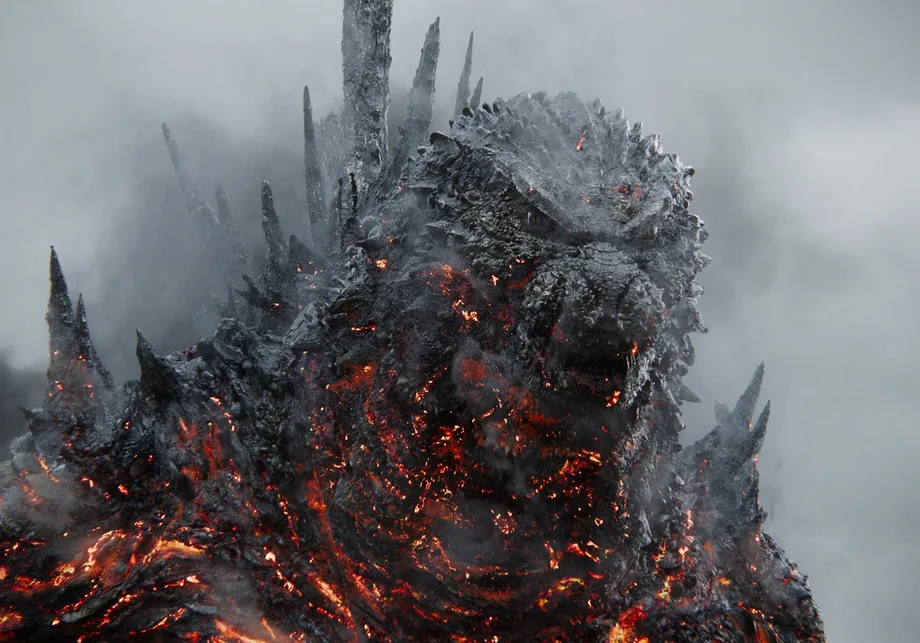
The creature images show Godzilla bearing extensive scars across its face and body, while King Ghidorah fires destructive beams. The confrontation expands the spectacle, but the returning characters give the destruction personal consequences: people who survived one disaster now have homes and relationships to protect.
Toho lists all filming locations as being in Japan, across Tokyo and eight prefectures, including Ibaraki, Nagano and Kyoto. Location work included large crowd scenes in Ibaraki and filming in Maizuru, Kyoto prefecture. Yamazaki again combines responsibility for the story, direction and visual effects, with Shirogumi handling VFX and Naoki Sato composing the music.
Strong audience scores accompany the sales
Rotten Tomatoes recorded a 91% critics' score and a 96% audience score in the release update. Japanese review platform Filmarks showed 4.0 out of 5, while North American audience survey CinemaScore gave the film an A, one grade below its highest rating of A+.
Those measurements answer different questions. Rotten Tomatoes percentages show the share of reviews classified as positive, while Filmarks uses a numerical rating scale and CinemaScore surveys cinema audiences. Together, they show a favorable reception across several groups of viewers.
Jesteadt described the distributor's aim as reaching both committed Godzilla fans and people who had not previously engaged with Japanese entries in the franchise. The festival premiere, reviews and emphasis on the human story were part of that effort.
The immediate business test is whether that enthusiasm keeps drawing people once the opening celebrations pass and premium screens become harder to secure. Japan's second consecutive weekend at number one provides an early sign of continuing demand, while the wider international rollout gives the film more markets in which to build its run.
Key Points
- Godzilla Minus Zero passed ¥4 billion and 2.5 million admissions in Japan by November 15, its 13th day.
- Worldwide box office revenue exceeded ¥15 billion, according to Toho.
- Its first seven days set Japan's IMAX opening week record for a live action film.
- The $31.6 million North American opening set a record for a live action film in a foreign language.
- Eight Asian countries and territories recorded first place opening weekends.
- Premium screen availability faces growing competition as North America approaches Thanksgiving.