Memory chips drive a $47 billion export increase
South Korea exported $70.35 billion worth of information and communications technology products in October 2026, up 202% from a year earlier, as spending on artificial intelligence infrastructure sent demand for memory chips and server storage soaring. Semiconductors accounted for $56.47 billion, or 80.3% of the ICT total.
Contents
- Memory chips drive a $47 billion export increase
- Why memory dominates the AI boom
- Higher prices add to export earnings
- Server storage becomes another major engine
- China leads while US demand accelerates
- Phones and displays grow at a gentler pace
- Smaller exporters see a different picture
- A technology surplus larger than the national total
- November brings a trillion dollar milestone into view
- Key Points
The October ICT trade figures, announced on November 15 by the Ministry of Science and ICT and the Ministry of Trade, Industry and Energy, show how heavily the country's export growth now depends on the equipment behind AI services. Memory chips alone brought in $50.14 billion, while exports of solid-state drives, which store data electronically, reached $5.64 billion.
October's ICT exports were $47.06 billion higher than the $23.29 billion recorded in October 2025. Their value was about 3.02 times the earlier total, marking the first annual growth rate above 200% in the series.
ICT products made up 61% of South Korea's $115.28 billion in total goods exports. The trade ministry's October trade report puts growth across all goods at 93.7%, showing that technology exports expanded much faster than the wider export economy.
October was the strongest October on record and the second largest month for ICT exports. September remained the monthly peak at $75.15 billion. October's total was $4.80 billion, or about 6.4%, lower, even as its growth against the same month a year earlier set a record.
Why memory dominates the AI boom
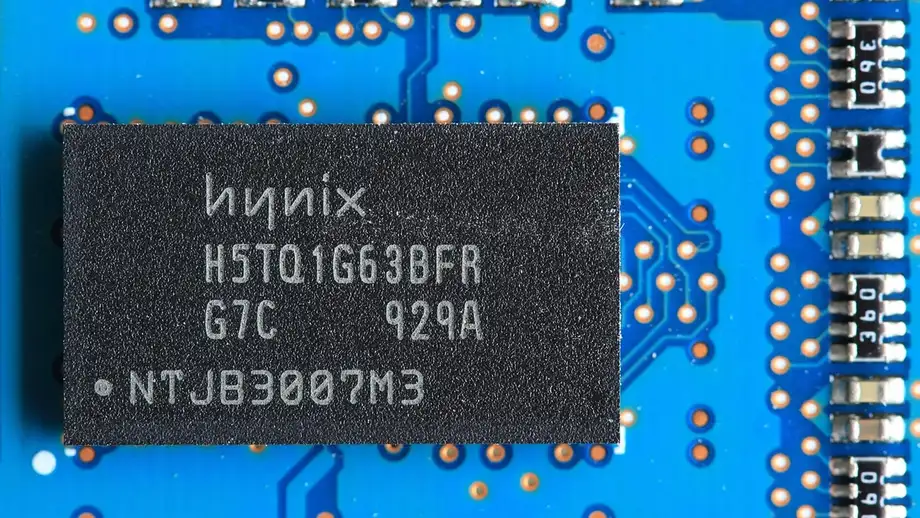
Semiconductor exports rose 259.4% from October 2025. Within that total, memory exports increased 360.5% to $50.14 billion, and dynamic random access memory, known as DRAM, rose 595.3% to $33.77 billion.
DRAM gives computers a temporary workspace for information they need to access quickly. AI systems process enormous quantities of data, creating demand for fast memory alongside the processors that carry out calculations. High-bandwidth memory, or HBM, supplies data rapidly to powerful processors and was among the products supporting the export surge.
Memory represented about 71.3% of all ICT exports, calculated from $50.14 billion out of $70.35 billion. DRAM alone accounted for roughly 48%. Those shares show that a large part of South Korea's technology export earnings came from a specific group of components rather than an even expansion across electronics.
The ICT release put semiconductor exports at $56.47 billion, while the trade ministry's broader goods release recorded $56.44 billion. Both gave the same annual growth rate of 259.4%. The ministry attributed the strength to continuing investment by major global technology companies, with both shipment volumes and prices remaining high.
Higher prices add to export earnings
Memory prices helped lift the dollar value of shipments. The trade ministry recorded a fixed price of $50 for DDR5 16Gb memory in October, up from $40 in June. That is a 25% increase over four months. Fixed prices are prices agreed for supply contracts, rather than the changing prices of individual market transactions.
The ICT figures also cited 8Gb DRAM at $27.50 in October, compared with $24 in July, an increase of about 14.6%. For NAND flash, the memory used to retain stored information when power is switched off, the quoted price for a 128Gb product rose from $30.10 in July to $30.60 in October.
The figures describe different memory products, each with its own specifications and price. The ministries attributed export strength to demand and firm prices, but did not publish a numerical breakdown of how much of the ICT increase came from higher prices and how much came from additional units shipped.
Server storage becomes another major engine
Computers and peripherals generated $5.99 billion in exports, up 439.3% from a year earlier. Solid-state drives, or SSDs, contributed $5.64 billion of that amount, with their export value rising 584.3%.
SSDs retain the files and data that servers need over time, while DRAM holds information being actively processed. Data centers need both. Investment in AI computing therefore supported two major Korean export streams: memory for active processing and storage for keeping large collections of information.
SSDs accounted for about 94.2% of computer and peripheral exports, calculated from $5.64 billion out of $5.99 billion. High capacity drives for servers led the growth, tying this category closely to infrastructure spending rather than simply to household purchases of computers.
The broader goods report recorded computer exports of $5.85 billion, up 496.6%, under its computer category. It also reported a record $1.99 billion in electrical equipment exports, up 74%, supported by demand for transformers, wires and cables for AI data centers. The investment boom was reaching equipment needed to supply electricity as well as the electronics doing the computing.
China leads while US demand accelerates
China, including Hong Kong, remained the largest destination for ICT exports at $27.21 billion, up 213.1%. The same destination total was also given as $27.11 billion. Semiconductors and computers drove the expansion.
The United States received $15.56 billion in ICT products, an increase of 522.4%, meaning shipments were worth more than six times their value a year earlier. Semiconductor exports to the United States rose 734.1%, while SSD exports to that market reached $3.83 billion.
American buyers accounted for about 67.9% of South Korea's $5.64 billion in SSD exports. That concentration connects much of the storage surge to a single destination. Across ICT products, China including Hong Kong and the United States together received approximately 61% of exports, using the $27.21 billion China figure.
Taiwan received $7.64 billion, up 78.6%, and Vietnam $6.34 billion, up 78.2%. ICT exports to the European Union rose 125% to $2.79 billion. India received $880 million, up 107%, while Japan received $590 million, up 94.3%.
The broader goods figures use a different geographical grouping for China, excluding Hong Kong: exports across all products to mainland China were $26.98 billion, up 133.6%. Total goods exports to the United States reached $24.90 billion, up 185.8%.
Phones and displays grow at a gentler pace
Display exports increased 23.6% to $2.03 billion. Rising sales of foldable smartphones supported demand for organic light-emitting diode panels, known as OLEDs, while new notebook models helped exports of OLED panels for computers.
OLED displays produce light through their individual picture elements. Their use in foldable phones and newer laptops connected display growth to particular product launches and consumer purchases, rather than to the same server investment driving memory and storage.
Mobile phone exports rose 6.5% to $1.71 billion. Sales volumes of premium finished phones increased despite higher average prices. Telecommunications equipment exports also grew, rising 26.5% to $230 million.
The trade ministry's wider wireless communications category recorded exports of $1.95 billion, up 6.7%, extending its growth to 12 consecutive months. The ministry cited Apple's new product launches and strong Samsung smartphone sales. These gains broadened the technology expansion, although their growth rates were far below those of semiconductors and SSDs.
Smaller exporters see a different picture
Small and medium sized companies exported $5.61 billion in ICT products, up 10.3%. Their semiconductor exports fell 6.2%, a sharp contrast with the 259.4% increase in semiconductor exports across the industry.
Smaller firms accounted for about 8% of October's total ICT exports, calculated from $5.61 billion out of $70.35 billion. Their slower growth shows that the surge in national export earnings was distributed unevenly across businesses.
The chip figures also showed foundry shipments falling 6.9%, while system chip exports rose 32.5%. Foundries manufacture chips designed by customers. System chips perform processing or control tasks, whereas memory chips primarily hold information. The differences show why a boom centered on memory can leave other parts of the semiconductor business growing more slowly or contracting.
Minister of Trade, Industry and Energy Kim Jung-kwan said smaller and medium sized businesses continued to face difficulties from stronger national preference policies abroad, changes in global supply chains and geopolitical instability in the Middle East. He pledged stronger trade cooperation and action on export difficulties so that more companies could benefit from export growth.
A technology surplus larger than the national total
ICT imports rose 52.7% to $19.80 billion, compared with $12.96 billion a year earlier. Subtracting those imports from exports left an ICT trade surplus of $50.55 billion.
The surplus stayed above $50 billion for a second consecutive month, although it was $3.16 billion below September's record $53.71 billion. Exports were growing much faster than imports, giving the technology sector a large positive trade balance.
Across all goods, South Korea imported $72.78 billion and recorded a surplus of $42.50 billion, according to the trade ministry. The ICT surplus exceeded the national goods surplus by $8.05 billion. Subtracting the ICT balance from the total leaves a combined deficit of that size for goods outside ICT.
Imports elsewhere in the economy were rising too. Energy imports reached $16.49 billion, up 63.1%. Crude oil import volumes fell 6.3%, but higher prices lifted their value by 51.9% to $10.70 billion. Imports of semiconductor manufacturing equipment increased 49.2% to $2.52 billion, adding another measure of activity around the chip industry.
November brings a trillion dollar milestone into view
South Korea exported $930 billion in goods during January through October, up 60.6% from the same period in 2025. That left $70 billion to reach annual exports of $1 trillion for the first time.
Kim said the country was expected to reach that threshold during November. A projection using early November's daily export pace of $4.46 billion placed the possible crossing around November 19 or 20. Those dates depended on the pace continuing.
The main developments span several months:
- June 2026: The trade ministry recorded a DDR5 16Gb fixed price of $40, before it rose to $50 in October.
- September 2026: ICT exports reached a monthly record of $75.15 billion, with a record surplus of $53.71 billion.
- October 2026: ICT exports reached $70.35 billion, while cumulative goods exports for the year reached $930 billion.
- November 15, 2026: The ministries announced the October ICT export and import figures.
- November 19 to 20, 2026: A projection based on early November trade pointed to a possible crossing of $1 trillion in annual goods exports.
October's wider export expansion extended beyond technology: 18 of the 20 main product groups grew, and exports excluding semiconductors rose 34%. Memory and storage nevertheless supplied the fastest growth and a large share of earnings, making spending on AI infrastructure central to the country's approach to the milestone.
Key Points
- October ICT exports rose 202% to $70.35 billion, the fastest annual growth on record.
- Semiconductors contributed $56.47 billion, including $50.14 billion in memory chips.
- SSD exports reached $5.64 billion, with the United States receiving $3.83 billion.
- ICT products accounted for 61% of South Korea's $115.28 billion in monthly goods exports.
- Smaller companies' ICT exports grew 10.3%, while their semiconductor exports fell 6.2%.
- The ICT trade surplus reached $50.55 billion, exceeding the national goods surplus of $42.50 billion.
- Annual goods exports stood at $930 billion through October, with the government expecting $1 trillion during November.