Job gains hide a widening age divide
South Korea added 139,000 jobs in October 2026 compared with a year earlier, bringing total employment to 29,179,000. Yet employment among people aged 15 to 29 fell by 196,000, extending a decline that has lasted 48 consecutive months.
Contents
- Job gains hide a widening age divide
- How the recovery developed
- Why a lower unemployment rate can accompany weaker hiring
- Younger workers face a prolonged decline
- Older workers account for much of the increase
- Restaurants and construction lose ground
- Health services lead growth as exports pull ahead
- Employment rates tell different stories by age
- Government plans jobs support as the central bank weighs rates
- Key Points
The October Employment Trends figures, announced on November 11 by the national statistics agency, showed a sharp contrast between generations. Employment among people aged 65 and older increased by 255,000, exceeding the net gain across the entire economy. Health care and social welfare added 249,000 jobs, while accommodation and food services lost 137,000.
Bin Hyun-joon, chief of the agency's Social Statistics Bureau, presented the figures at the government complex in Sejong. October marked the fifth consecutive month of employment growth compared with a year earlier, and the fourth consecutive month in which the increase exceeded 100,000.
The unemployment rate fell to 2%, with 602,000 people counted as unemployed. At the same time, the population outside the labor force grew by 179,000. Together, the figures describe an economy creating jobs in some areas while younger workers and several industries continue to lose ground.
How the recovery developed
South Korea returned to employment growth in June after losing 40,000 jobs in May, its first annual decline in 17 months. The increases since then have varied, with August recording the strongest gain in the recent sequence.
Each figure below measures the change from the same month a year earlier, rather than the number of jobs added since the preceding month:
- May 2026: employment fell by 40,000.
- June: employment increased by 63,000.
- July: employment increased by 108,000.
- August: employment increased by 184,000.
- September: employment increased by 113,000.
- October: employment increased by 139,000.
October's annual gain was 26,000 larger than September's, but 45,000 smaller than August's. The sequence shows a sustained return to growth, with an uneven pace of improvement.
Why a lower unemployment rate can accompany weaker hiring
The number of unemployed people fell by 56,000 from October 2025 to 602,000. The unadjusted unemployment rate declined by 0.2 percentage points to 2%.
A separate measure, adjusted for recurring seasonal patterns, fell to 2.5% from 2.6% in September, matching its lowest level since May 2023. Seasonal adjustment helps compare neighboring months by accounting for predictable changes in hiring during the year.
Employment nevertheless fell by 50,000 compared with September, while unemployment fell by 29,000. Economists attributed the lower jobless rate largely to people leaving the labor force. A person generally counts as unemployed when they have no job, are available to work and are actively seeking work. Someone who stops looking moves outside that count.
Hyosung Kwon, an economist, explained why the falling unemployment rate gave a stronger impression than the hiring figures:
The unexpected drop in South Korea's unemployment rate in October overstates the labor market's strength. The rate fell because people left the labor force, not because hiring picked up.
Kwon also described the broader labor market as solid, with unemployment tracking below its average of 3.1% since the pandemic. The annual employment increase and the monthly decline capture different comparisons: more people were working than a year earlier, but fewer were working than in September.
Younger workers face a prolonged decline
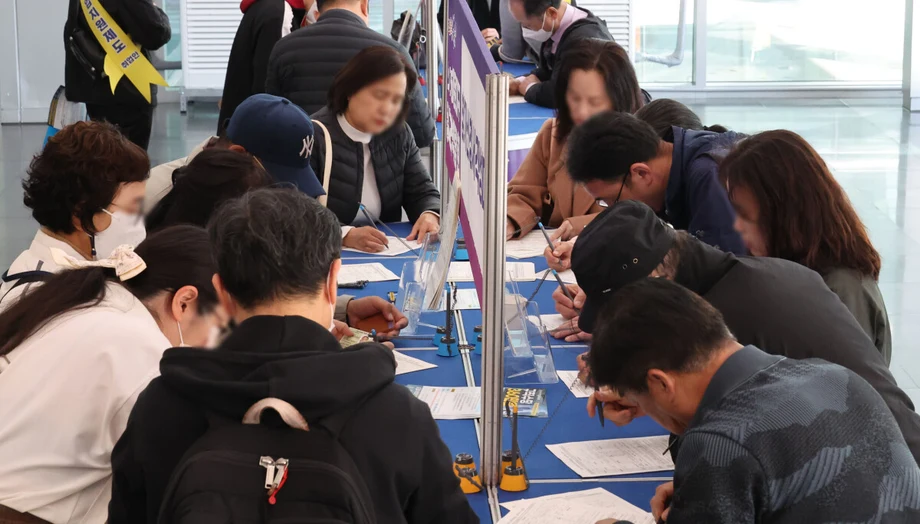
Employment among people aged 15 to 29 fell by 196,000 from a year earlier. The 48 consecutive months of annual declines represent the longest such stretch since the 62 months of decreases recorded between November 2004 and December 2009, a period spanning the global financial crisis.
The employment rate for this age group fell by 1.7 percentage points to 42.9%, its 30th consecutive monthly decline compared with a year earlier and its lowest October reading since 2020. Put simply, fewer than 43 in every 100 people aged 15 to 29 were working.
Bin attributed the weakness to conditions in industries employing young people, employers preferring experienced recruits and the spread of recruitment throughout the year. Hiring as vacancies arise, rather than through large scheduled recruitment rounds, can make entry into employment harder for applicants seeking their first position.
The statistics agency pointed to weakness in information and communications, health and welfare employment among younger people, and accommodation and food services, where young workers make up a substantial share of employees. An industry can expand its total workforce while employing fewer people in a particular age group.
The unemployment rate for people aged 15 to 29 fell by 0.1 percentage points to 5.2%, even as their employment rate deteriorated. For the broader group aged 15 to 34, used under the Special Act on the Promotion of Youth Employment, the employment rate fell by 0.6 percentage points to 55.4%. Its unemployment rate declined by 0.3 percentage points to 4.1%.
Older workers account for much of the increase
Employment among people aged 65 and older rose by 255,000, while employment among those aged 70 and older increased by 149,000. The latter group is included within the former, so the two increases overlap.
The increase among people aged 65 and older was about 1.8 times the national net gain of 139,000. Gains in an individual age group can exceed the national total because losses elsewhere reduce the final balance.
Employment among all people aged 60 and older increased by 196,000. The smaller gain for this broader group, compared with the increase among those aged 65 and older, indicates that employment among people aged 60 to 64 declined.
People in their 30s gained 128,000 jobs, and those in their 50s gained 42,000. Employment fell by 203,000 among people in their 20s and by 32,000 among those in their 40s. The figures show that the divide extends beyond a simple contrast between young and old.
Restaurants and construction lose ground
Accommodation and food services lost 137,000 jobs compared with October 2025, marking a third consecutive month of decline. It was the sector's largest fall since February 2021, when employment dropped by 232,000 during the COVID-19 pandemic.
The statistics agency attributed part of October's decrease to a base effect from consumer vouchers issued in the second half of the previous year. Those vouchers had supported spending and employment, creating a stronger starting point for the annual comparison. Current weakness in the industry also contributed.
Construction employment fell by 42,000, extending its annual declines to 30 consecutive months. Agriculture, forestry and fisheries lost 101,000 jobs.
Manufacturing shed 7,000 jobs after returning to growth in September for the first time in two years and three months. The agency identified textiles, automobiles and clothing among the areas losing workers, while describing the manufacturing production index as showing a favorable trend.
Production and employment measure different things. Factories can produce more without increasing their workforce at the same pace, depending on the products being made, the equipment used and how much existing capacity is operating.
Health services lead growth as exports pull ahead
Health care and social welfare added 249,000 jobs, making it the largest source of growth among the industries listed. Transportation and storage gained 48,000, while business facilities management, business support and rental services added 37,000.
The health and welfare increase alone was about 179% of the national net gain. Its contribution was partly offset by losses in restaurants, construction, farming and other areas.
Demand for semiconductors used in artificial intelligence has supported exports and economic growth. The employment figures show a different experience in industries more closely connected to spending within South Korea, particularly accommodation and food services.
John Bromhead, a senior economist at Moody's Analytics, described the gap between those parts of the economy:
The data highlight the growing disconnect between South Korea's export-led recovery and subdued domestic demand.
For a young person seeking restaurant work or a worker looking for a construction job, stronger export sales may offer little immediate relief. October's industry figures show where employment opportunities expanded and where the pool of jobs contracted.
Employment rates tell different stories by age
The employment rate for people aged 15 to 64 rose by 0.3 percentage points to 70.4%, a record for October. The rate for everyone aged 15 and older fell by 0.1 percentage points to 63.3%.
Each rate uses a different population. The first measures employment among people aged 15 to 64. The second also includes everyone aged 65 and older, including retirees. Changes in the size and age composition of those populations help explain why the rates can move in opposite directions.
The economically inactive population, people neither employed nor counted as unemployed, increased by 179,000 to 16,299,000. This category includes people studying, caring for family members, retired or otherwise outside the labor force.
Within that population, 2,511,000 people described themselves as resting without a specific reason for not working, down by 69,000 from a year earlier. The wider inactive population therefore grew even as this particular subgroup became smaller.
Government plans jobs support as the central bank weighs rates
The government plans a joint ministry National Jobs Project aimed at improving employment conditions for young people, older workers and people in middle age who retired early. It also intends to expand opportunities for job training suited to the adoption of artificial intelligence.
Officials said direct employment programs would be carried out through the end of 2026 to support income and work for vulnerable groups during winter, alongside preparations for programs in 2027. No detailed launch date or spending total was given for the broader project.
The Bank of Korea was weighing another interest rate increase in November. Persistent inflation and firm export growth supported further tightening, while weak household spending and hiring in industries employing large numbers of people pointed to pressure from higher borrowing costs.
Higher interest rates generally make loans more expensive for households and businesses. That can restrain spending and investment, which matters for restaurants, construction companies and other employers already reducing their workforces. Bromhead expected one more increase in November followed by a lengthy pause.
Key Points
- South Korea added 139,000 jobs in October 2026, taking employment to 29,179,000.
- Employment among people aged 15 to 29 fell by 196,000, extending the decline to 48 consecutive months.
- Health care and social welfare gained 249,000 jobs; accommodation and food services lost 137,000.
- Employment among people aged 65 and older increased by 255,000, exceeding the national net gain.
- The unadjusted unemployment rate fell to 2%, while the economically inactive population grew by 179,000.
- The government plans targeted employment support and training, with direct employment programs continuing through the end of 2026.