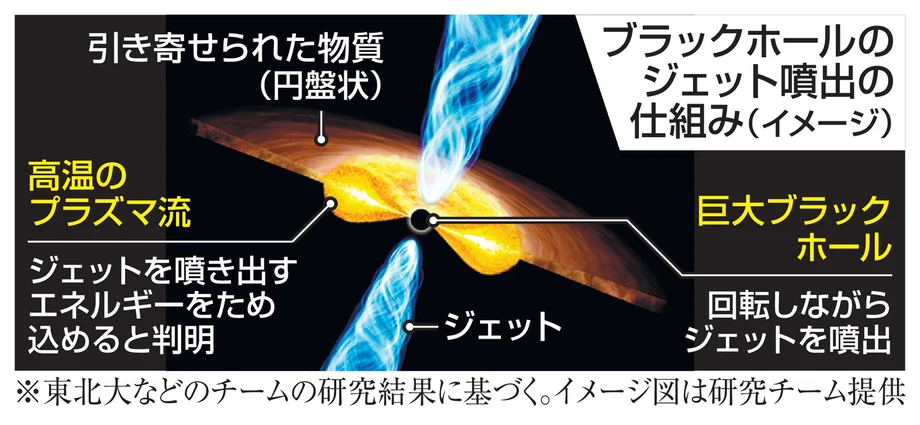
A change in gas reveals the jet's starting region
Astronomers studying a giant black hole about 420 million light years from Earth have identified a crucial change in the material falling toward it: a relatively cool gas disk ends about 20 black hole radii from the center, giving way to plasma heated to hundreds of millions of degrees. A narrow jet emerges from within that inner region.
Contents
The observations target 3C120, an object in the direction of the constellation Taurus whose central black hole has about 60 million times the mass of the Sun. Researchers combined Japan's XRISM X ray astronomy satellite with international networks of radio telescopes to connect the structure of the incoming gas with the region where the outgoing jet takes shape.
According to Tohoku University's announcement, the team achieved the first simultaneous observations of this powerful jet source using XRISM and the international radio telescope networks. The findings appeared in The Astrophysical Journal Letters on October 19, 2026, at 5 p.m. Japan time.
The result addresses a specific puzzle: how a black hole that is rapidly swallowing matter can also power a stream of gas moving close to the speed of light. The newly identified arrangement links a break in the cooler disk, an extremely hot inner flow and the jet emerging from inside it.
Why a feeding black hole presents a puzzle
Hirofumi Noda, an associate professor at Tohoku University, and Kazuhiro Hada, an associate professor at Nagoya City University, are corresponding authors of the study. Their team investigated a system in which abundant incoming material and a powerful outgoing jet exist together.
A leading explanation for these jets involves the black hole's rotation and the magnetic fields around it. In this picture, magnetic fields provide a way to draw energy from the spinning black hole and drive matter outward at enormous speed.
Rapid feeding makes that explanation harder to work through. Researchers have considered whether the large amount of incoming material interferes with the buildup of the magnetic energy needed to sustain a powerful jet. A system receiving plenty of matter therefore presents a demanding test of the proposed mechanism.
3C120 gives astronomers a place to examine both sides of the process. Material is falling toward its central black hole while a jet carries some matter and energy away from the surrounding region. The study connects those processes through the structure of the gas close to the black hole.
Where the cooler disk ends
The team's central finding is that the relatively cool disk stops at a distance of about 20 times the black hole's radius. Closer in, the material takes the form of a much hotter plasma flow. The university says this is the kind of inner flow expected in theories that extract energy from a rotating black hole.
An accretion disk is the flattened arrangement of material orbiting a compact object as it moves inward. The term describes how matter gathers and feeds the central object. Here, the important feature is the disk's inner edge: the cooler disk ends before reaching the black hole, and a different kind of flow occupies the space inside it.
In the research paper, the authors explain that XRISM resolved a broadened iron Fe-Kα emission line whose shape reflects the effects of orbital motion and gravitational redshift. Fitting that shape placed the disk's inner edge at 17.4 gravitational radii, with uncertainties of +6.3 and −6.5 gravitational radii at the 1σ confidence level. A gravitational radius is the distance scale set by the black hole's mass. Earlier measurements with X ray CCD detectors were limited by their energy resolution, which made it difficult to distinguish the disk's line profile from narrow iron absorption lines and reflection from distant material.
Plasma is gas heated so intensely that electrons separate from atoms, leaving electrically charged particles. At hundreds of millions of degrees, the inner flow is an extreme environment in which magnetic fields can affect the movement of matter.
The researchers also identified the jet emerging from inside the region bounded by the disk's inner edge and narrowing into a concentrated stream. That spatial relationship supplies the main connection between the incoming material and the jet: the transition to hot plasma occurs outside the place from which the jet emerges.
The paper's argument combines that disk measurement with the radio images: extending the measured jet profile back toward the black hole's horizon gives a jet radius comparable to, or smaller than, the disk's truncation radius. The authors interpret this geometry as evidence that the jet is linked to a hot, geometrically thick inner flow inside a cold, geometrically thin disk truncated at about 20 gravitational radii. Such a thick flow could sustain the large-scale magnetic fields needed to extract rotational energy through the Blandford–Znajek process, even while the black hole is feeding rapidly. But this is a possible mechanism, not an established one: the evidence concerns the arrangement of the disk and jet and does not directly demonstrate magnetic-field-driven launching.
Two kinds of light connect the picture
XRISM and the radio telescope networks examine different parts of this system. X rays carry information about energetic material near the black hole, while radio observations reveal the structure of the jet. Bringing the measurements together lets researchers compare the feeding region with the outgoing flow.
XRISM stands for X-Ray Imaging and Spectroscopy Mission. JAXA led its development, working with NASA, the European Space Agency, universities and research institutions. Its detectors distinguish X ray energies with very high precision, helping astronomers investigate the physical conditions of distant material.
Spectroscopy separates light according to its energy or wavelength. Much as visible light contains different colors, X rays span different energies. Measuring those differences gives researchers information beyond what an ordinary image can show.
The radio networks contribute exceptionally fine detail. They combine observations from telescopes separated by large distances, producing resolving power comparable to that of a telescope roughly the size of Earth. Resolution is the ability to distinguish nearby features rather than merge them into one indistinct spot.
The coordinated observing campaign brought together measurements taken on different dates, rather than all at exactly the same time. XRISM observed 3C120 from March 19 to 24, 2025, UTC, collecting approximately 200 kiloseconds of net exposure, or about 56 hours. The GMVA observed at 86 GHz continuously for 20 hours, from 9 UT on April 26 to 5 UT on April 27, 2025. EAVN observations at 22 GHz took place on April 23, 2025, while the VLBA datasets include observing epochs in February, March, April and June 2025.
A telescope network spanning continents
The radio observations used three networks operating at different wavelengths. Each brought a distinct configuration of observatories to the effort, extending the study beyond what a single telescope or observing band could provide.
- The Global Millimeter VLBI Array, or GMVA, used 18 stations across the United States, Europe, Chile, South Korea and Greenland, observing at a wavelength of 3 millimeters.
- The Very Long Baseline Array, or VLBA, used 10 stations in the United States, observing at wavelengths of 7 millimeters and 2 centimeters.
- The East Asian VLBI Network, or EAVN, used 10 stations in Japan, South Korea and China, observing at a wavelength of 1 centimeter.
VLBI means very long baseline interferometry. It is the technique that combines signals from widely separated radio telescopes so researchers can reconstruct very small structures on the sky. The distance between observatories helps determine how fine a detail the network can distinguish.
The three configurations list 18, 10 and 10 participating stations respectively. Their contribution is best understood through their geographic reach and different observing wavelengths, which bring several radio views into the same investigation of 3C120.
From satellite launch to published findings
XRISM's journey into orbit preceded the study by about three years. The mission gave the researchers access to precise X ray measurements that could be paired with established international radio networks.
- September 7, 2023: XRISM launched aboard H-IIA rocket No. 47.
- October 19, 2026: The research appeared in The Astrophysical Journal Letters at 5 p.m. Japan time.
- October 20, 2026: Tohoku University published its announcement describing the disk edge, hot plasma flow and jet structure.
The paper is titled "Disk truncation triggers relativistic jet launching of a highly accreting supermassive black hole." In plain language, its title connects the ending of the cooler disk with the launch of a jet moving at close to light speed from a black hole receiving large amounts of material.
Why the structure matters for galaxies
Jets from giant black holes play an important role in galaxy formation and evolution because they carry energy away from the central region. Understanding how that energy begins its outward journey is therefore part of understanding how a galaxy's central black hole affects its surroundings.
The 3C120 observations bring the question down to a particular arrangement of matter. The cooler disk ends at about 20 black hole radii, a plasma flow occupies the inner region, and a jet emerges from inside it. Researchers can use that arrangement to test calculations of how magnetic fields and rotation power the outflow.
The finding also connects two extremes that are often described separately: a black hole consuming material and a jet sending material outward. In this system, the transition between cooler gas and intensely hot plasma provides a physical link between those processes.
Tohoku University describes the result as a step toward understanding how black hole rotation drives jets. The remaining task is to work out the mechanism in detail, including how the magnetic fields interact with the hot inner flow to transfer energy into the escaping stream.
Key Points
- The central black hole in 3C120 has about 60 million times the Sun's mass and lies roughly 420 million light years away toward Taurus.
- A relatively cool gas disk ends about 20 black hole radii from the center, giving way to plasma at hundreds of millions of degrees.
- A narrow jet emerges from inside that inner region, matching the spatial arrangement expected by the theory discussed by the researchers. The geometric evidence supports a possible Blandford–Znajek process but does not directly demonstrate magnetic-field-driven launching.
- The team combined XRISM observations from March 19–24, 2025, with approximately 200 kiloseconds of net exposure, and coordinated radio observations spanning February to June 2025, including a continuous 20-hour GMVA observation on April 26–27.
- The findings were published in The Astrophysical Journal Letters on October 19, 2026.