Three wickets before India score a run
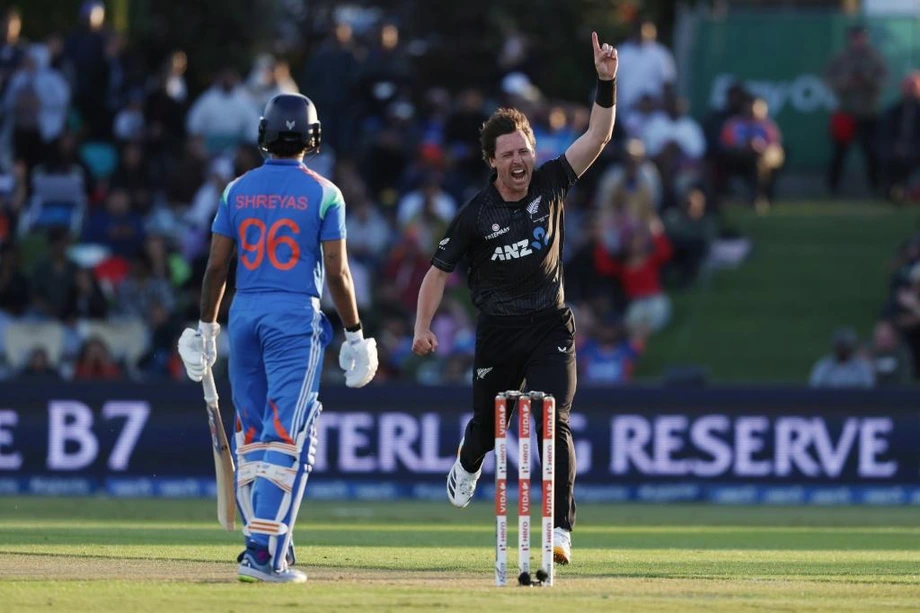
Matt Henry dismissed Rohit Sharma, Virat Kohli and stand-in captain Shreyas Iyer for ducks in the opening over as New Zealand overwhelmed India by 244 runs at Mount Maunganui on Friday, November 13, 2026. His figures of six wickets for 27 runs followed Will Young's 125 from 108 balls, giving the hosts their first victory in the five match ODI series.
Contents
- Three wickets before India score a run
- Henry makes the new ball count
- The lengths that trapped India's batters
- Young turns two chances into 125
- A record defeat avoided by one run
- Gambhir worries about how quickly wickets fell
- Earlier victories had already exposed a weakness
- Selection choices come under scrutiny
- New Zealand must finish the job without Henry
- Key Points
New Zealand made 333 before bowling India out for 89 in 26.4 overs at Bay Oval. The result was India's second largest defeat by runs in one day international cricket, just one run short of the 245 run loss to Sri Lanka at Sharjah in 2000.
India still lead the series 2-1 because the third match was abandoned through rain. New Zealand cannot win the series, but victory in the final ODI at the same ground on Sunday, November 15, would secure a 2-2 draw.
The scale of the defeat also sharpened a concern for India head coach Gautam Gambhir. India had already fallen to 111 for seven while chasing 135 in the second ODI before escaping with a victory under the rain adjustment rules. This time, the collapse ended the innings with almost half of the permitted 50 overs unused.
Ishan Kishan supplied India's highest score with 27. Axar Patel and Naman Dhir each made 21, providing enough resistance to keep the defeat just below India's largest losing margin, but nowhere near enough to threaten New Zealand's total.
Henry makes the new ball count
Henry's opening over left India at zero for three. Rohit was caught in the slips, the catching positions beside the wicketkeeper, while Kohli and Iyer were beaten on the inside edge of the bat. Three experienced batters had gone before India could begin building a chase of 334.
Henry, returning from injury, explained that his plan centred on threatening the stumps during the brief period when the new ball could put incoming batters under immediate pressure.
"With the way the wind was going, I wasn't too worried about the swing," said Henry.
The New Zealand fast bowler described keeping his approach simple when deliveries moved sharply and batters had little time to settle.
So just trying to be as simple as possible, obviously, and when it moves sharply like that in the first over, when people are facing first balls, it's pretty tough.
Henry eventually took six of India's 10 wickets. Ruturaj Gaikwad also departed early, leaving the remaining batters to attempt a recovery while the target was still almost entirely intact.
The lengths that trapped India's batters
Henry's success came largely from deliveries landing at a distance that made batters hesitate between stepping forward and staying back. A good length makes that choice difficult; a slightly shorter length can draw a batter back while still threatening the wicket.
The delivery breakdown recorded five wickets for just five runs from Henry's 40 balls pitched on a good length or slightly shorter. That concentration of wickets explains why his spell was more than an explosive first over: he kept India under pressure through repeated accuracy.
Gambhir identified the placement of deliveries from Henry and Kyle Jamieson as a central problem. The India coach said the batters were getting stuck between two possible responses.
"I thought, more than the wobble seam, it's the areas that have probably created problems for us. It was that length where you couldn't go forward, you couldn't go back. It was that half-half length," he said.
A wobble seam delivery has a seam that does not remain upright and steady in flight, making movement after the bounce harder to anticipate. Gambhir's assessment put the greater responsibility on India's response to where the ball landed.
Young turns two chances into 125
Young's innings began with two opportunities for India to remove him cheaply. Rohit and Kishan dropped him on consecutive deliveries in the second over, with his score on five. He went on to make his highest ODI score and fifth century in the format.
The opener had scored nine and six in the first two matches. His 125 therefore transformed a quiet start to the series into the innings that gave New Zealand control of the fourth game.
Young reached his century from 88 balls and finished with 125 from 108. Tim Seifert made 58 from 48 deliveries in an opening partnership of 85, while Young later added 90 with Finn Allen, who contributed 41.
New Zealand had reached 72 without loss after the opening 10 overs, the first powerplay, when fielding restrictions limit how many players can patrol the boundary. Young and Seifert used that period to build a platform that India never approached in their own innings.
Mitchell Santner added 24 and Kristian Clarke made 22. For India, Axar took two wickets for 39 runs, while Auqib Nabi and Gurnoor Brar also claimed two wickets each. Gambhir backed the inexperienced bowling group but acknowledged the cost of giving Young repeated chances.
A record defeat avoided by one run
India's 89 was their sixth lowest completed ODI total. Their lowest remains 54 against Sri Lanka at Sharjah in 2000, while their previous lowest against New Zealand was 88 at Dambulla in 2010.
Kishan and Axar added 44, and Dhir's brisk 21 helped India move just far enough to avoid matching their largest defeat by runs. Being dismissed for 88 against New Zealand's 333 would have produced a losing margin of 245, equal to the Sharjah record.
New Zealand's victory was also their second largest by runs in ODIs. Their biggest remains the 290 run win over Ireland at Aberdeen in 2008, a margin 46 runs larger than Friday's result.
Henry's 6-27 ranks behind Shane Bond's 6-19 against India at Bulawayo in 2005 among six wicket performances by New Zealand bowlers against India. Henry now has four ODI innings with at least five wickets, level with Bond, behind Trent Boult's six and Richard Hadlee's five.
Gambhir worries about how quickly wickets fell
Gambhir's concern extended beyond the final score. India used only 160 legal deliveries, or 26 overs and four balls, before losing all 10 wickets. An ODI innings normally allows 300 legal deliveries.
The India coach said the speed of the collapse was the bigger warning as his team prepares for the 2027 ODI World Cup in South Africa, Zimbabwe and Namibia.
I think the bigger concern is not the runs, it's how quickly we got bundled out.
Gambhir said the conditions were close to those India might encounter at the World Cup, where batters could face a stronger contest against the ball than on many pitches at home. His proposed adjustment was practical: survive the hardest opening phase rather than demand immediate fast scoring.
"If you get 35 or 40 in the first 10 overs without losing a wicket, that is also good enough. Here, it's probably the most difficult time," he said.
Iyer also credited Henry for bowling in the right areas from the first ball, while saying the pitch played differently between the two innings. Gambhir placed more weight on India's ability to handle the lengths being bowled and to make clearer decisions at the crease.
Earlier victories had already exposed a weakness
India's lead was built on a five wicket Auckland victory on November 4 and a narrow Wellington escape on November 7. Kohli scored 74 in Auckland, but India's second win required a much tighter finish.
India slipped to 111 for seven while pursuing an initial target of 135 in Wellington. Rain ended that innings at 113 for seven, four runs above the required par score under the Duckworth-Lewis-Stern method, usually called DLS.
DLS adjusts targets when weather removes playing time, taking account of the overs and wickets a team has left. India's four run victory preserved their series advantage, while the loss of seven wickets gave Gambhir an earlier example of the batting problem that returned at Bay Oval.
The series has developed through four distinct stages:
- November 4: India won the opening ODI in Auckland by five wickets.
- November 7: India won the second ODI in Wellington by four runs under DLS.
- Third ODI: Rain forced an abandonment, leaving India ahead 2-0.
- November 13: New Zealand won at Mount Maunganui by 244 runs.
- November 15: The final ODI is scheduled at the same venue, with India leading 2-1.
Selection choices come under scrutiny
India were without regular captain Shubman Gill and KL Rahul, who were also set to miss the final ODI while preparing for the two Test series. Iyer led the ODI side in Gill's absence.
Gambhir explained that Gaikwad had been preferred as an opener to Kishan because of his greater experience in that position. Kishan's 27 was India's highest score on Friday, but the coach described the batting choices as an attempt to maintain continuity while giving players opportunities in different roles.
India also selected a wrist spinner instead of Mohammed Siraj. Gambhir said the larger ground and the need for an attacking option during the middle overs had influenced that decision.
Former Board of Control for Cricket in India official Makarand Waingankar argued for a different balance in the coming Tests. He urged India to select four fast bowlers, including Siraj, and one spinner, describing the ODI collapse as a warning before the longer format.
India last won a Test series in New Zealand in 2009, taking the three match contest 1-0. Their subsequent tours ended in a 1-0 defeat in 2013-14 and a 2-0 defeat in 2019-20. The opening Test in Wellington has been listed for Thursday, although Wednesday has also been given as the start of the series.
New Zealand must finish the job without Henry
New Zealand produced the victory despite nine players being unavailable through injury and others moving into the Test squad. Henry's return supplied the decisive spell, but he was listed as unavailable for Sunday's final ODI.
His recent figures show the size of that absence: from the start of 2025, Henry has taken 37 wickets in 14 ODIs at an average of 16.29 runs per wicket. His strike rate of 19.6 means he has taken a wicket roughly every 20 deliveries, while conceding 4.97 runs per over.
New Zealand now have an opportunity to avoid their first ODI series defeat at home in seven years. To take it, they must repeat enough of Friday's batting discipline, catching and accurate bowling without the player who removed six Indian batters.
India need a win to secure the series outright. Their immediate task is concrete: hold the early catches, survive the new ball and prevent another cluster of dismissals from turning a difficult passage into a lost innings.
Key Points
- New Zealand beat India by 244 runs at Mount Maunganui after making 333 and dismissing the visitors for 89.
- Matt Henry took 6-27, including Rohit Sharma, Virat Kohli and Shreyas Iyer for ducks in the opening over.
- Will Young made 125 from 108 balls after being dropped twice in the second over.
- India's defeat was their second largest by runs in ODIs, one run short of their 245 run loss to Sri Lanka in 2000.
- Gautam Gambhir said the speed of India's repeated batting collapses concerned him before the 2027 World Cup.
- India lead 2-1 before the final ODI on November 15. New Zealand can draw the series but are set to play without Henry.