May 23 Exam Date Comes With Calculator Access
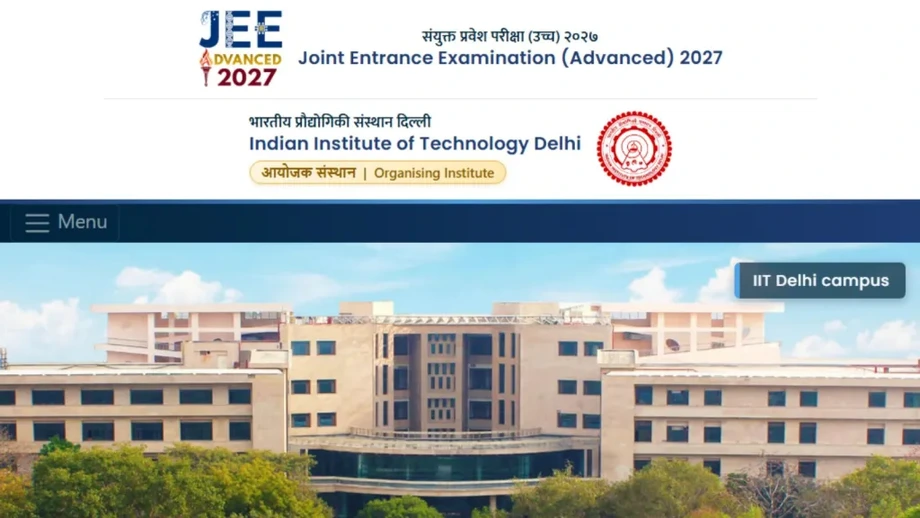
The Indian Institute of Technology Delhi has announced that JEE Advanced 2027 will take place on Sunday, May 23, 2027, with candidates allowed to use a basic calculator on their computer screens. The institute has also launched the examination website, jeeadv.ac.in, and published eligibility requirements covering JEE Main performance, age, previous attempts, Class 12 examinations and earlier IIT admission.
Contents
- May 23 Exam Date Comes With Calculator Access
- What Calculator Will Candidates Receive?
- Who Qualifies Through JEE Main?
- Which Birth Dates Meet the Age Rule?
- Two Attempts Remain Despite the Petition
- Class 12 Timing Includes a Specific Exception
- Earlier IIT Admission Can Affect Eligibility
- A Separate Route for Foreign Candidates
- Registration Dates Are Still Awaited
- Key Points
IIT Delhi, the organising institute, issued the notification on November 13, 2026. For Indian candidates, the main entry requirement is a place among the top 250,000 successful candidates in the BE/BTech paper of JEE Main 2027. Applicants must also satisfy the other eligibility conditions at the same time.
The rules retain a maximum of two attempts in two consecutive years, despite a petition signed by more than 12,000 students seeking another opportunity. Most candidates must have first appeared for Class 12 in 2026 or 2027, although a specific exception covers some students from boards that declared their 2025 results late.
The key announced dates are:
- November 13, 2026: IIT Delhi issued its notification announcing the examination date and calculator provision.
- May 23, 2027: JEE Advanced 2027 will be held on a Sunday.
For students planning their preparation, the announcement provides both an examination date and a detailed eligibility checklist. A qualifying JEE Main result is one part of that checklist; a candidate's school examination history and any previous IIT admission can also determine whether they may appear.
What Calculator Will Candidates Receive?
IIT Delhi says the examination will provide an on-screen basic calculator with a display of 10 to 12 digits. Candidates will access it through the computer screen during the test.
IIT Delhi, which is responsible for organising the examination, described the facility in its notification:
Candidates appearing for JEE (Advanced) 2027 will have the provision of using an on-screen basic (non-scientific) calculator with a 10-12 digit display.
A basic calculator is intended for ordinary arithmetic. A scientific calculator has additional functions, such as trigonometric calculations and logarithms. The announced facility is the basic type, so students should plan their preparation around that specification.
The display size describes how many digits the calculator can show. For example, a display capable of showing 10 digits has room for a number such as 1,234,567,890. Students will still need to work out which equations and calculations a question requires before entering numbers.
Who Qualifies Through JEE Main?
Indian nationals and candidates classified as OCI/PIO (I) must be among the top 250,000 successful candidates across all categories in the BE/BTech paper of JEE Main 2027. OCI and PIO refer to Overseas Citizen of India and Person of Indian Origin classifications; candidates need to check which eligibility route applies to their status.
The published distribution of the JEE Main shortlist is:
- OPEN: 40.5%.
- GEN-EWS: 10%.
- OBC-NCL: 27%.
- Scheduled Castes: 15%.
- Scheduled Tribes: 7.5%.
GEN-EWS refers to the category for economically weaker sections, while OBC-NCL refers to Other Backward Classes in the non-creamy layer. OPEN places are open to candidates across categories.
Five percent horizontal reservation for persons with disabilities, or PwD candidates, applies within each of these five categories. In practical terms, the PwD provision operates inside each category's allocation rather than as a sixth category alongside the others.
The five category shares add up to 100%. Applied to a shortlist of exactly 250,000, the OPEN share would represent 101,250 candidates and the OBC-NCL share 67,500. The actual number shortlisted may exceed 250,000 because of candidates with tied ranks or scores.
Which Birth Dates Meet the Age Rule?
Candidates must generally have been born on or after October 1, 2002. Scheduled Caste, Scheduled Tribe and PwD candidates receive an age relaxation of five years, making their cutoff October 1, 1997.
The phrase "on or after" includes the date itself. A candidate born on October 1, 2002, therefore meets the general birth date condition. Someone born earlier must qualify for an applicable relaxation.
Age eligibility operates alongside the academic and attempt requirements. A student who meets the birth date condition must still satisfy the JEE Main requirement where applicable, the Class 12 rule, the attempt limit and the restrictions relating to previous IIT admission.
Two Attempts Remain Despite the Petition
More than 12,000 students signed an online petition seeking a third opportunity to take JEE Advanced in 2027. Addressed to the Ministry of Education, the IIT Council and the Joint Admission Board, the petition proposed two possible changes.
One proposal would permit three attempts in three consecutive years. The other would retain two attempts but allow candidates to use them within a period of three years. The second option would give students more flexibility over when to take their two attempts.
IIT Delhi's published criteria retain a maximum of two attempts in two consecutive years. Students planning for 2027 therefore need to apply the existing rule when checking their eligibility.
The attempt limit and the Class 12 timing rule work together. Students cannot calculate eligibility simply by counting how many times they have taken JEE Advanced. Their first appearance in the Class 12 examination also determines the normal period in which they may compete.
For most candidates in the 2027 examination, that means a first Class 12 appearance in 2026 or 2027. A student who first appeared in 2026 must assess their position against both the consecutive years requirement and their previous JEE Advanced attempts.
Class 12 Timing Includes a Specific Exception
Candidates must normally have appeared for Class 12 or an equivalent examination for the first time in either 2026 or 2027. Physics, Chemistry and Mathematics must have been compulsory subjects.
The first appearance date matters. Although some descriptions of the attempt rule refer to the year a student passes Class 12, the detailed eligibility condition uses the year the student first appeared for that examination. Students checking their position should use that stated test.
Candidates whose first Class 12 appearance was in 2025 or earlier are generally ineligible. IIT Delhi's detailed criteria, however, provide an exception for certain candidates who took their examination in 2025.
The exception applies when the candidate's examination board declared the results for the 2024-25 academic year on or after June 12, 2025. Candidates from such a board who appeared in 2025 may be eligible for JEE Advanced 2027 if they meet all the other requirements.
The relevant date is the board's declaration of results for that academic year. A student seeking to use this exception needs to check the board's result announcement date as well as their own examination history.
This gives some candidates from the 2025 examination year a possible route into the 2027 test. The age, attempt and previous admission conditions continue to apply to them.
Earlier IIT Admission Can Affect Eligibility
Candidates previously admitted to an IIT under an academic programme listed in the Joint Seat Allocation Authority's 2026 Business Rules are generally ineligible. JoSAA is the body whose seat allocation rules are referenced in this condition.
The restriction covers candidates who accepted an IIT seat by reporting online or at a reporting centre, even if they subsequently left the programme. Candidates whose IIT admission was cancelled after they joined are also ineligible.
There are specific exceptions. Candidates admitted to an IIT preparatory programme for the first time in 2026 may appear for JEE Advanced 2027, provided they meet the other eligibility conditions.
Certain candidates allotted an IIT seat through JoSAA 2026 may also remain eligible. The listed situations include candidates who did not report, withdrew before the final round of seat allotment, or had their seat cancelled before the final round.
The stage reached in the admission process therefore matters. A seat allotment followed by no reporting falls under a different provision from joining an IIT and later leaving. Students with a previous allocation should check the precise status and timing recorded in their JoSAA documents.
A Separate Route for Foreign Candidates
Foreign nationals and candidates classified as OCI/PIO (F) may register directly for JEE Advanced 2027 without taking JEE Main 2027. They are considered separately from the 250,000 candidates shortlisted through JEE Main.
These applicants must still meet the eligibility conditions that apply to their route. The listed requirements include the age limit, a maximum of two attempts in two consecutive years, the Class 12 timing and compulsory subject rules, and restrictions concerning earlier IIT admission.
The general birth date cutoff is October 1, 2002. The eligibility provisions also describe an age relaxation for candidates from certain countries where military service is compulsory.
Seats for foreign nationals and OCI/PIO (F) candidates are supernumerary, meaning they are additional to the regular seat allocation. They are capped at up to 10% of seats in each IIT programme. For a programme with 100 regular seats, that ceiling would allow up to 10 such additional seats.
Candidates in this route are not eligible for GEN-EWS, OBC-NCL, SC, ST or PwD category reservations. They must provide valid identity documentation, such as a citizenship certificate, foreign passport or OCI/PIO card, as applicable.
Registration Dates Are Still Awaited
IIT Delhi has announced the examination date, but registration opening and closing dates and the fee payment deadline have not yet been announced. Those dates are expected through the official examination website, jeeadv.ac.in.
The application process will involve online submission and payment of the examination fee. Candidates will need to enter personal, academic and category details, making the eligibility checks relevant before they begin filling out a form.
IIT Delhi has encouraged candidates to check the portal frequently for updates. For applicants, the immediate task is to establish which eligibility route applies and review the records that support it: birth date, first Class 12 appearance, compulsory subjects, previous attempts and any IIT seat allocation or admission.
May 23, 2027, is the announced examination date. The next practical milestone will be the release of the registration schedule, which will tell eligible students when they can apply and pay.
Key Points
- JEE Advanced 2027 is scheduled for Sunday, May 23, with IIT Delhi organising the examination.
- Candidates will have access to an on-screen basic calculator with a display of 10 to 12 digits.
- The main Indian candidate route requires a place among the top 250,000 successful candidates in JEE Main 2027 BE/BTech.
- The maximum remains two attempts in two consecutive years.
- First Class 12 appearance must generally be in 2026 or 2027, with a specific exception for some candidates who appeared in 2025.
- Age and earlier IIT admission rules also apply; foreign nationals and OCI/PIO (F) candidates have a separate registration route.
- Registration dates and the fee payment deadline are still to be announced.