A commanding lead before the November 14 vote
Barisan Nasional and Perikatan Nasional are ahead in 24 of Melaka's 28 state constituencies, according to an Ilham Centre survey released on November 13, with supporters of both coalitions showing a strong willingness to vote for each other's candidates. The finding puts their coordinated campaign well above the 15 seats needed to form the state government.
Contents
- A commanding lead before the November 14 vote
- Why supporters are crossing coalition lines
- A federal agreement has not brought local coordination
- State services strengthen BN's position
- PH's defensive battles extend beyond two strongholds
- Young voters remain a late campaign target
- What the November survey measured
- The 2021 study shows how the contest has changed
- Turnout and final choices will settle the seats
- Key Points
The survey found that 91% of PN supporters were willing to vote for BN candidates, while 78% of BN supporters would back PN contenders. BN is contesting 23 seats and PN the remaining five, giving voters a single candidate from their partnership in every constituency.
Pakatan Harapan had a comfortable lead in only Kota Laksamana and Bandar Hilir. Two other seats it previously held, Ayer Keroh and Kesidang, were closely contested. Ilham described PH's support as stable but stagnant, concentrated among urban and non-Malay voters, with limited gains among Malay voters, rural communities and people who had yet to choose a party.
The projected 24 seats would give BN-PN about 86% of the assembly and nine seats more than a simple majority. BN alone won 21 seats in the 2021 state election, so the latest projection places the combined partnership three seats above that earlier result.
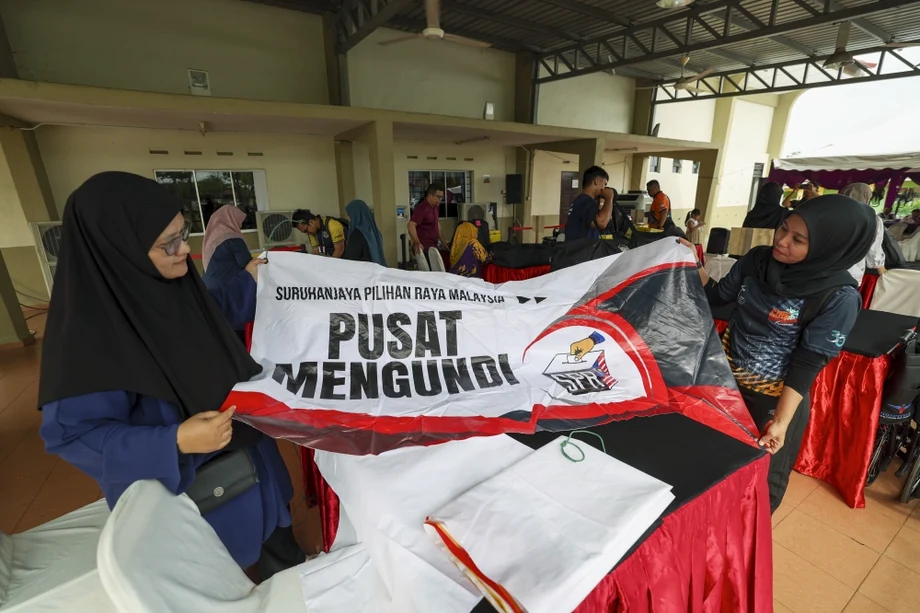
Polling is scheduled for November 14, following early voting on November 10. Both BN and PH leaders have urged attention to the voters who will make the final decision, with BN warning against complacency and PH insisting that a surprise remains possible.
Why supporters are crossing coalition lines
Ilham Centre attributed the BN-PN advantage to an openly coordinated partnership backed by the local networks of Umno and PAS. Those networks extend to polling districts, helping the parties reach residents and direct their supporters towards the agreed candidate.
Vote transfer means that a supporter chooses an allied party's candidate when their own party is not standing. The survey's figures suggest this arrangement has broad acceptance, although willingness was stronger among PN supporters backing BN than among BN supporters backing PN, a gap of 13 percentage points.
Melaka uses a first-past-the-post electoral system: the candidate with the most votes in a constituency wins its seat. When parties appealing to similar voters compete against each other, their support can split between candidates. A shared slate brings those votes together behind one contender.
Ilham said the combined campaign strengthened BN-PN across 23 constituencies where at least half the voters are Malay. Its findings also pointed to the appeal of an anti-PH campaign message, expressed through slogans including Asal Bukan PH, meaning Anyone But PH.
PH, by contrast, struggled to bring concerns about corruption, economic inequality and governance scandals into a campaign message strong enough to expand its support, according to the institute's assessment.
A federal agreement has not brought local coordination
The confidence and supply agreement between the Madani administration and Bersatu had produced little effective cooperation among voters and local campaign workers, Ilham Centre found. Such an agreement concerns parliamentary support, particularly confidence votes and government spending. An election partnership also requires decisions about candidates, seats and campaigning.
Bersatu president Muhyiddin Yassin and five other MPs from the party signed the agreement the previous month. The arrangement gave them access to constituency development funds that government MPs had been able to access for the preceding four years.
Ilham found that the understanding lacked a clear public message and practical arrangements for directing supporters towards one another's candidates. Traditional party rivalries continued to shape choices, while uncertain voters were left unclear about the relationship.
The institute called for a formal electoral arrangement between PH and Bersatu:
PH and Bersatu must demonstrate greater political resolve in formalising an electoral alliance.
Ilham said that would require agreed candidates, seat allocations, a common message and integrated campaign teams. Its assessment placed the contrast with BN-PN at the centre of the contest: one partnership had organised a shared electoral slate, while the other understanding remained largely among senior leaders.
State services strengthen BN's position
Caretaker chief minister Ab Rauf Yusoh received an approval rating of 86% in the survey, while the BN state government recorded 85%. Ilham linked those ratings partly to programmes bringing state representatives and assistance directly to residents.
The initiatives, Wakil Rakyat Untuk Rakyat and Jelajah Ketua Menteri Sayang Rakyat, involved public engagement, help for residents and efforts to address local problems. The institute found that these activities strengthened perceptions that the administration was responsive to people's needs.
For BN, that record gave candidates concrete services to discuss alongside campaign promises. Residents were assessing the government through their experience of assistance and access to representatives, as well as through the wider competition between parties.
Rais Yasin, Melaka Umno's deputy chief and chairman of BN Tangga Batu, nevertheless urged the coalition against becoming too comfortable with the projections. He said the findings reflected voter preferences during the survey period and that the actual outcome belonged to voters on polling day.
Rais also said public trust required work, service and continued commitment beyond an election campaign. His response acknowledged the favourable findings while urging BN workers to keep serving and engaging residents.
PH's defensive battles extend beyond two strongholds
Kota Laksamana and Bandar Hilir offered PH its strongest positions in Ilham's assessment. Ayer Keroh faces a contest involving four candidates, while Kesidang has three, making the distribution of votes between rivals especially important.
Former DAP MP Ong Kian Ming separately forecast that BN-PN would win between 24 and 25 seats, with PH taking three or four. His estimate placed PH somewhat above the two seats where Ilham found it comfortably ahead, while reaching a similar judgment about the scale of BN-PN's advantage.
Ong also predicted that Bersatu would lose two seats and warned that Melaka PH chairman Adly Zahari could be defeated in Bukit Katil by PAS candidate Ridzuan Sarif. Malay voters make up 68% of that constituency's electorate.
Adly, an Amanah vice-president and former chief minister, had represented Bukit Katil for two terms. Ong described PH's campaign as lacklustre and said the fortnight of campaigning had not changed his view that BN would dominate.
PKR Youth chief Muhammad Kamil Abdul Munim offered a different campaign assessment. Speaking on November 13 after meeting paddy farmers in Kampung Pinang A, Klebang, alongside PH candidate Farzana Hayani Mohd Nasir, he said PH was still working towards the 15 seats needed to form a government. PH is contesting 24 seats.
Kamil described the response during the campaign as positive, particularly among Generation Z, and said many voters remained undecided. He also said findings from Ilham Centre and Merdeka Centre contradicted one another; he gave no comparable figures from Merdeka Centre in those remarks.
Young voters remain a late campaign target
Twenty-one per cent of survey respondents younger than 30 had not decided how to vote. Ilham found that many intended to choose at the last minute after weighing the candidates and parties.
Younger Malay voters leaned towards BN-PN, while younger Chinese voters were more inclined towards PH. Employment, income, the cost of living and basic amenities were prominent concerns, with family influence, social media trends and local issues also shaping preferences.
Ilham expected undecided young voters to be drawn towards the BN-PN campaign. Kamil's account of a positive youth response gave PH a more hopeful reading of the final campaign stretch. The survey ended on November 12, leaving the last stages of campaigning outside its interview period.
Chinese voter choices also featured in the discussion of PH's prospects. Ong suggested that dissatisfaction with established parties could prompt voters to consider Muda or Bersama. Muda secretary-general Ainie Haziqah Shafii said her experience of the Johor election had been different: some Chinese voters unhappy with PH had chosen BN instead of those alternatives.
Ainie, explaining why smaller parties needed to examine their appeal, said:
Muda and Bersama must reflect on why these voters chose BN.
BN entered the Melaka campaign encouraged by earlier results in Johor and Negeri Sembilan. BN won 48 of Johor's 56 seats, while BN and PN won 18 and seven respectively in Negeri Sembilan, a combined 25 of 36 seats.
What the November survey measured
Ilham Centre interviewed 805 registered voters across all 28 Melaka constituencies from November 1 to 12. The interviews were conducted face to face using stratified random sampling, a method that divides the electorate into groups before selecting respondents so that different parts of the population are represented.
The study covered ethnicity, gender, age, education, income, employment and geographical location. Researchers also held five focus group discussions involving 40 participants and conducted 22 in-depth interviews to explore the reasons behind voter preferences.
Ilham gave a statewide sampling margin of error of 3.45 percentage points at a 95% confidence level. In simple terms, sampling creates some uncertainty because researchers speak to a selection of voters rather than everyone. The published margin applies to the statewide survey; uncertainty is greater for smaller groups drawn from that sample.
The key dates in the election assessment are:
- November 1: Ilham Centre began its voter survey.
- November 10: Early voting took place.
- November 12: Survey interviews ended.
- November 13: Ilham released its findings, and party leaders responded.
- November 14: Voters are scheduled to choose the 28 state assembly members.
The 2021 study shows how the contest has changed
Ilham Centre's 2021 Melaka election study provides a useful earlier comparison. That research involved 1,051 respondents interviewed from October 23 to November 15, 2021, with a stated margin of error of three percentage points at a 95% confidence level.
The institute then placed BN comfortably ahead in 11 seats and PH in seven, with 10 too close to predict. BN ultimately won 21 seats. In the current survey, PH's comfortable positions have narrowed to two, with Ayer Keroh and Kesidang among its defensive battles.
Adly also entered the 2021 contest with favourable personal ratings. Fifty-six per cent of respondents approved of his performance as chief minister, while 57% preferred his policies, compared with 35% choosing those of Sulaiman Md Ali and 8% choosing those of Idris Haron. Ong's current warning about Bukit Katil places Adly in a more difficult electoral position.
The 2021 document recorded strong concern about daily life: 83% prioritised local issues, 93% said the COVID-19 pandemic had affected them, 87% regarded flash floods as critical and 73% considered sea reclamation a serious issue. Those findings give historical context to the current survey's attention to local services, assistance and basic amenities.
Party competition has also changed. In 2021, Ilham examined whether PN could split BN's Malay support and create openings for PH. The current findings instead describe BN-PN coordination bringing much of that support behind an agreed candidate.
Turnout and final choices will settle the seats
Ilham's 2021 study placed particular weight on turnout. It recorded participation of 84.7% in the earlier general election, when PH won 15 of Melaka's 28 seats and formed a government with a narrow majority. The institute argued that reduced participation would favour parties with a dependable core of supporters.
The present contest combines that practical task of bringing supporters to polling stations with the effort to persuade people who remain undecided. BN-PN's extensive local networks and strong stated vote transfers give it an organisational advantage, while PH is seeking late gains among younger voters and in closely contested seats.
Rais and Kamil approached the forecast from opposing political positions, yet both put the final choice with voters. On November 14, the most closely watched outcomes will include whether BN-PN converts its projected lead into seats, whether PH holds Ayer Keroh and Kesidang, and whether Adly survives in Bukit Katil.
Key Points
- Ilham Centre placed BN-PN ahead in 24 of Melaka's 28 seats; 15 are needed to form a government.
- The survey found 91% of PN supporters willing to vote BN and 78% of BN supporters willing to vote PN.
- PH was comfortably ahead in Kota Laksamana and Bandar Hilir, with Ayer Keroh and Kesidang closely contested.
- Ab Rauf Yusoh recorded 86% approval, while the state government received 85%.
- Twenty-one per cent of respondents younger than 30 remained undecided.
- The survey covered 805 voters from November 1 to 12, ahead of polling on November 14.