National brands gain ground in a record market
Proton and Perodua accounted for 448,364 of Malaysia's 715,879 new vehicle registrations from January to October 2026, giving the two national carmakers a combined market share of 62.6%. Their grip is the strongest since 2003, when they held 66.6%, but the growth is coming from Proton while Perodua's registrations fall.
Contents
- National brands gain ground in a record market
- Perodua still leads, but the distance is shrinking
- Three models power Proton's expansion
- Perodua's newcomers cannot offset wider declines
- Axia wins October as Bezza protects its annual lead
- Electric models give Proton a second engine of growth
- Geely technology now accounts for most Protons
- Other brands face an uneven October
- Another annual record depends on the final two months
- Key Points
Road Transport Department (JPJ) registration figures put Proton at 172,322 vehicles, up 37.7% from 125,120 during the same period in 2025. Perodua remained comfortably ahead with 276,042 registrations, although its total fell 4.6%.
Proton's market share rose from 18.0% to 24.1%, its highest since 2011, when it held 26.2%. Perodua's share slipped from 41.6% to 38.6%. Together, the companies gained three percentage points from their combined 59.6% a year earlier.
Malaysia's market also expanded, reaching a record for the first ten months of a year. Registrations increased by 20,523 from 695,356 in January to October 2025. Proton alone added 47,202 vehicles, more than twice the entire market's net increase, meaning its expansion outweighed losses elsewhere.
Electric cars, a refreshed Saga and a cheaper S70 are reshaping Proton's business. Perodua's new Traz and QV-E have added registrations, but their contribution has been smaller than the losses across its established models. Meanwhile, the battle for Malaysia's most popular individual car has opened into a contest between the Bezza, Saga and Axia.
Perodua still leads, but the distance is shrinking
Perodua registered about 1.60 vehicles for every Proton during the first ten months. October brought the ratio closer still: Perodua recorded 28,645 vehicles against Proton's 19,004, or roughly 1.51 to one.
Proton took 25.3% of October registrations, its third highest monthly share of 2026 after January's 29.0% and August's 26.1%. Perodua held 38.2% in October.
July's assessment of the first half had already shown the gap narrowing. Proton registered 98,010 vehicles from January to June, up 40.5%, while Perodua recorded 158,295, down 4.7%. The ratio of roughly 1.6 Peroduas for every Proton was the closest first half contest since 2013.
Proton's recovery also stands out against its own recent history. It registered just 27,105 vehicles in the first half of 2018, taking 9.1% of the market. By the first half of 2026, its volume was about 3.6 times that level.
The October cumulative total of 172,322 has already surpassed Proton's 171,110 registrations for the whole of 2005. It is higher than any complete year since 2002, when Proton registered 218,821 vehicles. Perodua nevertheless retains a lead of 103,720 registrations with two months left in 2026.
Three models power Proton's expansion
The e.MAS 5, Saga and S70 account for most of Proton's increase. The electric e.MAS 5, launched at the end of October 2025, contributed 22,589 registrations during January to October 2026.
The Saga added 18,271 registrations, rising 32% to 75,350 after its MC3 update went on sale in November 2025. That total has already passed its previous annual high of 74,335 in 2011, using registration records going back to 2000.
The S70 rose by 11,809 vehicles, or 83%, to 26,064. Its cheaper S70 NA version, launched on September 22 with prices starting at RM57,000, had its first complete month on sale in October. Registrations reached 5,355, almost twice September's 2,756 and well above the previous monthly high of 3,235 in August.
Proton's launch schedule helps explain when these additions entered the market:
- Late October 2025: The electric e.MAS 5 launched.
- November 2025: The updated Saga MC3 went on sale.
- December 2025: Perodua launched the Traz.
- February 2026: Proton introduced the e.MAS 7 plug-in hybrid.
- September 22, 2026: The cheaper S70 NA launched.
- October 2026: The S70 NA completed its first full month on sale.
The gains come alongside a changing older range. Persona registrations fell by 7,817 as the S70 NA took its place, while Iriz registrations declined by 2,158 following the end of production in September 2025. The X70 and fully electric e.MAS 7 also registered fewer vehicles than a year earlier.
Perodua's newcomers cannot offset wider declines
Perodua's Traz contributed 16,926 registrations through October, while the QV-E added 511. Together, those newcomers supplied 17,437 vehicles.
Six established models lost a combined 30,605 registrations compared with January to October 2025. The Myvi recorded the largest decline, down 10,857, followed by the Ativa with 6,652 fewer registrations and the Alza with 5,935 fewer.
The Aruz fell by 4,492, the Axia by 1,657 and the Bezza by 1,012. Subtracting the newcomers' contribution from those losses leaves a shortfall of 13,168 vehicles. The Bezza had remained ahead of its 2025 cumulative total through September, but slipped behind in October.
October nevertheless brought some stronger results within Perodua's range. Ativa registrations rose 35.7% from September to 3,645, making it the country's most popular SUV that month. The Myvi registered 4,229 vehicles, placing fifth among all models, while the Alza recorded 2,895.
Perodua is offering discounts during November and December, including up to RM7,500 off the Ativa. For buyers considering that model, the promotion changes the purchase price during the final push for registrations in 2026.
Axia wins October as Bezza protects its annual lead
The Axia topped October's model rankings with 8,035 registrations, its first monthly victory since January 2025. It rose 4.6% from September's 7,678.
The Bezza followed with 7,714 registrations and the Saga with 7,312. Just 723 vehicles separated first and third, making the monthly contest much tighter than the gap between the two manufacturers.
Bezza had dominated the preceding stretch, leading in 17 of the 20 months from February 2025 through September 2026. Saga took the other three monthly titles, in January, May and September 2026.
For January to October, Bezza remains first with 81,190 registrations, followed by Saga on 75,350 and Axia on 67,858. Bezza's lead over Saga widened to 5,840 in October from 5,438 in September. At the end of June, the gap had been 3,229.
Saga would need to register 5,841 more vehicles than Bezza across November and December to finish ahead, equivalent to an average advantage of about 2,921 per month. A victory would end a long wait: no Proton has finished a year as Malaysia's most popular model since the Wira in 2003.
Electric models give Proton a second engine of growth
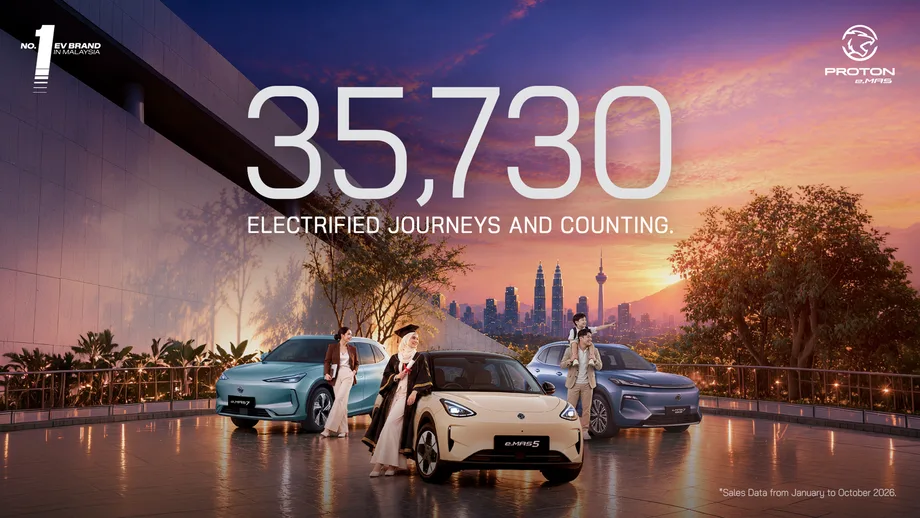
Proton New Energy Technology, known as PRO-NET, reported 35,730 combined domestic and export e.MAS sales for January to October in its November 11 statement. The Proton subsidiary put domestic sales at 34,629 and exports at 1,101.
PRO-NET's domestic breakdown comprised 22,589 e.MAS 5 vehicles, 6,957 e.MAS 7 plug-in hybrids and 5,083 fully electric e.MAS 7 vehicles. It said the brand held 47.3% of Malaysia's battery electric vehicle market, citing JPJ registrations.
A battery electric vehicle runs entirely on electricity stored in a battery. A plug-in hybrid combines a battery that can be charged externally with a petrol engine. The e.MAS total includes both types, while the 47.3% market share concerns battery electric vehicles alone.
PRO-NET chief executive Zhang Qiang described the sales milestone as a reflection of customer support and the wider acceptance of different electrification options.
Surpassing more than 35,000 sales in the first ten months of 2026 is a significant milestone for Proton e.MAS, and one that we share with every Malaysian who has supported and placed their trust in our brand.
For October, PRO-NET reported 3,763 domestic and export sales, including 238 exports. Its domestic figures included 553 fully electric e.MAS 7 sales, while the JPJ registration tally was 554.
The 1,101 exports through October were about 67% above the 659 exported during all of 2025. That expansion follows Proton's planned Singapore return in September 2025 with the e.MAS 7, after an absence of 11 years.
Geely technology now accounts for most Protons
Models based on Geely vehicles accounted for 90,881 Proton registrations through October, or 52.7% of its total. Proton's homegrown models contributed 81,441.
The Geely group includes the X70, X50, X90, S70 and three e.MAS models. These vehicles outsold Proton's homegrown range every month from March, reaching a 61.6% share of Proton registrations in August. Their previous highest annual share was 41.4% in 2022.
Of Proton's increase of 47,202 registrations, 38,905 came from models based on Geely vehicles, about 82% of the growth. The homegrown range added 8,297. Electric and plug-in hybrid vehicles helped move the balance: Geely based petrol models alone totalled 56,251, below the homegrown range.
Malaysian suppliers remain part of that changing production mix. Proton says it bought RM4 billion in parts from Malaysian vendors in 2025 and aims to raise that to RM8 billion by 2030. Assembly of the e.MAS 5 began in Tanjong Malim in the middle of 2026, while the locally assembled e.MAS 7 plug-in hybrid has 30% locally sourced parts.
Proton also has further vehicles planned on its Advanced Modular Architecture, the platform used by the current Saga and for which Proton says it owns the full intellectual property rights. A supplier indicated that AMA02 production would begin in the fourth quarter of 2026. Supplier EP Manufacturing confirmed the AMA05 programme in August, although a firm launch date was not given.
Other brands face an uneven October
Toyota remained Malaysia's third largest brand in October with 11,793 registrations and a 15.7% share. Honda followed with 4,003, while Jetour ranked fifth with 1,700.
Mazda rose 32.1% from September to 1,304 registrations. Its CX-5 nearly doubled to 488 after the launch of a new generation on October 8. BMW returned to the top ten brands with 541 registrations.
Kia reached 208 registrations, nearly three times September's 71, making its first appearance in the top 20 since April 2024. The Sportage accounted for 168 vehicles, alongside a reported RM40,000 rebate that brought its starting price to RM88,800.
Tesla registrations fell 84.9% from September to 106, while BYD declined 45.9% to 333. Across the market, battery electric vehicles accounted for 6.1% of October registrations.
Malaysia's cumulative electrified vehicle totals were much stronger. Through October, 58,129 electric vehicles and 45,204 hybrids had been registered, compared with 44,813 and 31,190 respectively during the whole of 2025. Ten months of electric registrations had already exceeded the previous full year by 13,316 vehicles, while hybrids were ahead by 14,014.
Another annual record depends on the final two months
Malaysia's 715,879 registrations through October were 15,879 above the previous record for the first ten months, set at 700,000 in 2024. October itself was softer, with 75,004 registrations, up 1% from September's 74,259 but down 7.9% from 81,404 in October 2025.
To surpass the full year record of 870,188 set in 2025, Malaysia needs at least 154,310 registrations in November and December. That means an average of 77,155 per month, compared with about 71,588 during the first ten months.
The corresponding two months of 2025 brought 174,832 registrations, including a record 96,967 in December. Repeating the final two months of either 2023, with 157,397 registrations, or 2024, with 156,237, would also be enough to set a new annual record.
Proton enters that final stretch with a broader range of popular models and a larger market share. Perodua retains the stronger total volume and the leading individual model. November and December will determine whether the narrowing monthly gap translates into a further shift in the annual standings.
Key Points
- Proton and Perodua held 62.6% of Malaysia's vehicle market through October 2026, their strongest combined share since 2003.
- Perodua led with 276,042 registrations, down 4.6%, while Proton rose 37.7% to 172,322.
- The e.MAS 5, refreshed Saga and cheaper S70 drove much of Proton's growth.
- Axia won October with 8,035 registrations, but Bezza retained the cumulative lead over Saga by 5,840 vehicles.
- PRO-NET reported 35,730 domestic and export e.MAS sales and a 47.3% share of Malaysia's battery electric vehicle market.
- Malaysia needs 154,310 registrations in November and December to surpass its 2025 annual record.