Eight deliveries will mark Proton's Singapore comeback
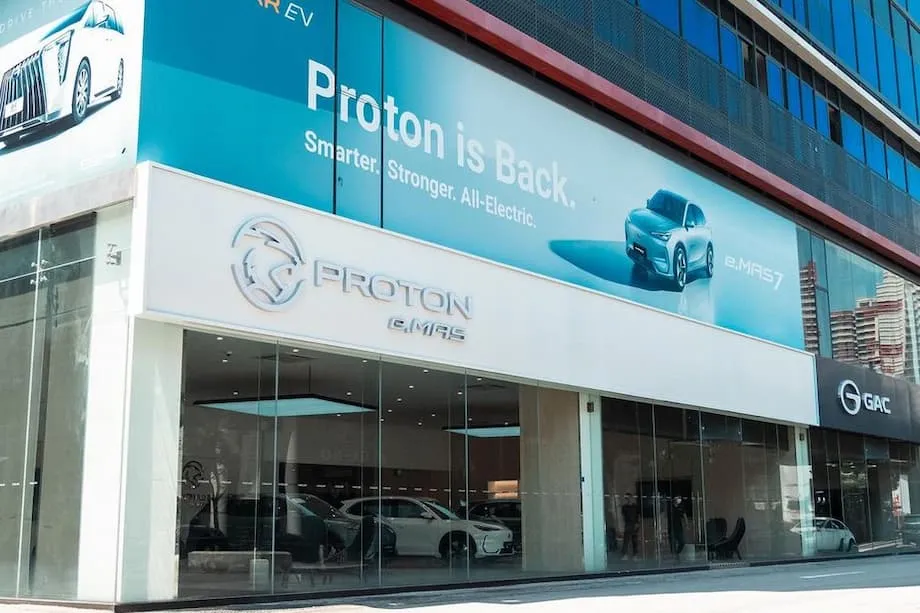
Proton will return to Singapore on September 17, 2025, after an absence of 11 years, opening a showroom in the Leng Kee automotive belt and handing over e.MAS 7 electric SUVs to its first eight customers. The Malaysian national carmaker is rebuilding its presence with an electric model, a limited introductory price of about S$173,988 and planned ownership support extending across the border.
Contents
- Eight deliveries will mark Proton's Singapore comeback
- From a showroom preview to the first handovers
- Why Singapore carries weight beyond its size
- Which e.MAS 7 will Singapore receive?
- Cabin technology and safety shape the pitch
- Why the Singapore price is much higher than Malaysia's
- Charging at home and travelling into Malaysia
- A Malaysian factory with an export purpose
- Can Malaysian sales momentum carry into Singapore?
- A smaller electric model is planned next
- At a Glance
The launch represents a change for a brand once associated in Singapore with affordable sedans. The e.MAS 7, a midsize electric sport utility vehicle launched in Malaysia in December 2024, has become that country's best selling EV. Singapore will join early export destinations including Nepal and Trinidad and Tobago, with Mauritius in the pipeline later in 2025.
Distributor VINCAR Group is expected to offer free servicing for up to 10 years and emergency assistance through 35 e.MAS dealers across Malaysia. For Singapore motorists who regularly drive to Johor or farther north for work and holidays, that support is a practical part of the sales pitch.
Land Transport Authority records show how much ground Proton has to recover. Its Singapore fleet has fallen from about 4,000 cars in the early 2010s to 311 in December 2024. The company now plans to focus on fully electric models, while keeping hybrids under consideration depending on local policies related to vehicle emissions.
Proton's return also coincides with investment at home. On September 4, the company inaugurated its first EV assembly plant at the Automotive High Technology Valley in Tanjong Malim, Perak. Singapore cars will initially come from China, while the new Malaysian facility prepares to support a larger electric vehicle business.
From a showroom preview to the first handovers
Singapore shoppers first saw the e.MAS 7 at The Car Expo 2025 earlier this year. Proton and VINCAR followed that preview with a Founders Edition offer limited to 99 vehicles, carrying a S$20,000 discount from the initial pricing and bringing the advertised starting figure to about S$173,988.
The September 17 handover at VINCAR's Leng Kee showroom will turn that introduction into the start of customer deliveries. Eight owners are scheduled to receive their vehicles on the day Proton formally reestablishes its presence.
The dates place the Singapore return within a wider programme of product launches, manufacturing investment and exports:
- 2017: Zhejiang Geely Holding Group acquired 49.9 percent of Proton, while Malaysian conglomerate DRB Hicom retained 50.1 percent.
- 2019: Proton returned to profitability after several years of losses.
- December 2024: The e.MAS 7 launched in Malaysia.
- Earlier in 2025: Proton previewed the e.MAS 7 at The Car Expo in Singapore.
- September 4, 2025: Proton inaugurated its EV assembly plant in Tanjong Malim.
- September 17, 2025: The Singapore showroom launch and first eight deliveries are scheduled.
- Fourth quarter of 2025: Proton plans to launch the smaller e.MAS 5 in Malaysia.
- By the end of 2025: Proton is targeting completion of preparations for local e.MAS 7 assembly from completely knocked down kits.
Geely's investment has helped reshape Proton's vehicle lineup. The e.MAS 7 is the first electric vehicle under that collaboration and now leads an export push intended to take the company's newer products beyond Malaysia.
Why Singapore carries weight beyond its size
Singapore sells relatively few cars compared with larger markets in Southeast Asia, but its growing EV adoption, expanding public charging network and demanding buyers make it a valuable test for Proton. Customers expect strong safety equipment, dependable software and reliable service, alongside competitive pricing.
Proton chief executive Li Chunrong has described Singapore as a proving ground for the company's electric vehicle business and wider international ambitions. Explaining the market's role to regional media, he said:
"Singapore is a developed market and if we can get good performance in Singapore, I believe we can go to more countries," said Proton CEO Li Chunrong.
Li wants Proton to rank among the top three brands in the fully electric SUV class. He has also acknowledged strong competition from Chinese rivals. Performance in Singapore will help shape the company's approach to further exports, making the launch more than a return to a familiar neighbouring market.
Which e.MAS 7 will Singapore receive?
The e.MAS 7 is a C segment SUV, a vehicle size category, with power sent to the front wheels. Its wider lineup consists of Prime and Premium variants. Singapore cars are slated to follow the Prime specification at launch.
Both variants have one electric motor producing 218 PS, equivalent to 160 kW, and 320 Nm of torque. Power describes the motor's output, while torque describes its turning force. Proton gives a top speed of 175 kmh for both versions.
The Prime has a 49.52 kWh Aegis short blade lithium iron phosphate battery and a stated range of 345 km under the WLTP test cycle. The Premium uses a larger 60.22 kWh battery, with a stated WLTP range of up to 410 km. Battery capacity, measured in kilowatt hours, describes how much energy the pack can store.
WLTP is a standardised vehicle testing cycle that allows buyers to compare range figures. Drivers still need to consider their own daily journeys and charging access when deciding how those figures fit their needs.
Both variants accept AC charging at up to 11 kW. Their DC fast charging limits differ: up to 80 kW for the Prime and 100 kW for the Premium. Proton quotes a charge from 30 to 80 percent in about 20 minutes under optimal conditions. Actual charging time depends on the charger, temperature, the battery's starting charge and battery conditioning.
Singapore buyers will have six colours to choose from: the new Moyu Black, Platinum Silver, Turquoise Green, Slate Grey, Quartz Rose and Lithium White. The initial focus on the Prime specification means buyers should distinguish the local launch vehicle from the Premium when comparing battery size, range and charging power.
Cabin technology and safety shape the pitch
A 15.4 inch touchscreen with 2.5K resolution sits at the centre of the e.MAS 7 cabin. It runs Flyme Auto and is paired with an intelligent cockpit chip manufactured using a 7 nm process. Connected services and infotainment form part of Proton's focus as it expands its electric lineup.
The vehicle also uses a 12 in 1 electric drive system, integrating key power electronics to improve efficiency and packaging. Full LED lighting, 18 inch wheels and a streamlined body with a drag coefficient of 0.275 complete a package intended to balance driving range and ride comfort. The drag coefficient describes how easily a vehicle moves through the air.
Proton has made safety and service central to its Malaysian sales message and intends to carry that approach into Singapore. The company says the e.MAS 7 includes active driver assistance features and claims a water wading depth of 400 mm, presented as an adaptation to regional conditions.
For families, interior space and cabin layout will be important alongside the technology. A showroom visit gives prospective owners the opportunity to assess build quality, infotainment responsiveness and the behaviour of the driver assistance systems before committing to a purchase.
Why the Singapore price is much higher than Malaysia's
The Founders Edition's advertised starting price of about S$173,988 includes the S$20,000 introductory discount. In Malaysia, the e.MAS 7 costs roughly RM105,800 to RM119,800, depending on the variant. Singapore's tax structure and Certificate of Entitlement costs explain the large difference in headline prices.
A Certificate of Entitlement, or COE, is part of Singapore's vehicle ownership system and a major component of the final price. The e.MAS 7 falls into Category B because its motor output exceeds the Category A power threshold. Category B tends to carry a higher COE premium.
The Additional Registration Fee, known as ARF, is another large part of the bill. Electric vehicles can qualify for the EV Early Adoption Incentive, which reduces ARF by up to S$20,000. Incentives under the Vehicle Emissions Scheme can reduce it by up to another S$25,000 for vehicles in the cleanest bands.
Those two programmes can therefore provide combined ARF reductions of up to S$45,000, subject to eligibility and emissions banding. The final vehicle price still depends on the COE clearing price when the car is registered.
Buyers also need to account for optional equipment, financing and insurance when comparing ownership costs. VINCAR's package at the time of booking should be checked for any home charging arrangements and guaranteed COE options. Insurance quotations for the Category B EV and the timing of COE bids will also affect an individual buyer's budget.
The e.MAS 7 is positioned competitively against other Category B electric vehicles once incentives are applied. Proton's challenge is to combine that price with enough space, technology and service support to persuade buyers comparing it with Chinese rivals and established global brands.
Charging at home and travelling into Malaysia
Singapore's charging expansion provides a supportive setting for the launch. Government targets call for about 12,000 chargers across some 2,000 Housing and Development Board parking locations by the end of 2025, followed by 60,000 charging points across the island by 2030. A nationwide shift to clean energy vehicles is planned by 2040.
The e.MAS 7's charging capability is intended to make useful battery top ups possible during errands or a meal stop. Proton's claim of about 20 minutes for a 30 to 80 percent DC charge fits within the capabilities of current charging infrastructure, although the conditions at each stop will determine the actual time.
Home or workplace charging access remains a practical consideration before purchase. For journeys into Malaysia, drivers should check charging availability along their planned routes and the charging policies of hotels where they intend to stay.
VINCAR's expected offer of free servicing for up to 10 years addresses another recurring ownership cost. Buyers should confirm the included work and service intervals in the distributor's package.
The planned emergency assistance network covers 35 e.MAS dealers across Malaysia. That gives the Singapore sales proposition a regional dimension for owners driving to Johor Bahru, Malacca or Kuala Lumpur, where dependable support outside the home market can influence an EV purchase.
Full package terms, including roadside assistance limits in Malaysia and the precise servicing inclusions, still need confirmation at booking. Those details will determine how the advertised support works for an owner travelling across the border.
A Malaysian factory with an export purpose
Proton's new plant at the Automotive High Technology Valley in Tanjong Malim is designed for an initial capacity of 20,000 vehicles a year, with scope to expand to 45,000 as demand grows. The e.MAS 7 will be its first model, followed by the smaller e.MAS 5.
Singapore vehicles will initially arrive as completely built units from Geely's facility in China. Proton has also started work on Malaysian e.MAS 7 assembly using completely knocked down kits, with completion targeted by the end of 2025. Completely built units arrive as finished cars; completely knocked down kits are assembled at the destination plant.
An investment of RM82 million is dedicated to Proton's EV production capability. The manufacturing programme also requires changes among suppliers: electric cars have fewer mechanical parts than vehicles with internal combustion engines, while relying on complex battery systems, power electronics and more semiconductors.
Proton has been connecting Malaysian vendors with Geely's EV suppliers to help them move into new components and meet the necessary quality standards. Exports matter because the Malaysian market alone is not large enough to secure the production scale needed for competitive costs. Singapore, Nepal and Trinidad and Tobago form part of that effort.
Malaysian Prime Minister Anwar Ibrahim placed the factory within a wider industrial ambition at its September 4 inauguration, urging investment in skills and technology as well as production. He said:
"Use the opportunity to establish not only a factory to produce cars but also a centre of excellence for training and education," said Malaysian Prime Minister Anwar Ibrahim at the Tanjong Malim plant launch.
The plant is intended as a base for future new energy vehicles. That term, often shortened to NEV, can include vehicles powered entirely by batteries, plug in hybrids and extended range models. Proton's eventual product mix will depend on demand and policy signals across Southeast Asia.
Can Malaysian sales momentum carry into Singapore?
The e.MAS 7 has delivered a strong start in Malaysia, outpacing rivals such as BYD in recent months. Nearly 5,000 vehicles had been delivered by July 2025, with thousands more on order.
Singapore presents a different competitive setting. COE categories, tightly managed vehicle supply and competition for Category B quotas influence buying decisions alongside the vehicles themselves. Proton will face Chinese brands competing aggressively on price and software, established global manufacturers and Tesla.
Familiarity with Proton's name may help, but its local presence has faded since 2014. With only 311 Proton cars registered by December 2024, VINCAR must rebuild awareness and confidence in the brand as well as introduce an unfamiliar electric model.
Li's target of a place among the top three fully electric SUV brands will require more than a low advertised price. Safety equipment, cabin technology, servicing and assistance in Malaysia are the main parts of Proton's proposed advantage. Buyers will weigh those against competing packages, charging access and the cost of ownership.
A smaller electric model is planned next
Proton plans to launch the e.MAS 5, a B segment hatchback, in Malaysia in the fourth quarter of 2025. The company has indicated two variants with WLTP ranges similar to the e.MAS 7 versions, at about 345 km and up to 410 km.
Singapore availability is expected to follow, potentially in 2026, depending on local policy alignment and market conditions. A smaller, more affordable vehicle would complement the e.MAS 7 rather than leave Proton dependent on a single SUV.
For now, the September 17 return centres on a usable stated range, performance suited to daily driving, a large modern cabin and an ownership package designed for motorists who use both Singapore and Malaysian roads. The first deliveries will begin the test of whether that combination can rebuild Proton's place in the city state.
At a Glance
- Proton returns to Singapore on September 17, 2025, after 11 years, with a Leng Kee showroom and eight initial e.MAS 7 deliveries.
- A Founders Edition offer covers 99 vehicles, starting at about S$173,988 after a S$20,000 introductory discount.
- Singapore launch cars are slated to follow the Prime specification, with a 49.52 kWh battery, 345 km WLTP range and DC charging at up to 80 kW.
- The wider lineup includes a Premium variant with a 60.22 kWh battery, up to 410 km WLTP range and DC charging at up to 100 kW.
- VINCAR is expected to offer free servicing for up to 10 years and emergency assistance through 35 e.MAS dealers in Malaysia.
- Initial Singapore supply will come from China while Proton develops Malaysian EV assembly at Tanjong Malim.
- Proton aims to rank among the top three fully electric SUV brands in Singapore.
- The e.MAS 5 is planned for Malaysia in late 2025, with Singapore availability potentially following in 2026.