Higher bills are changing decisions about care
Japan's higher limits on outpatient medical bills are prompting older patients to delay appointments, reduce tests and ask for less medicine, according to a survey released on November 12, 2026, by the Japanese Medical and Dental Practitioners for the Improvement of Medical Care, known as Hodanren.
Contents
- Higher bills are changing decisions about care
- What changed in August?
- A second increase is already scheduled
- What patients are cutting back
- Cancer, kidney disease and care at home
- Dental treatment is being postponed too
- Why the ministry and doctors disagree
- A cancer example shows the annual stakes
- Key Points
Of 1,029 valid responses from people using the outpatient cost protection or their families, 668, or 64.9%, said medical expenses had increased since August. Among that group, 57.3% reported cutting back on visits or treatment. Some 90.9% were responding by reducing living expenses or drawing on savings.
The findings arrive as the Finance Ministry seeks to abolish the outpatient protection altogether. The ministry argues that other limits on medical payments already provide protection. Hodanren says those arrangements leave gaps for older people who need regular care across several clinics or receive treatment at home.
One patient described by Yoichi Nakamura, a physician providing care at home and Hodanren's policy director, was born in 1934 and has chronic heart failure and respiratory failure. He uses an oxygen concentrator, receives a medical visit every week and has been assessed at care level 5, Japan's highest level of need under its long term care insurance system.
His monthly payment rose from 18,000 yen through July to 22,000 yen in September. Nakamura said it was expected to reach 28,000 yen in August 2027. For someone requiring continuing treatment, the change means finding more money repeatedly, rather than meeting a single unexpected bill.
What changed in August?
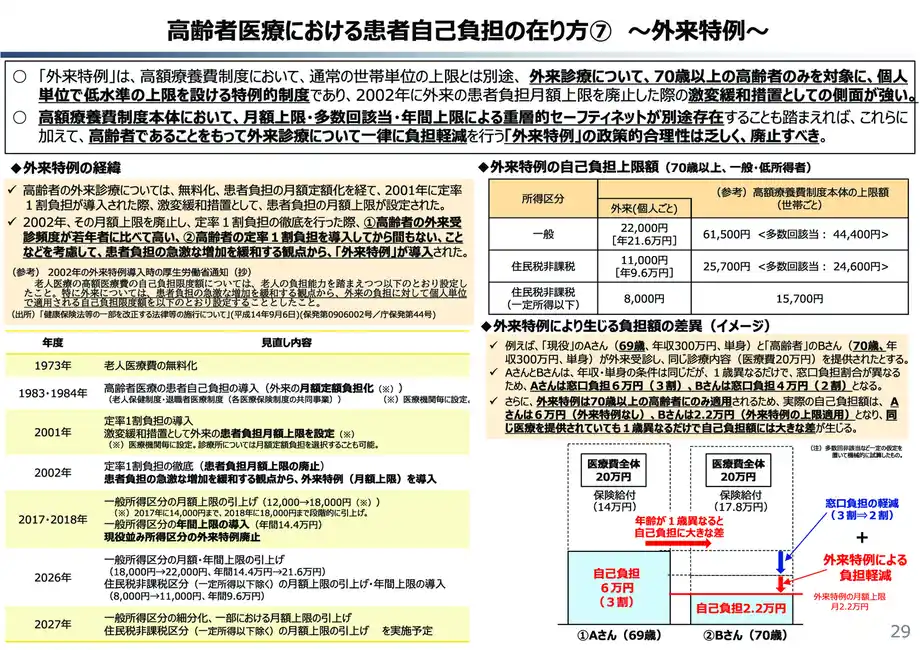
The outpatient special provision is part of Japan's high cost medical expense benefit system. It sets individual monthly and annual limits on eligible outpatient payments for people aged 70 or older with annual incomes of roughly 3.7 million yen or less. Outpatient care includes treatment without admission to hospital, including medical care delivered at home.
Patients normally pay a share of covered medical costs. A cap limits how much they ultimately bear within a specified period. Monthly protection helps with an expensive month, while annual protection matters when smaller bills keep arriving throughout the year.
In August 2026, the monthly outpatient ceiling for the general income category, described as annual income of approximately 1.56 million to 3.7 million yen, increased from 18,000 yen to 22,000 yen. The annual ceiling rose from 144,000 yen to 216,000 yen. Some people exempt from resident tax also faced a monthly increase from 8,000 yen to 11,000 yen.
For those with annual incomes of approximately 2 million to 3.7 million yen, the monthly limit is scheduled to reach 28,000 yen in August 2027. Compared with the original 18,000 yen ceiling, that is an increase of 10,000 yen, or about 56%.
Hodanren's November 12 statement gives conflicting descriptions of the future annual ceiling: its opening explanation lists 261,000 yen for the 2 million to 3.7 million yen income group, while a later cancer treatment example uses 216,000 yen from August 2027. The precise annual limit applicable to that example needs clarification.
A second increase is already scheduled
The survey captures the period after the first increase and before the next scheduled step. The main dates show how quickly the debate has moved from higher ceilings to a proposal to remove the special protection.
- August 2026: The first increase in outpatient payment ceilings takes effect.
- October 30 to November 9, 2026: Hodanren collects online responses from users of the provision and their families.
- November 4, 2026: The Finance Ministry proposes abolition at the Fiscal System Council.
- November 12, 2026: Hodanren releases its survey findings in Tokyo and issues a protest statement.
- August 2027: A second increase is scheduled, including a monthly ceiling of 28,000 yen for the specified income group.
Abolition is a ministry proposal, separate from the scheduled increases. No implementation date for abolition was given.
What patients are cutting back
Yuzo Uesawa, who handled the survey for Hodanren, said respondents reporting higher costs described longer intervals between appointments, temporarily skipping visits, fewer tests and reductions in medicine. These are concrete changes in the amount or frequency of care people receive.
Among respondents whose medical bills increased, 61.5% said they were drawing on savings and 55.5% were cutting food or clothing expenses. The survey also found that 90.9% used some form of reduced living expenditure or savings withdrawal to manage the increase. Families could take more than one of these actions, so the individual percentages are not separate groups that can be added together.
People in the income category of up to 2 million yen reported particular pressure: 59.4% said they had reduced visits or treatment, while 62.8% were using savings. Among people using the outpatient protection at least six times a year, 84.6% reported higher medical expenses.
Hodanren collected responses through an online form rather than a random sample. The percentages describe the people who participated; a national estimate would require a representative survey. The findings nevertheless document decisions reported by hundreds of patients and families already using the protection.
Cancer, kidney disease and care at home
Patients undergoing treatment for stomach cancer and colorectal cancer frequently reported higher expenses. The proportions were 92.0% and 87.5%, respectively. Reductions in visits or treatment were reported by 61.5% of respondents with kidney failure, 60.0% with stomach cancer and 58.6% with cerebral infarction or stroke.
Hodanren also identified pressure among people with designated intractable diseases, a Japanese category covering specified illnesses that are difficult to treat. The disease figures describe different groups within the survey, so they should be read alongside the broader finding that frequent users of outpatient services reported substantial increases.
Among 108 responses involving medical care at home, 80.6% reported higher bills and 68.5% reported drawing on savings. Home treatment can include medical visits, prescriptions and oxygen support, putting it within the reach of an outpatient payment change even when a patient rarely leaves home.
Nakamura, Hodanren's policy director and a physician involved in home care, explained why patients with greater medical needs can face mounting costs:
The more severe the condition becomes, the more medical care is actually used.
The patient born in 1934 illustrates that pressure. His increase from 18,000 yen to 22,000 yen was 4,000 yen in a month, about 22%. The planned move to 28,000 yen would add a further 6,000 yen to his monthly payment when that ceiling applies.
Dental treatment is being postponed too
Dental patients also reported interruptions. Among respondents receiving treatment involving dentures or dental crowns, 54.3% said they had postponed visits or interrupted treatment.
Hodanren's statement warns that delaying work on dentures or restorations can make eating difficult. It raises concerns about poor nutrition, worsening frailty and aspiration pneumonia, an infection that can occur when material such as food or saliva enters the lungs.
The dental findings connect two forms of household pressure identified in the survey: spending less on treatment and spending less on food. For an older person who already has difficulty chewing, both can make daily meals harder to manage. Hodanren presented the health consequences as concerns about what delayed care could lead to.
Why the ministry and doctors disagree
The Finance Ministry's argument, as reproduced in Hodanren's statement, is that the broader high cost medical expense system already contains monthly ceilings, protection for repeated expensive months and annual limits. It considers an additional outpatient reduction based on older age to lack a sufficient policy rationale.
Hodanren argues that the existing arrangements serve different patterns of spending. An older person may have several illnesses, attend different departments and accumulate repeated bills that are individually modest but substantial together.
The association points to a rule under the ordinary monthly ceiling arrangements requiring a patient payment of at least 21,000 yen on an eligible medical billing statement before it can be combined with other qualifying bills. A billing statement records the treatment charged for reimbursement. Hodanren says the threshold and separation of bills can leave costs outside the calculation.
The association says similar restrictions affect the related annual and repeated use protections. Its central argument is that removing the dedicated outpatient provision would leave some patients paying more even though other ceilings remained in place.
Health ministry figures cited by Hodanren show the scale of use: 6.3 million people received the outpatient protection at least once in fiscal 2023, out of 25.3 million eligible insurance members. That is approximately one in four.
A cancer example shows the annual stakes
Hodanren uses a health ministry calculation involving a man in his 70s with stomach cancer and metastatic lung cancer to illustrate the proposed abolition. His annual income is approximately 2.1 million yen, and the treatment costs total about 2.33 million yen.
At a patient payment rate of 20%, his share before the special protection is approximately 466,000 yen. Under the outpatient annual ceiling in place through July 2026, his payment was limited to 144,000 yen.
Hodanren says abolition would leave him paying approximately 466,000 yen because his payments in individual months would remain below the ordinary monthly ceiling of 61,500 yen. The example shows how a large annual expense can build up without any single month triggering a refund under a monthly limit.
The difference between 144,000 yen and 466,000 yen is 322,000 yen. The higher figure is more than three times the earlier protected payment and equals about 22% of the man's annual income of 2.1 million yen. The earlier payment represented about 7%.
Shogo Honami, Hodanren's deputy secretary general, used the example to challenge the affordability of the proposal. Nakamura also warned that patients needing substantial care at home could eventually abandon treatment as medical payments and long term care insurance costs put pressure on their finances.
The immediate changes are already visible in the survey: patients report drawing down savings, reducing basic spending and receiving less care. The next scheduled increase is August 2027, while the separate proposal to abolish the outpatient protection remains under debate.
Key Points
- Hodanren received 1,029 valid survey responses; 668 reported higher medical expenses after the August 2026 changes.
- Among those reporting higher costs, 57.3% reduced visits or treatment and 61.5% drew on savings.
- The general monthly outpatient ceiling increased from 18,000 yen to 22,000 yen. A ceiling of 28,000 yen is scheduled for the specified income group in August 2027.
- Cancer patients, frequent users of the protection and people receiving medical care at home reported substantial financial pressure.
- The Finance Ministry has proposed abolition. Hodanren argues that other payment ceilings would leave gaps for patients with recurring outpatient bills.
- The survey was voluntary and conducted online. Its figures describe respondents rather than a representative sample of all eligible older people.