Higher patient bills could leave workers paying more too
Japan is considering making more people aged 70 and older pay 30% of their insured medical bills, but a Health Ministry document identifies a financing problem: expanding that group without changing how its care is funded could increase the burden on working people.
Contents
- Higher patient bills could leave workers paying more too
- What patients currently pay
- Where the coalition parties disagree
- Who counts as having income comparable to workers?
- Why higher copayments may not reduce premiums
- Patients could also face higher monthly limits
- Regular treatment makes small rate changes matter
- Older households have very different resources
- How the decisions fit together
- Key Points
The Ministry of Health, Labour and Welfare set out the issue in its November 13 briefing for the Social Security Council's Medical Insurance Committee in 2025. Older patients classified as having income comparable to current workers receive no public funding toward their insurance benefits. Expanding that category would shift more financing onto contributions from insurance schemes covering working people.
The Liberal Democratic Party and its coalition partner, Nippon Ishin no Kai, also known as the Japan Innovation Party, began formal discussions on October 21, 2025. They sought a reform roadmap by the end of that year, while the ministry's committee aimed to settle a policy direction over the same period.
The proposal brings together three difficult decisions: which older patients can afford higher bills, how much protection people receiving regular treatment should retain, and whether taxpayers or insurance contributors should cover the remaining costs.
Ishin wants a standard copayment of 30% for older adults. The LDP is more cautious about the effect on household finances. Their shared commitment to payments based on ability to pay leaves substantial choices about income thresholds, age rules and funding.
What patients currently pay
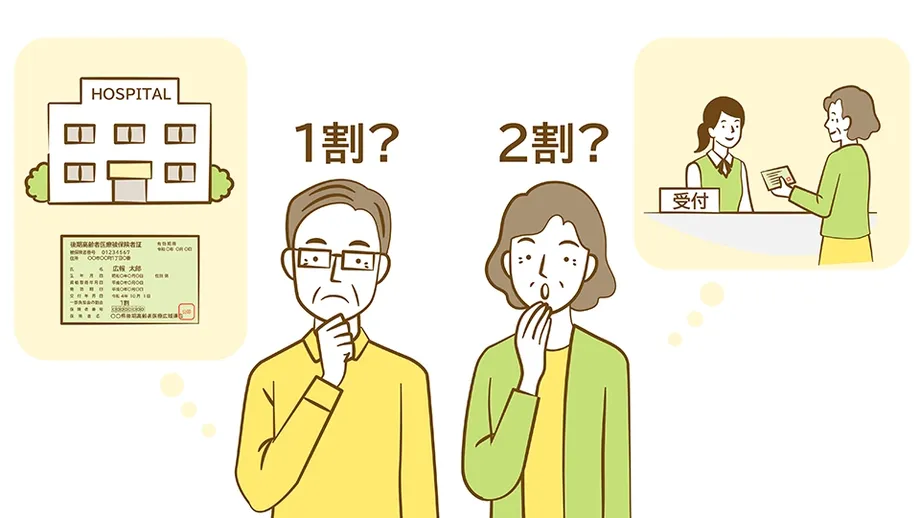
Japan's copayment is the share of an insured medical bill paid by the patient. For most people from school entry through age 69, that share is 30%. The standard rate falls to 20% at ages 70 to 74 and to 10% from age 75.
Income changes those rules. People aged 75 and older with a specified level of income pay 20%, while people aged 70 and older classified as having income comparable to current workers pay 30%.
For an insured bill of 10,000 yen, those rates mean an initial patient payment of 1,000, 2,000 or 3,000 yen. Moving from 10% to 30% triples that payment; moving from 20% to 30% increases it by half. Monthly spending limits can reduce the final amount for patients with large bills.
Age also affects insurance membership. At 75, people generally move into the separate medical insurance system for older adults, whether they are still employed or retired. Some people aged 65 to 74 with qualifying disabilities also belong to it. Negotiators have therefore called for the different arrangements for ages 70 to 74 and ages 75 and older to be considered separately.
Where the coalition parties disagree
Ishin argues that a standard 30% contribution for older patients would bring their treatment closer to that of working people and help reduce the burden on younger generations. The LDP is concerned about applying that rate broadly to people whose income may be limited to pensions.
The parties agreed to discuss medical copayments before the other 12 items in their package of 13 social security reforms. Their October 20, 2025, coalition agreement called for genuinely fair contributions based on ability to pay, regardless of age.
Norihisa Tamura, a former health minister and acting LDP policy chief, told the October 21 meeting that the consequences for households required serious discussion:
The agreement reached here will have a major impact on people's lives, so I want us to discuss it seriously.
Satoshi Umemura, Ishin's policy chief, described the balance his party wanted to strike:
We will discuss this while considering the balance between good social security and the sustainability of Japan as a whole.
The disagreement concerns the route to that balance. Lowering income thresholds would bring selected households into the 30% category. Changing age thresholds would alter when people become eligible for lower rates. A standard 30% rate would reach a much broader group.
Who counts as having income comparable to workers?
The current test combines taxable income with household revenue. For people in National Health Insurance and the medical insurance system for older adults, it generally requires at least one insured household member to have taxable income of 1.45 million yen or more, alongside combined annual revenue of at least 3.83 million yen for one insured person or 5.2 million yen for multiple insured people.
Taxable income is the amount remaining after relevant deductions. Annual revenue is measured before some of those deductions. The two figures therefore describe different stages of the calculation.
For employees aged 70 to 74, the first part of the test instead uses a standard monthly remuneration amount of at least 280,000 yen, together with the applicable revenue requirement. Household composition and insurance membership matter when determining the rate.
The ministry says the criteria have not been revised since 2006. A November 5, 2025, Fiscal System Council discussion cited in its briefing put the share of people in the older adult system classified as having income comparable to workers at about 7%.
Simply updating the old calculation for newer wages would raise the thresholds. The ministry illustrated that using fiscal 2023 earnings and deductions would produce a taxable income figure of 1.5 million yen, with revenue thresholds of 4.25 million yen for a single person and 5.65 million yen for a couple. Broadening the 30% group would therefore require reconsidering the design of the test, rather than merely refreshing its figures.
Why higher copayments may not reduce premiums
The usual financing arrangement for the medical insurance system covering people aged 75 and older divides benefits, after patient copayments, roughly three ways: 50% from public funds, 40% from contributions by insurance schemes covering working people, and 10% from older members' premiums.
Patients in the 30% category are treated differently. Public money does not fund their insurance benefits, so contributions from working generations take on the portion that public funds would otherwise cover.
The ministry warns that moving more patients into this category under the existing rules would increase the support contribution burden on working generations. Patients would pay more at the hospital, while the financing of the remaining bill would move further toward workers' insurance schemes.
The National Federation of Health Insurance Societies, known as Kenporen, has proposed coupling any expansion of the 30% group with public funding for that group's benefits. It estimates that introducing public funding for people already paying 30%, on the same basis as those paying 10% or 20%, would require about 520 billion yen annually.
That estimate concerns funding for the existing 30% group. The government would need a stable revenue source to meet the expense. The debate therefore extends beyond the patient's payment to how costs are divided among taxes, premiums and contributions between insurance systems.
Patients could also face higher monthly limits
Japan's high medical expense benefit system limits eligible patient payments when treatment becomes expensive. The ceiling depends on income and other conditions. For many older patients, a separate outpatient limit provides protection for repeated visits without hospital admission.
The ministry's November briefing warns that entering the income category associated with a 30% copayment would also move patients into a higher ceiling category and remove them from the special outpatient arrangement.
For people aged 75 and older in the general and 20% categories, the briefing lists an outpatient ceiling of 18,000 yen a month, with an annual ceiling of 144,000 yen. The combined monthly household ceiling for outpatient and inpatient care is generally 57,600 yen, subject to rules including reduced limits after repeated expensive months.
The 30% categories have higher ceilings. At the lowest of those income bands, the combined monthly ceiling starts at 80,100 yen, plus 1% of eligible medical expenses above 267,000 yen. Higher income bands have higher limits.
A patient receiving regular treatment could therefore face two changes together: a larger share of each bill and a higher amount to pay before the monthly ceiling applies. The ministry has asked that copayments and protection against high medical expenses be considered together.
Regular treatment makes small rate changes matter
Older patients use care more frequently. Fiscal 2023 data in the ministry's briefing show that about four in 10 outpatient users in the older adult insurance system received treatment every month.
Only about one in 10 used outpatient services in two months or fewer during the year. The corresponding share in employee insurance and National Health Insurance was about three in 10.
The ministry also reports that annual medical spending per person in fiscal 2023 was approximately 1.14 million yen for those aged 85 and older, compared with 631,000 yen for those aged 70 to 74. The figure for the older group was about 1.8 times as large.
Other data in the briefing show that older people tend to have more illnesses, with treatment for circulatory conditions becoming more common as age rises. At the same time, annual inpatient and outpatient treatment days across several older age groups have fallen compared with fiscal 2008.
For households, the practical issue is repeated expenditure. A higher payment for a single appointment may be manageable for some patients, while monthly visits and several conditions make the increase a continuing claim on pension income.
Older households have very different resources
The ministry's figures show rising average income among older insurance members, particularly those aged 75 to 79. Wage income and declared interest and dividend income have grown, and the share recorded as having no income has declined.
Many older people still have limited annual resources. Data on income in 2021 show that more than half of individuals aged 75 and older received less than 1.5 million yen a year.
Savings are unevenly distributed too. More than 40% of households headed by someone aged 75 or older had savings of at least 10 million yen, while 13.7% had no savings, according to figures presented in the briefing.
Committee discussions have consequently covered financial income and assets as well as wages and pensions. Members have also called for close examination of households exempt from resident tax and people with limited ability to increase their earnings.
Working households face different demands. The ministry's household spending comparisons show greater expenditure on education among working generations. Policymakers are weighing those costs against older patients' lower incomes and greater need for treatment when deciding what ability to pay should mean.
How the decisions fit together
The latest discussions follow an earlier increase for some people aged 75 and older. The government's copayment guidance explains that the 20% rate introduced in October 2022 was expected to cover about 20% of members, approximately 3.7 million people.
That rate generally applies when an insured household member has taxable income of at least 280,000 yen and the relevant pension revenue plus other income totals at least 2 million yen for one insured person or 3.2 million yen for multiple insured people, unless the 30% category applies.
- October 1, 2022: The 20% rate began for people with specified incomes in the older adult insurance system.
- December 22, 2023: A Cabinet reform roadmap included consideration of revised criteria for the 30% category by fiscal 2028.
- September 30, 2025: Temporary protection limiting the monthly outpatient payment increase associated with the 2022 change to 3,000 yen ended.
- October 20 and 21, 2025: The coalition agreement committed to payments based on ability to pay, and party negotiators began formal talks.
- November 13, 2025: The ministry presented its analysis of income criteria, patient protections and financing.
The October coalition agreement envisaged agreement on concrete reform outlines during fiscal 2025, followed by detailed system design during fiscal 2026 and implementation in stages. Negotiators also sought a roadmap by the end of calendar 2025. The discussions described here had not settled new thresholds, the number of people affected or a starting date for higher payments.
Key Points
- Japan is considering expanding the group aged 70 and older paying 30% of insured medical bills.
- Ishin supports a standard 30% rate for older adults; the LDP is cautious about household costs.
- The income criteria used for the 30% category have not been revised since 2006.
- The Health Ministry warns that expansion without funding changes would increase contributions from working generations.
- Patients moved into the higher income category would also face higher monthly spending ceilings and lose special outpatient protection.
- The negotiations sought a roadmap by the end of 2025, with detailed design envisaged during fiscal 2026.