A million exchanges turn invented words into shared meaning
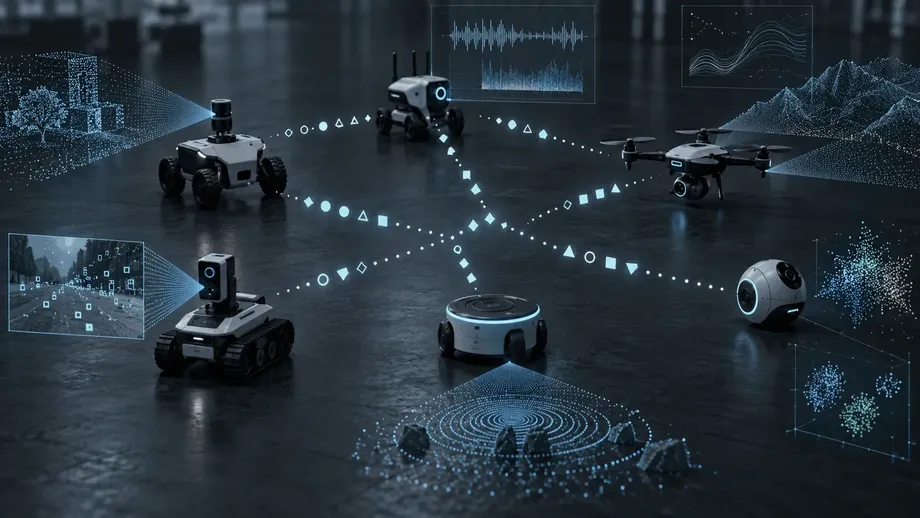
Ten artificial intelligence agents, starting with empty vocabularies, learned to identify objects for one another with up to 99.76% success after one million interactions in experiments by researchers at Vrije Universiteit Brussel (VUB) and the University of Namur in Belgium. Their words and meanings developed through repeated exchanges, rather than through a dictionary written by humans.
Contents
- A million exchanges turn invented words into shared meaning
- How a word becomes useful
- What the agents store as meaning
- How well did the shared vocabularies work?
- Different sensors can still support agreement
- A vocabulary that changes when inputs disappear
- Larger groups need more exchanges
- People can inspect what a word refers to
- Publication, collaboration and possible uses
- Key Points
The researchers tested their method on 37 public datasets, ranging from chemical measurements of wine and NASA exoplanet data to photographs of birds and human faces. Across seven highlighted datasets, success on test interactions ranged from 95.77% to 99.76%.
The central achievement was an agreement about how to refer to things. Each agent kept its own associations between invented words and observed properties. Through feedback, those individual associations became compatible enough for the group to communicate, even when members perceived their environment differently.
The research paper, titled Emergent Communication in Continuous Worlds: Self-Organisation of Conceptually Grounded Vocabularies at Scale, describes experiments in computer simulation. The agents worked with numerical representations of objects and images. Robots, autonomous vehicles and industrial sensors are possible applications that the researchers identify for this approach.
How a word becomes useful
Two agents take part in each exchange. One becomes the speaker and the other the listener, with roles assigned anew as interactions continue. Both encounter a scene containing several entities, but only the speaker is told which entity is the target.
The speaker must choose a word that helps the listener pick that target. If its vocabulary has no suitable word, it invents one. The paper uses arbitrary strings of three syllables, such as "demoxu", so the label itself carries no built-in meaning.
The listener compares the word with its own stored concepts and chooses an entity. Both agents receive feedback about whether the choice was correct. After a failure, the target is revealed to the listener, giving it information with which to revise its understanding.
Researchers supplied the procedures for inventing words, representing concepts and learning from outcomes. The particular vocabulary and the categories attached to it emerged during interaction. Successful exchanges strengthen useful associations, while subsequent experience adjusts the concepts attached to words.
Katrien Beuls, a professor at the University of Namur and a coauthor, described how local exchanges produce agreement across a population in the university announcement:
What's fascinating is that there's no central computer imposing the rules. Each time, we let two agents communicate with one another at a local level. It is solely through these individual interactions and updates that a global convention emerges spontaneously across the entire population.
What the agents store as meaning
Each entity reaches an agent as a feature vector, a list of values describing its properties. A wine sample, for example, can be represented by chemical measurements. An image can be represented by numerical features extracted by a vision system.
A word is linked to a conceptual prototype: a mathematical description of the kinds of observations to which it applies. The prototype records typical values, how much those values vary, and which features matter most. This lets an agent judge how closely a newly encountered entity fits a familiar word.
Context also matters. The speaker searches for a word whose concept fits the target better than the other entities in the scene. A useful word therefore helps distinguish something from its immediate alternatives, rather than simply attaching a permanent label to every object.
Agents keep these representations privately. They have no access to one another's internal settings or to a central knowledge base. Shared communication develops because their words guide compatible choices, while their individual representations remain tied to their own observations.
For the image datasets, the researchers used features with 384 dimensions from DINOv2, an existing vision encoder. A vision encoder turns an image into a numerical description that other software can process. The vocabulary learning then operated on those descriptions.
How well did the shared vocabularies work?
The standard experiments trained populations of 10 agents over one million interactions. Researchers then evaluated communication over 100,000 test interactions, including entities held apart from training, and averaged the results across 10 independent runs.
The seven highlighted results show both the strength of the method and the variation between tasks:
- CLEVR, a dataset involving visual object attributes: 99.76% communicative success.
- Wine analysis data: 99.76%.
- Exoplanet data: 99.67%.
- Mushroom data: 98.10%.
- MS COCO image data: 95.77%.
- CelebA face images: 96.66%.
- Bird images: 95.88%.
These percentages measure how often the listener selected the intended entity. For the wine and CLEVR tasks, 99.76% corresponds to roughly 24 unsuccessful exchanges in every 10,000 test interactions. For MS COCO, 95.77% corresponds to roughly 423 in every 10,000.
The gap between those results is 3.99 percentage points. Communication remained highly successful across the highlighted tasks, but the natural image datasets produced more mistakes than the wine and exoplanet tasks.
The team also measured vocabulary size and convention agreement, which tracks how consistently agents use words. Those measures address different parts of the process: a population needs both a workable set of labels and enough agreement about their use to identify targets reliably.
Different sensors can still support agreement
Machines rarely observe the world in exactly the same way. Sensors may have different calibration settings, readings can contain noise, and one device may capture properties that another cannot detect. The study tested variations of these conditions.
Paul Van Eecke, a professor of artificial intelligence at VUB and a coauthor, explained the motivation using the example of people identifying a red car. People can understand the same description even though their eyes register slightly different colour values. The shared word sits above those individual readings.
The experiments applied that idea to artificial agents by changing their observations. They included numerical offsets resembling calibration differences, noise in observed values and populations whose members had different sets of available features.
Under strong noise in the CLEVR experiments, communicative success was 87.67%. In a condition with larger differences in available sensors, success was 83.47%. The method retained substantial ability to coordinate under these conditions, with lower accuracy than in the standard CLEVR experiment.
The paper describes populations with different perceptual structures as heteromorphic. In plain terms, their members receive different kinds or amounts of information. Their task is to develop compatible references despite those differences, using the observations each member can access.
A vocabulary that changes when inputs disappear
The researchers also tested an abrupt loss of information during learning. In one experiment, half of the inputs standing in for sensor readings were removed midway through the process. Communicative success after that change reached 93.82%.
Continued interaction gives the agents opportunities to revise their concepts as conditions change. A word associated with several features can become useful in a different way when some of those features disappear and the remaining observations take on greater importance.
The paper also reports adaptation to environmental changes. This makes ongoing learning a central part of the approach: the population builds a convention through use and continues adjusting it as its observations change.
For a future machine system, that capacity could matter when equipment degrades or operating conditions shift. The immediate experimental finding concerns agents adapting their vocabulary within the simulated tasks.
Larger groups need more exchanges
The study examined populations of 2, 10, 25, 50 and 100 agents. Expanding a population changes how widely each useful word must spread, because exchanges still take place between individual pairs.
In CLEVR experiments with 100 agents, communicative success reached 92.69% after one million interactions. Extending training to 10 million interactions raised success to 99.16%, an increase of 6.47 percentage points.
The interaction budget helps explain the scale of that challenge. If participation is evenly distributed, one million exchanges involving two agents each provide an average of 200,000 participations per agent in a group of 10. In a group of 100, the same number of exchanges provides an average of 20,000 participations per agent.
Ten million exchanges restore that average to 200,000 participations for each member of a population of 100. Individual encounters are selected randomly, but this comparison shows why a larger group can need a much larger total learning budget to spread its conventions.
People can inspect what a word refers to
The researchers describe interpretability as an advantage of their design. A word points to a prototype whose values and feature weights can be examined. Researchers can trace which observations helped form a concept and how its representation changes through use.
For a dataset with named chemical measurements, inspection can connect a word to particular ranges of those measurements. For image data, the concept is linked to features produced by the vision encoder, so explaining its meaning also involves understanding those numerical image representations.
Jérôme Botoko Ekila, a doctoral researcher at VUB's Artificial Intelligence Laboratory and a coauthor, described the purpose of letting agents construct concepts around their own perceptions:
They construct effective concepts that correspond exactly to what they perceive via their sensors, even if the data is incomprehensible to humans.
Human oversight would involve examining those associations as they develop. A useful check is whether two agents applying the same word continue selecting the intended entity after their inputs or environment change. The study's feedback mechanism makes that relationship central to learning.
Publication, collaboration and possible uses
The work brings together Jérôme Botoko Ekila, Lara Verheyen, Jens Nevens and Paul Van Eecke at VUB, and Katrien Beuls at the University of Namur. Funding came from the Research Foundation Flanders (FWO) and the Belgian National Research Fund (FNRS) through the WEAVE project.
VUB's publication record identifies the journal as Transactions of the Association for Computational Linguistics, volume 14, pages 2234–2257, with DOI 10.1162/TACL.a.799. It lists publication in August 2026.
The publication and announcement followed this sequence:
- April 2026: The paper was submitted.
- May 2026: The paper was revised.
- August 2026: The university publication record lists the journal publication.
- October 14, 2026: The university announcement presented the findings.
The researchers identify autonomous vehicles, robots and industrial sensors as potential users of communication adapted to machine perceptions. Lidar measures distance using light, sonar uses sound, infrared sensors detect radiation associated with temperature, and chemical instruments measure substances. A shared vocabulary could help machines refer to useful patterns across such inputs.
The next practical step would be testing how these conventions work with physical equipment, changing surroundings and operational demands. No deployment timetable was given. For now, the result is a tested method for building shared references across diverse data, with measurable performance under noise, perceptual differences and lost inputs.
Key Points
- Researchers at VUB and the University of Namur tested vocabulary formation across 37 public datasets.
- Groups of 10 agents trained through one million interactions, then underwent 100,000 test interactions.
- Success ranged from 95.77% to 99.76% across seven highlighted datasets.
- Researchers supplied learning procedures; agents developed the particular words and associated concepts through feedback.
- Experiments tested adaptation to noisy observations, different perceptual structures and missing inputs.
- A population of 100 agents reached 99.16% success on CLEVR after 10 million interactions.
- The study used computer simulations. Applications in robots, vehicles and industrial sensors are proposed uses.