Four black hole systems reveal an early warning
A shrinking disk of gas and a decline in flickering X-rays could give astronomers between one and 10 days to prepare for a black hole jet. Researchers at the University of Toyama and Nagoya University found those warning signs in four black hole systems, opening a way to arrange observations before narrow streams of plasma erupt at nearly the speed of light.
Contents
- Four black hole systems reveal an early warning
- What changes before a jet erupts?
- Why the disk's inner edge matters
- How an older eruption led to the forecast
- Reading the warning in X-rays
- A sudden flood of gas was not the trigger
- Turning a warning into coordinated observations
- What the next observations could test
- At a Glance
The team consists of Toshihiro Kawaguchi, a professor at the University of Toyama, and Kazutaka Yamaoka, an associate professor at Nagoya University's Institute for Space-Earth Environmental Research. Toyama University's research announcement describes their work as the world's first method for forecasting these eruptions. The findings were published in The Astrophysical Journal on November 5, 2026, Japan time.
The advance builds on a result published in April 2025: jets appeared when the inner edge of a gas disk rapidly moved toward the black hole and reached a particular orbital boundary. The new study found a shared warning pattern across four objects rather than just the original system.
For astronomers, the practical benefit is time. An unexpected eruption can begin before the right telescopes are watching. A warning could allow teams to coordinate instruments, take measurements more frequently and follow the same event through different kinds of light.
What changes before a jet erupts?
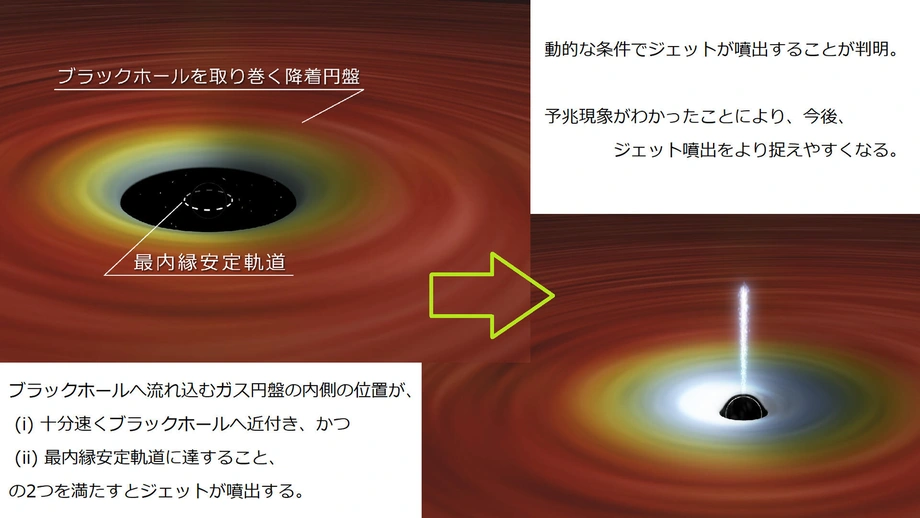
The researchers examined XTE J1859+226, XTE J1550-564, GX 339-4 and MAXI J1820+070. Each is a black hole binary, a system in which a black hole and a companion star orbit one another. Gas flowing toward the black hole forms a hot, rotating structure called an accretion disk.
All four systems showed decreases in two measurements between one and 10 days before jet activity: the disk's inner radius and the size of fluctuations in X-ray brightness. The inner radius describes how close the disk's inner edge lies to the black hole. Smaller fluctuations mean the X-ray emission is flickering less strongly.
The findings are set out in the team's jet forecast paper, titled Jet Forecast: Timing of Discrete Jet Ejections of Stellar-Mass Black Holes Anticipated via X-ray Properties. Its proposed alert condition combines continuing decreases in both measurements with evidence that the disk is approaching its innermost stable orbit.
The interval of one to 10 days describes the advance warning found in the observations. The study's forecasting approach still needs testing through observations organised in response to future alerts; no date for such a campaign was given.
Why the disk's inner edge matters
A black hole's gravity is so strong that light cannot escape from inside its event horizon. The gas involved in a jet is outside that boundary, in the surrounding environment. Plasma, the material carried by the jet, is gas whose particles have become electrically charged.
The disk's critical boundary is called the innermost stable circular orbit, or ISCO. It is the closest circular path on which matter can continue orbiting stably. Farther inward, matter can no longer maintain a stable circular orbit and moves rapidly toward the black hole.
Nagoya University's 2025 research announcement gives an ISCO radius of about 64 kilometres for the system examined in that earlier work, XTE J1859+226. The relevant boundary depends on the black hole, so the forecast follows the disk's approach to that object's ISCO.
The team's proposed trigger has two parts: the disk edge must move inward sufficiently quickly, and it must reach the critical orbit. Tracking movement over time therefore matters as much as measuring where the disk sits at a particular moment.
How an older eruption led to the forecast
XTE J1859+226 provided the starting point. Its black hole has about five times the Sun's mass, and its companion star has roughly the Sun's mass. During the activity examined by the researchers, the system produced five or six jet eruptions over 20 days, giving them several events to compare.
The earlier analysis used observations from 1999 and 2000. Researchers compared how quickly physical properties inferred from X-rays changed with the total energy recorded in radio observations. In simple terms, they examined both how fast the disk was changing and how much radio energy accompanied the jet activity.
The result connected jet eruptions with rapid inward movement of the disk edge toward the ISCO. The newer investigation then examined three more binaries to test whether that behaviour appeared elsewhere. Its shared warning pattern extends the finding from one system to four.
The research developed through these stages:
- 1999 to 2000: Observations of XTE J1859+226 recorded the activity later used to investigate the connection between disk changes and jets.
- April 8, 2025: The initial study was published in Publications of the Astronomical Society of Japan.
- November 5, 2026: The study extending the forecast method to four binaries was published in The Astrophysical Journal, according to Toyama University.
- November 12, 2026: The forecasting findings were described publicly in coverage of the university's announcement.
Reading the warning in X-rays
The investigation drew on X-ray and radio observations, including data from the Rossi X-ray Timing Explorer satellite, known as RXTE, and the NICER and MAXI instruments aboard the International Space Station. These observations let researchers connect changes near the black hole with later jet activity.
X-rays carry information about the hot gas close to a black hole. Researchers use their energy distribution to estimate properties of the disk, including its inner radius. They also measure how much the brightness varies, expressed in the paper as a fractional variability amplitude.
At least two of the systems showed the disk edge beginning to shrink before the decline in X-ray variability began. That sequence makes continued measurement of the inner radius especially useful: it could provide an earlier indication that conditions are changing.
The study also connects the disk's movement with previously recognised changes in X-ray hardness and flickering. Hardness describes the balance between X-rays of higher and lower energy. As the disk moves inward, its steadier emission becomes more prominent relative to the strongly fluctuating emission from the hotter region nearby.
A sudden flood of gas was not the trigger
The researchers also examined the accretion rate, meaning how much gas flows toward the black hole in a given time. Across the four systems, they found no huge increases in that rate before jet ejections. That result challenges explanations in which a sudden rush of incoming gas is required to launch a jet.
Two systems, XTE J1859+226 and MAXI J1820+070, produced jets while accretion remained below the Eddington rate. This is a reference level associated with the balance between gravity pulling gas inward and pressure from radiation pushing outward.
The authors conclude that models requiring either a large increase in the gas supply or accretion above the Eddington rate are unlikely explanations for these events. Their measurements instead direct attention toward the changing structure of the inner disk.
Nagoya University's earlier announcement likewise argued that theories built around fixed conditions would need revision to account for the role of rapid change. The disk's inward motion gives theorists a measurable process that their explanations of jet formation must address.
Turning a warning into coordinated observations
A future alert would be based on repeated measurements showing the inner radius and X-ray variability continuing to fall while the disk approaches the ISCO. Astronomers could then request target-of-opportunity observations, arrangements that allow a telescope to respond to a developing event outside its ordinary schedule.
Kawaguchi said the forecasting method would allow researchers to prepare observations on a firmer basis, obtain sensitive measurements more frequently and examine brightness changes at different wavelengths. X-rays reveal conditions near the black hole, while radio observations help follow the jet.
The practical gain comes from recording the transition. Watching before, during and after an eruption would give researchers a fuller sequence than observations that begin once the jet is already active. Several instruments watching together could connect changes in the disk with the appearance and evolution of the outflow.
The 2025 work also identified circumstances in which a jet was unlikely to erupt soon. That gives observatories another useful guide: they can concentrate limited observing time on periods when the disk's behaviour points toward an approaching event.
What the next observations could test
The four binaries contain black holes with masses comparable to those of stars. The researchers plan to investigate whether the forecasting approach also works for much larger black holes, including those at the centres of galaxies. Those objects can contain hundreds of thousands to billions of times the Sun's mass.
Jets from large black holes can reach far beyond their host galaxies and affect the gas from which stars form. Establishing when those jets turn on would help researchers examine how black hole activity influences a galaxy's growth.
Future observations could also test the role of black hole rotation. If rapid rotation is essential to producing a jet, a slowly rotating black hole might show the disk warning signs without an eruption. Comparing predictions with what actually happens across more systems would help separate competing explanations.
Cosmic rays provide another reason to pursue the work. These are energetic particles travelling through space, and black hole jets are considered a potential major source. Toyama University identifies understanding their origin as a longer term goal. Catching jets as they begin could give scientists better data on how particles gain such high energies.
At a Glance
- Researchers at Toyama and Nagoya universities found shared warning signs one to 10 days before jet activity in four black hole binaries.
- The signs were a shrinking inner disk radius and declining fluctuations in X-ray brightness.
- The proposed forecast tracks the disk's approach to the innermost stable circular orbit.
- No huge rise in the gas accretion rate preceded the jets; two systems produced them below the Eddington rate.
- The method could help observatories coordinate measurements before an eruption begins.
- Future work will examine more systems and whether the approach applies to much larger black holes.