A solar financing deal tied to verified results
Norway has agreed to purchase up to 12 million tonnes of verified emissions reductions from renewable electricity projects in Indonesia, creating a potential source of funding worth $240 million to $480 million at the prices Indonesian officials have indicated. Payment will depend on projects delivering independently verified results, rather than simply receiving approval or beginning construction.
Contents
- A solar financing deal tied to verified results
- What Norway is buying
- How the incentive reaches power producers
- Why floating solar and batteries come first
- How reductions will be checked
- What the price and timetable mean
- From the 2025 framework to the 2026 contract
- Where the deal fits in Indonesia's electricity plans
- A partnership expanding beyond forests
- Key Points
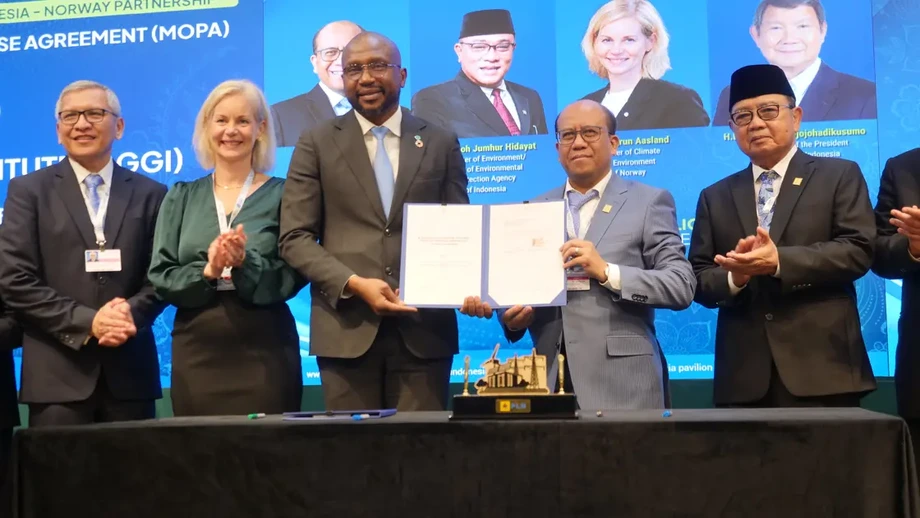
The Mitigation Outcome Purchase Agreement (MOPA) was signed on 11 November 2026 at the Indonesia Pavilion during the COP31 climate summit in Antalya, Türkiye. Indonesia's state electricity company, PT PLN, signed with the Global Green Growth Institute (GGGI), acting on Norway's behalf. Norwegian Climate and Environment Minister Sigrun Aasland and Indonesian Environment Minister Moh Jumhur Hidayat witnessed the ceremony.
The initial focus is floating solar power, with priority for projects paired with batteries that can supply electricity during periods of heavy demand and after sunset. Norway's Ministry of Climate and Environment says coal supplies more than 70 percent of Indonesia's electricity, while solar and wind together contribute less than one percent.
GGGI's agreement announcement identifies the contract as Indonesia's first MOPA to put Article 6.2 of the Paris Agreement into operation. The mechanism lets countries cooperate on emissions reductions and transfer the resulting credits under international accounting rules.
The practical aim is to make additional clean electricity projects financially possible. A developer would earn money from selling electricity and receive a further payment for verified emissions reductions. For projects facing expensive batteries, new transmission connections or other substantial costs, that second revenue stream could help attract financing.
What Norway is buying
Norway is purchasing emissions reductions generated in Indonesia. A carbon credit represents a measured quantity of greenhouse gas emissions avoided or reduced. The agreement's ceiling of 12 million tonnes is expressed in carbon dioxide equivalent, a common unit used to compare the warming effects of different greenhouse gases.
Indonesia can generate those reductions when additional renewable electricity replaces electricity that would otherwise come from fossil fuels. Once the reductions have been measured, checked and authorised, they can be transferred to Norway as Internationally Transferred Mitigation Outcomes, known as ITMOs.
Norway can use transferred reductions towards its climate commitments, subject to the applicable accounting rules. Indonesia must account for the transfer so that the same reduction is counted towards only one country's target. The physical benefit occurs in Indonesia, where cleaner electricity enters the grid; the accounting determines which country claims the transferred reduction.
GGGI says the purchases are supported by the Norwegian Article 6 Climate Action Fund, hosted within its Carbon Transaction Facility. The transfers will operate under Norway's Global Emissions Reduction initiative. These arrangements connect Norway's demand for verified reductions with Indonesian projects that need additional revenue to proceed.
How the incentive reaches power producers
Indonesia's Generation-Based Incentive programme provides the link between the purchase agreement and individual electricity projects. GGGI describes it as a mechanism that rewards actual results from new and additional clean electricity supplied to the grid.
The programme offers extra incentive payments when the standard electricity purchase price is insufficient to make an eligible project financially viable. This targets a specific financing gap: a project may be technically workable and useful for the electricity system, yet earn too little from power sales to cover its costs and attract investors.
Independent power producers can apply voluntarily if they meet financial, technical and geographic criteria. They must also demonstrate measurable emissions reductions, positive sustainable development effects and additionality. Additionality means showing that the credited emissions savings arise because the programme helps bring about activity beyond what would otherwise happen.
PLN is the Indonesian signatory, while the programme also provides a route for eligible independent developers to participate. Although floating solar is the first technology focus, GGGI says the incentive mechanism can apply across renewable energy technologies.
Why floating solar and batteries come first
Floating solar plants use photovoltaic panels installed on floating structures on water. Like other solar plants, they generate electricity when sunlight is available. Batteries can store some of that electricity and release it later, allowing a project to serve the grid beyond its hours of direct solar production.
GGGI says the programme prioritises combinations of new renewable generation and battery storage to deliver power during peak and evening hours, when grid emissions are highest. The timing matters because the emissions savings depend on which electricity source is displaced when clean power reaches the system.
Aasland has described difficult projects as those facing limited grid infrastructure, the need for new transmission lines or large battery facilities. These costs can make a solar project unattractive to banks and investors even when the electricity would help reduce fossil fuel use.
Norway's climate minister explained the intended change in electricity supply in GGGI's announcement:
Indonesia's emissions are growing rapidly. Norway's cooperation with Indonesia is helping ensure that more of the country's electricity comes from solar power rather than coal. This demonstrates how international cooperation can contribute both to reducing emissions and accelerating the transition to renewable energy.
For Indonesia's electricity system, the programme therefore links two tasks: adding renewable generation and making that power available at useful times. Batteries add cost, but they also allow solar electricity to meet demand after the sun has gone down.
How reductions will be checked
A digital monitoring, reporting and verification system will record electricity generated and delivered to the grid. Independent auditors will review the data before carbon payments are made to project operators on the basis of verified performance.
Electricity production is the starting measurement. Calculating emissions savings also requires a baseline, an estimate of the emissions that would occur without the credited activity. GGGI says the programme will use dynamic baselines anchored in Indonesia's unconditional Nationally Determined Contribution, the part of its national climate pledge it commits to pursue without depending on international support.
A dynamic baseline can change over time as the relevant conditions and national commitments develop. This matters because the emissions savings associated with a quantity of renewable electricity can change as the surrounding power system becomes cleaner.
Indonesia's Carbon Unit Registry System, known as SRUK, is intended to support transparent recording and tracking of international transfers. Hidayat, who also heads Indonesia's Environmental Protection Agency, set out the government's priorities in GGGI's announcement:
Our priority is to ensure that this cooperation delivers credible mitigation outcomes, upholds environmental integrity, and is implemented in line with Indonesia's national climate commitments.
What the price and timetable mean
Indonesian officials have indicated an expected price of $20 to $40 per tonne of carbon dioxide equivalent. At the full ceiling of 12 million tonnes, multiplying the volume by those prices gives a potential purchase value of $240 million to $480 million. The final transaction value has not been confirmed.
Actual payments will depend on eligible projects producing reductions that pass verification and are delivered under the agreement. The purchase ceiling sets the maximum potential volume, while the programme's performance determines how much can be paid.
Norway's Ministry of Climate and Environment describes purchases over the next ten years. Indonesia's carbon governance director, Haryo Pambudi, says claims can run through 2038, with the same ceiling of 12 million tonnes. The operational arrangements still to be finalised will need to make the delivery and claims schedule clear.
GGGI expects the agreement to rank among the largest Article 6.2 transactions to date. Its importance for developers will depend on how the prospective carbon revenue is incorporated into financing decisions and how efficiently projects move from eligibility checks to audited delivery.
From the 2025 framework to the 2026 contract
The purchase agreement follows a framework signed at COP30 in Belém, Brazil. Indonesia's Environment Ministry recorded that earlier step in its November 2025 statement, which already identified the Generation-Based Incentive programme and a volume of 12 million tonnes of carbon dioxide equivalent.
The ministry then expected a MOPA to be signed in late December 2025. GGGI dates the purchase agreement signing to 11 November 2026, almost a year after the framework. The sequence shows the time between setting out the cooperation and reaching the purchase contract:
- 13 November 2025: PLN and GGGI signed the framework agreement in Belém during COP30.
- Late December 2025: The purchase agreement signing was scheduled for this period in the Indonesian ministry's announcement.
- 11 November 2026: PLN and GGGI signed the MOPA at COP31 in Antalya.
- Through 2038: Haryo Pambudi says claims for eligible reductions can continue, subject to the volume ceiling.
GGGI will now work with Indonesian authorities, PLN and Norway's Ministry of Climate and Environment to complete implementation and operational arrangements. No date was given for the first verified delivery or payment.
Where the deal fits in Indonesia's electricity plans
Indonesia is seeking carbon finance alongside a much larger electricity investment programme. PLN President Director Suroso Isnandar says the 2025–2034 Electricity Supply Business Plan provides for 69.5 gigawatts of additional capacity, with 76 percent coming from renewable energy, nuclear energy and storage.
The Indonesian Environment Ministry's 2025 statement described the same 76 percent share as renewable energy and storage. Using the stated total, that share amounts to about 52.8 gigawatts of planned additions. Capacity measures how much power equipment can supply at a given moment; actual electricity output depends on operating conditions and, for solar, sunlight.
The carbon agreement is also intended to support clean energy development associated with President Prabowo Subianto's proposed solar programme of 100 gigawatts peak. Gigawatts peak describes solar panels' rated output under standard test conditions. Eligible projects would still have to meet the incentive programme's requirements and deliver verified reductions.
Suroso says about 1.2 gigawatts of renewable projects have begun operating or are nearing inauguration since the framework agreement. PLN has also named the Mentari Nusantara II solar project, the Nusantara wind project and the Sulawesi hydropower project among developments it is pursuing.
PLN says it secured $2.94 billion in energy transition financing commitments during COP31, with a further $587 million undergoing administrative completion. Hidayat has put the financing needed for Indonesia's draft climate pledge through 2030 at $281 billion, explaining why the government is seeking participation from businesses and international partners alongside public funding.
A partnership expanding beyond forests
Norway and Indonesia previously concentrated much of their climate cooperation on forest protection and reducing deforestation. Indonesia's Environment Ministry says Norway's contribution mechanism for forest management results had provided up to $260 million by November 2025. The electricity agreement extends that partnership into technology and power generation.
The 2025 ministry statement also recorded Norway's commitment to bear a five percent Share of Proceeds for adaptation, meaning support for responding to climate effects. Indonesia proposed routing that funding through its National Climate Fund. This creates a further potential connection between carbon trading and national climate priorities alongside emissions reduction.
Haryo Pambudi says Indonesia has proposed extending cooperation to waste management and potentially other sectors if the electricity collaboration succeeds. For now, the immediate work is to complete programme arrangements, assess eligible projects, establish reliable monitoring and deliver reductions that can pass independent review.
GGGI Executive Director Sang-hyup Kim described the shift from preparation to delivery in the institution's announcement:
Article 6 is moving from readiness to implementation, and this agreement is a clear example of what that transition requires: strong national drive and dedicated partners.
For power producers, the agreement offers a prospective additional income stream linked to cleaner electricity. For Indonesia and Norway, its operation will bring together project finance, electricity measurements and national carbon accounting. Those practical steps determine how the signed commitment becomes paid, verified emissions reductions.
Key Points
- PLN and GGGI signed the purchase agreement on 11 November 2026 at COP31 in Antalya, with GGGI acting on Norway's behalf.
- Norway can purchase up to 12 million tonnes of verified emissions reductions from Indonesian renewable electricity projects.
- Indicative prices of $20 to $40 per tonne imply a potential value of $240 million to $480 million at the full volume.
- The initial focus is floating solar, with priority for projects using batteries to supply electricity during peak and evening hours.
- Payments depend on verified performance, independent audits and delivery under international carbon accounting rules.
- The agreement follows a November 2025 framework. Implementation arrangements remain to be completed, and Indonesian officials identify 2038 as the claims endpoint.