Four missed opportunities add to the energy bill
Bangladesh could avoid an estimated $2.87 billion in annual fuel costs by producing more domestic gas, expanding rooftop solar, reducing gas losses and replacing some diesel irrigation pumps with solar systems. The estimate uses international fuel prices from before the Russia-Ukraine war, showing how expensive delays had become even before later market shocks.
Contents
- Four missed opportunities add to the energy bill
- More imported gas, less total supply
- Gas losses carry their own import bill
- Rooftop solar has room to grow
- A big public rooftop target met practical limits
- Solar irrigation could ease pressure on farmers
- Why surplus power plants still produce shortages
- Subsidies, unpaid bills and another price shock
- How the decisions have unfolded
- The Essentials
The largest potential saving, about $1.73 billion a year, comes from replacing imported liquefied natural gas with an additional 150 billion cubic feet of domestic gas. Rooftop solar could save about $350 million, lower gas losses about $550 million, and solar irrigation about $244 million. Together, those estimates total approximately $2.874 billion.
Those figures describe potential annual fuel savings under the proposed changes. Delivering them would require spending on exploration, solar equipment, pipelines, meters and project implementation. The price Bangladesh pays for imported fuel would also affect the eventual savings.
The Institute for Energy Economics and Financial Analysis, or IEEFA, identifies a broader problem in its energy transition study: primary energy imports rose from 47.7% of Bangladesh's supply in fiscal year 2020-21 to 62.5% in 2024-25. That is an increase of 14.8 percentage points in four years.
Renewables supply just 2.3% of electricity generated for Bangladesh's grid, compared with a global average of 33.8%, according to the study. Meanwhile, average electricity generation costs climbed from BDT6.61 per kilowatt-hour in 2020-21 to BDT11.33 in 2022-23, an increase of about 71%. A kilowatt-hour is the amount of electricity used by a 1,000 watt appliance running for one hour.
More imported gas, less total supply
Petrobangla figures cited for fiscal year 2025-26 put total gas supply at 980 billion cubic feet, including 352 billion cubic feet of imported LNG, or about 36%. In 2018-19, when LNG imports began, total supply was 1,078 billion cubic feet, including 113 billion cubic feet of LNG, or roughly 11%.
Across those figures, Bangladesh's total gas supply fell by about 9%, while the volume of LNG rose to more than three times its earlier level. Imported gas has increasingly filled the space left by declining domestic output, rather than producing a larger total supply.
LNG is natural gas cooled into liquid so that ships can carry it across oceans. Bangladesh must pay for the fuel, shipping and facilities that turn it back into gas. Purchasing more LNG also increases demand for foreign currency.
The Centre for Policy Dialogue's energy crisis assessment, dated May 31, 2025, documents slow exploration. Only eight of the 34 wells targeted for exploration in fiscal year 2025 were being explored as of October 2024.
At a Petrobangla seminar on July 29, 2025, officials described progress under a programme covering 50 wells: 18 had been completed, adding 78 million cubic feet per day, while work continued on four more. Former Bangladesh University of Engineering and Technology professor Ijaz Hossain told the seminar that domestic production had fallen to levels last seen 15 years earlier.
The estimated $1.73 billion saving assumes that exploration and extraction could deliver another 150 billion cubic feet annually, replacing an equivalent volume of LNG priced at an average $11.50 per million British thermal units. That unit measures the energy contained in fuel. Additional production depends on successful exploration and the development of usable reserves.
Gas losses carry their own import bill
Bangladesh recorded 77 billion cubic feet of gas as system loss or waste in fiscal year 2024-25, equivalent to 7.9% of total supply. Reducing losses toward 2% could save an estimated 50 billion cubic feet annually, valued at about $550 million using the same LNG price assumption.
Petrobangla's July 2025 presentation gave more detailed figures for parts of the network. Distribution pipeline losses reached 6.28% in 2023-24, costing BDT37.9 billion, and 7.44% through March of 2024-25, costing BDT32.86 billion. It separately reported transmission losses of 2%; CPD's May assessment estimated gas system losses at 12% to 14%.
The figures cover different periods and parts of the system. They show why consistent measurement matters when deciding which pipelines, customers and distribution companies need the most attention.
Petrobangla identified ageing pipes, leaks at gas connections, damage during construction and illegal residential connections among the causes. Metering errors, maintenance losses and weak management also contribute to the wider problem.
Pipeline repairs, modern meters, monitoring and removal of illegal connections could preserve gas already entering the network. Petrobangla said it was expanding prepaid residential meters and taking action against illegal connections. For factories and power stations facing shortages, recovered gas could improve supply without another shipment arriving at port.
Rooftop solar has room to grow
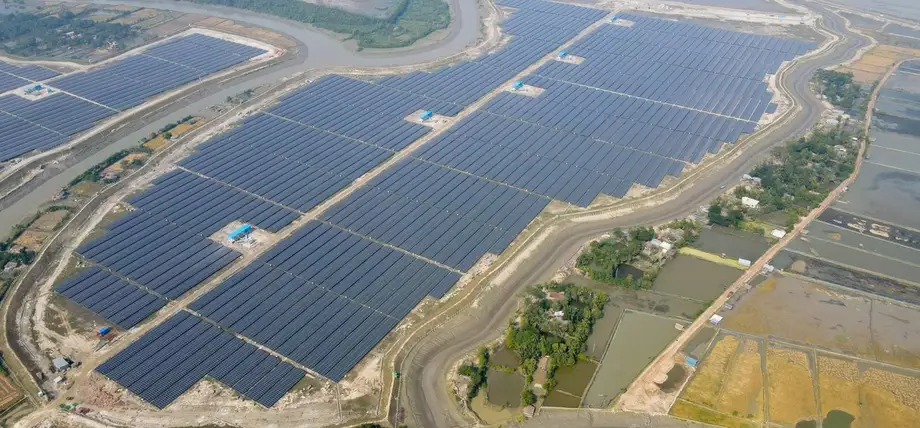
Industrial rooftops offer Bangladesh a way to generate electricity close to the factories using it. The missed opportunity estimate assumes that progress toward solar ambitions set in 2010 could have delivered at least 2,000 megawatts of rooftop capacity, cutting daytime use of expensive oil power and saving roughly BDT35 billion annually.
High duties on panels and equipment, inconsistent policies and limited incentives have slowed installations. Mustafa Al Mahmud, president of the Bangladesh Sustainable and Renewable Energy Association, said the cancellation of letters of intent for 31 renewable energy projects approved under special legislation had stalled activity and discouraged foreign investors.
Current capacity estimates also vary. Official estimates cited in the savings assessment put rooftop solar at about 500 MW, while a broader IEEFA estimate puts it near 1,000 MW, including 667 MW on large industrial roofs and the remainder on smaller industrial premises. IEEFA's dated rooftop solar briefing, published August 18, 2025, recorded only 245 MW installed between June 2008 and June 2025. A common inventory covering installation dates and categories would help establish a reliable national total.
Pakistan illustrates the speed possible when expensive grid electricity meets policy support for private installations. Its rooftop solar capacity reached about 15,000 MW by January 2025 after rapid expansion, much of it during 2024. India had more than 18,000 MW of rooftop solar by May 2025, according to IEEFA's briefing.
Bangladesh's challenge involves both encouraging installations and making them work reliably. IEEFA estimates that only 15 to 20 companies in the country have the quality and experience needed to handle engineering, procurement and construction to a high standard.
A big public rooftop target met practical limits
The government's programme announced in 2025 aimed to install 3,000 MW of rooftop solar by December that year. Against the 245 MW recorded in June 2025, that required installing more than 12 times the existing capacity in less than six months. The programme's final installation total was not given.
IEEFA identified a basic constraint: government offices, hospitals, educational institutions and religious institutions together had electricity demand below 1,500 MW. Their authorised electricity connections limited how much solar could be installed under net metering rules, which allow customers to send surplus electricity to the grid and receive credit.
The programme used two financing arrangements. Government offices would buy systems with public funds through a capital expenditure model, commonly called CAPEX. Hospitals and educational institutions would use an operating expenditure model, or OPEX, under which a developer pays for the installation and earns revenue from supplying electricity.
Public ownership can produce larger savings but leaves maintenance responsibilities with the institution. Developer ownership removes the initial purchase cost, although financing, small project sizes and rural outages can weaken commercial returns. Grid connected solar systems can lose generation during outages, affecting the revenue expected by investors.
IEEFA recommended documenting usable roof space, allowing realistic procurement schedules, maintaining panels and independently monitoring performance. Dust accumulation can reduce electricity production, so installing panels without paying for cleaning and repairs risks losing part of the expected saving.
Solar irrigation could ease pressure on farmers
Bangladesh has about one million diesel irrigation pumps consuming approximately 862.4 million litres of diesel a year. Replacing one third with solar pumps could displace around 287 million litres annually, with the savings assessment putting the avoided fuel cost at about $244 million.
Farmers already face a substantial fuel burden. CPD's May 2025 assessment found that higher diesel prices had raised irrigation costs by 20% to 30%, particularly for farmers growing boro rice who depend on shallow diesel pumps. Diesel and kerosene prices ranged between BDT104 and BDT108 per litre from June 2024 to May 2025.
Solar irrigation would move part of that spending from repeated diesel purchases toward equipment and maintenance. The financial benefit for an individual farmer would depend on installation costs, financing and the charge for irrigation water. National fuel savings would require systems to replace diesel pumping in practice.
Reliable grid electricity matters for agriculture too. CPD found that power shortages pushed farmers toward diesel pumps, while businesses used diesel generators to keep operating. Cleaner electricity and better supply can therefore work together: solar reduces fuel purchases, and a stronger grid reduces the need for expensive backup generation.
Why surplus power plants still produce shortages
Bangladesh's energy problem extends beyond buying costly fuel. IEEFA calculated a power reserve margin of 61.3% in fiscal year 2024-25, or 58.6% after adjusting plant capacity for actual operating capability. The reserve margin measures generating capacity above peak demand.
Power plants can stand idle while customers experience outages because fuel, transmission capacity or dependable equipment is missing. Contracts may still require capacity payments, which compensate plant owners for keeping generating equipment available.
Private oil plants received average capacity payments equivalent to BDT9.5 per kilowatt-hour in 2024-25, while private coal plants received BDT5.9, according to IEEFA. Fuel shortages also increased the capacity payment burden associated with gas plants.
Plant use makes a large difference to costs. IEEFA found that plants operating at less than 25% of capacity generated electricity at around BDT16.85 per kilowatt-hour. Plants operating above 75% generated at about BDT6. Low utilisation spreads fixed costs across fewer units of electricity.
Oil supplied 10.7% of Bangladesh's electricity generation in 2024-25. IEEFA put the equivalent shares at 0.02% in India, 0.6% in Pakistan and 0.06% in Vietnam. Replacing part of Bangladesh's oil generation with solar therefore targets a particularly expensive portion of the electricity mix.
Shafiqul Alam, IEEFA's lead energy analyst for Bangladesh and author of the transition study, described the cost problem in the document:
Currency depreciation and the high prices of imported fossil fuels do not fully explain Bangladesh's soaring power generation cost.
His analysis points to excess capacity, payments to underused plants and expensive generation alongside international fuel prices. Reducing costs requires changes in how Bangladesh plans, purchases and delivers electricity.
Subsidies, unpaid bills and another price shock
Petrobangla's finances show how import dependence reaches the public budget. At the July 2025 seminar, the corporation said LNG subsidies had risen from BDT25 billion in 2018-19 to BDT89 billion in the latest fiscal year cited, with cumulative subsidies reaching BDT367.12 billion.
In 2023-24, supplying a unit of gas cost BDT27.53 against a selling price of BDT22.93, leaving a BDT4.60 gap. Petrobangla also reported BDT271.99 billion in unpaid bills, including BDT165.23 billion owed by the power sector. Unpaid bills leave the gas supplier with less cash to meet its own costs.
IEEFA estimated that Bangladesh could need about $1.07 billion in LNG import subsidies during April-June 2026 if it purchased the same volume as in that quarter of 2025 at a spot price of roughly $20 per million British thermal units. Spot purchases are transactions for near term delivery rather than supply secured under longer contracts.
The institute said foreign currency constraints could limit purchases and force load shedding, meaning planned power cuts to balance available supply with demand. Bangladesh had sought about $2 billion from multilateral agencies to help maintain sufficient energy supplies.
Petrobangla chairman Md. Reza Nur Rahman said in July 2025 that a land terminal for LNG at Matarbari, Maheshkhali, was planned with an estimated construction period of five years. IEEFA proposed another longer term option: 6,000 MW of regional hydropower after 2030, supplying the high demand March-September period, could reduce annual gas consumption by up to 257 billion cubic feet.
How the decisions have unfolded
Bangladesh's recent energy history connects declining domestic supply, slow solar deployment and rising import costs. The dated milestones show where implementation has lagged behind plans.
- Fiscal year 2018-19: LNG imports began, supplying about 11% of total gas in the figures cited.
- October 2024: Eight of 34 wells targeted for exploration in fiscal year 2025 were being explored, according to CPD.
- May 31, 2025: CPD published its assessment of gas shortages, electricity outages and fuel costs.
- July 29, 2025: Petrobangla presented figures on gas losses, subsidies, completed wells and unpaid bills.
- August 18, 2025: IEEFA assessed the practical limits of the 3,000 MW rooftop programme targeting December 2025.
- April-June 2026: IEEFA's LNG subsidy scenario estimated a possible $1.07 billion requirement.
For households, factories and farms, the immediate priorities are usable energy and manageable bills. Gas repairs, credible solar procurement, successful exploration and reliable grid service each address a specific reason Bangladesh pays more while still experiencing shortages.
The Essentials
- Four proposed changes carry estimated annual fuel savings of about $2.87 billion, before implementation costs.
- Additional domestic gas accounts for roughly $1.73 billion of the estimated savings.
- Bangladesh's primary energy import share rose from 47.7% to 62.5% between 2020-21 and 2024-25.
- Gas loss reduction, rooftop solar and solar irrigation could reduce repeated fuel purchases.
- Underused plants, capacity payments and oil generation add to electricity costs.
- IEEFA's April-June 2026 LNG subsidy estimate depends on assumed prices and import volumes.