Nearly four in 10 Sundari trees show damage
An estimated 129.5 million Sundari trees in Bangladesh's Sundarbans show symptoms of top-dying disease, including 20.24 million classified as severely damaged, according to an ecological monitoring study conducted in 2024–25. The findings put a number on a growing conservation problem: almost 39 percent of the forest's estimated 330 million Sundari trees have some degree of damage.
Contents
- Nearly four in 10 Sundari trees show damage
- What the tree survey measured
- Where the damage is concentrated
- Freshwater is becoming harder to deliver
- Parasitic growth adds another pressure
- Fewer seedlings and a changing forest
- Satellites and forest users recorded earlier warning signs
- A water treaty deadline brings the rivers into focus
- What conservation work needs to answer
- Key Points
Severely affected trees have increased from 11.92 million in 1986 to 20.24 million, a rise of about 70 percent. Over a different monitoring period, seedling density across the forest fell from 2,689 per hectare in 1986 to 776 in 2022. Older trees are deteriorating while fewer young plants are growing to replace them.
Md Jahidul Kabir, deputy chief conservator of forests at the Bangladesh Forest Department and the country's national focal point for protected areas under the Convention on Biological Diversity, has called for further scientific investigation and field surveys. He raised the issue on the sidelines of the UN Biodiversity Conference, COP17, in Yerevan, Armenia.
Researchers have identified several pressures, including declining freshwater supplies, rising salinity, sediment accumulation, changing tides and parasitic plants. The precise causes of Sundari top-dying, and the contribution of each pressure, remain unresolved.
The concern reaches beyond a single tree species. Sundari, whose scientific name is Heritiera fomes, helps form the structure of the world's largest mangrove forest, shared by Bangladesh and India. Its deterioration affects a landscape that shelters wildlife, supports fishing and honey collection, and protects coastal communities from cyclones and storm surges.
What the tree survey measured
The Centre for Environmental and Geographic Information Services, known as CEGIS, and the Arannayk Foundation jointly conducted the ecological study. Researchers used 120 permanent survey plots established since 1986, tracking changes in sampled trees and applying a method to estimate conditions across the forest.
Arannayk Foundation's ecological monitoring project description places the work under the Protection of Sundarban Mangrove Forests Project. The Bangladesh Forest Department funds the study. Arannayk's responsibilities include monitoring reptiles and amphibians, fisheries resources, and soil and water quality, connecting tree health with conditions elsewhere in the ecosystem.
The findings, presented at the Forest Department headquarters in Dhaka on September 14, describe different degrees of damage. Approximately 83.03 million Sundari trees were assessed as having less than 25 percent infection, while 25.08 million had damage affecting 25 to 50 percent. The severely affected category contained 20.24 million trees with more than 50 percent infection. Around 200 million trees were assessed as healthy.
Top-dying usually begins with deterioration in leaves, shoots and branches near the upper canopy. In severe cases, damage extends to the main trunk and threatens survival. The monitoring categories therefore describe living trees with varying levels of injury, with the greatest concern focused on those suffering extensive damage.
Swapan Kumar Sarker, a professor at Shahjalal University of Science and Technology involved in the research, described the increase in severe cases:
In 1986, the number of severely affected trees was 11.92 million. It has now reached 20.24 million. This is a matter of concern. We need to monitor these trends over the long term and find solutions.
Where the damage is concentrated
Researchers divided the Sundarbans into 53 compartments. The highest levels of top-dying were recorded in Patkostam, Kaga Dobeki and Gewakhali in the Khulna Range. The next highest levels appeared in Dobeki in the Satkhira Range, Harbaria in the Chandpai Range, and Charaputia and Kokilmoni in the Sharankhola Range.
Areas with moderate and high salinity had more disease. Sarker said the prevalence of top-dying had declined somewhat compared with earlier assessments, even as the number of severely damaged trees increased. Tracking both measures is necessary to understand whether damage is becoming concentrated among more vulnerable trees.
Chief Conservator of Forests Md Amir Hosain Chowdhury described an earlier attempt to control the problem. During the 1980s and early 1990s, the Bangladesh Forest Research Institute identified and felled affected trees in an effort to protect healthy ones. The approach proved ineffective and was discontinued, he said.
Freshwater is becoming harder to deliver
The Sundarbans depends on freshwater arriving through the Ganges river system and mixing with saltwater entering from the Bay of Bengal. When freshwater supplies fall, saltwater can travel farther inland and alter the conditions in which mangrove roots and seedlings grow.
A study published in Environmental Monitoring and Assessment in October 2025 found a statistically significant decline in Ganges freshwater inflows through the Gorai River since the early 1980s. The Gorai branches from the Ganges and supplies freshwater to southwestern Bangladesh and parts of the Sundarbans.
Researchers from Australia's Commonwealth Scientific and Industrial Research Organisation and Bangladesh's Institute of Water Modelling found that salinity remained consistently higher in the western Sundarbans. Extreme salinity levels had increased since 2010. Their analysis connected downstream salinity with freshwater discharge while also examining rainfall, sea level rise and tidal movement.
Sediment creates another difficulty. As channels fill with silt, water has less room to pass through them. More freshwater upstream can therefore help the forest only if rivers and connecting channels carry it to the places that need it.
Md Rezaul Karim Chowdhury, divisional forest officer of the Sundarban East Forest Division, said about one kilometre of a silted stretch of the Bhola River measuring 16 kilometres had been excavated under the Sundarban Protection Project before work stopped. Plans were under way to resume the remaining excavation, with the aim of restoring freshwater flow to a large forest area.
The Gorai study also identified major gaps in continuous monitoring, especially in the many tidal creeks inside the forest. Measurements from those smaller waterways are needed to understand the water and salinity conditions experienced by individual stands of trees.
Parasitic growth adds another pressure
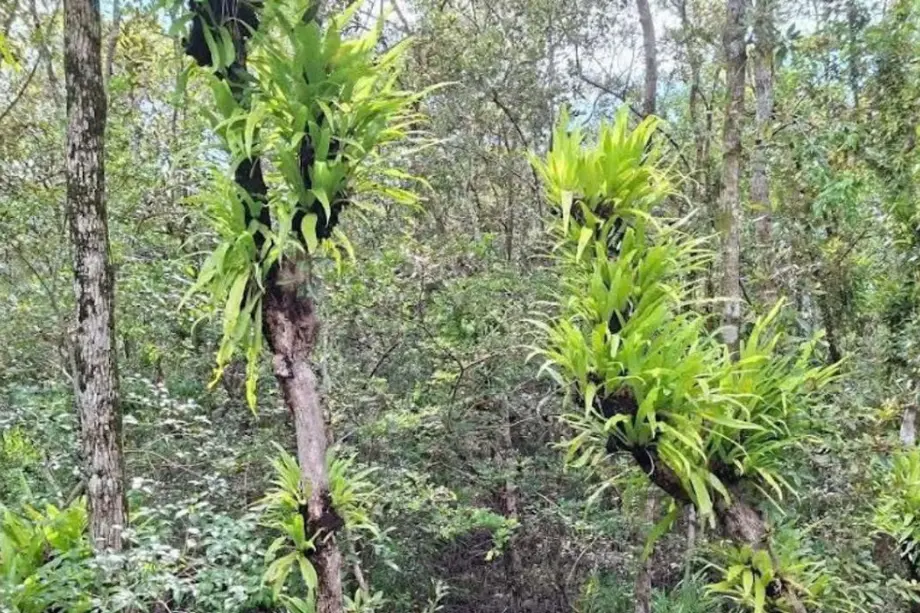
Forest officials are also concerned about parasitic plants on Sundari trees in the eastern division. Chowdhury estimated that growth affected about 25 to 30 percent of Sundari trees in areas including the Sharankhola and Chandpai ranges, particularly older trees.
Chowdhury described how the growth had spread:
"Previously, parasites stayed confined to branches. Now they've spread down to the trunk. Trees are weakening and eventually drying out and dying," he said.
Wasiul Islam, a professor in Khulna University's Forestry and Wood Technology Discipline, said parasitic vines spread more readily on trees already weakened by top-dying. He identified areas with high salinity or limited tidal flow as particularly vulnerable. Birds carry the seeds between trees, he said, while winter flowering and fruiting provide a potential point for intervention through removal before reproduction.
Mominul Islam Nahid, a senior research officer at the Bangladesh Forest Research Institute, said researchers had catalogued several kinds of parasitic plants but had yet to isolate the specific organisms responsible for the damage to Sundari. Forest official Imran Ahmed said Dhaka University botanist Ashfaque Ahmed had identified a vine species and that research was expected to begin. Establishing which plants cause which injuries is a central task for that work.
The Forest Department has said it cannot yet prescribe a rescue treatment. Chowdhury said scientific research focused on the parasite would begin promptly. For forest managers, the immediate challenge is to investigate the infestation alongside tree disease, salinity and water movement rather than treating each problem in isolation.
Fewer seedlings and a changing forest
Seedling density declined by about 71 percent between 1986 and 2022, from 2,689 to 776 per hectare. That is a reduction of 1,913 seedlings on an area equivalent to a square measuring 100 metres on each side. The figures point to a weakening supply of young plants that could replace damaged or ageing vegetation.
Khaled Misbahuzzaman, a professor at the University of Chittagong's Institute of Forestry and Environmental Sciences, said Sundari tends to establish late in the natural development of mangrove vegetation. Its regeneration therefore depends on conditions built up through earlier stages of forest growth.
Misbahuzzaman observed regeneration of smaller species, including Singra and Amur, in some areas formerly rich in Sundari. Gewa was also spreading in places where Sundari once predominated. Bangladesh Forest Research Institute observations similarly described increases in trees locally known as Geowa and Bola in some saline zones.
The ecological monitoring findings also recorded a decline of approximately 15 percent in above-ground biomass over three decades. Biomass means the living plant material above the soil, including trunks, branches and leaves. It is one measure of forest structure and of the carbon held in vegetation.
Researchers still need to measure how changes in growth, mortality, regeneration and species composition affect the forest's carbon balance. For wildlife and people, the more immediate issue is the changing mix and condition of the trees that provide shelter, food and protection.
Satellites and forest users recorded earlier warning signs
A study by researchers at Aberystwyth University examined Landsat satellite images covering January 1988 to June 2018 across the Sundarbans in both countries. It found declining mangrove health over 30 years while tree numbers remained stable. Co-author Katie Awty-Carroll described signs of declining health in about 25 percent of mangrove trees and warned that weakened areas could be more vulnerable to extreme weather.
The researchers used Continuous Change Detection and Classification, a method that follows repeated satellite observations to identify changes in land cover and vegetation. Their study tracked the wider mangrove forest, while the recent field assessment measured top-dying specifically in Sundari. Together, the findings show why forest monitoring must examine tree condition as well as the continued presence of vegetation.
Islam Sana, a fisherman and forest forager from Tetultala Char in Khulna's Koyra area who has depended on the Sundarbans for 40 years, described the change around him:
Areas that were dense Sundari jungle five or six years ago are now almost bare. Many Sundari trees have dried out.
Shahjahan Akon, a honey collector from Sharankhola with three decades of experience, described thinning forest and the disappearance of bees from places where Sundari had dried out. His observations connect canopy damage with the work of people who depend on seasonal flowers and honey harvests.
Sundari roots and surrounding mangrove vegetation also provide shelter for young fish and shrimp, while the canopy supports birds and the forest provides cover for deer and tigers. Changes in tree health can therefore affect several parts of the ecosystem at once.
A water treaty deadline brings the rivers into focus
Bangladesh and India face a December 12, 2026 expiry date for their Ganges Water Sharing Treaty, signed in 1996. The agreement governs the distribution of water during the dry season at India's Farakka Barrage.
On October 8, Bangladesh's Water Resources Minister Shahiduddin Chowdhury Anee said Bangladesh wanted a new agreement containing a guarantee clause similar to a provision in the 1977 water sharing agreement. The proposed clause is intended to give Bangladesh stronger assurances about its share during the dry season. Discussions are continuing through the bilateral Joint Rivers Commission.
The key dates connect decades of ecological measurements with an approaching diplomatic deadline:
- 1986: Permanent forest survey plots provided a reference point for tree damage and regeneration.
- 1996: Bangladesh and India signed the Ganges Water Sharing Treaty.
- 2022: Seedling density was recorded at 776 per hectare, down from 2,689 in 1986.
- 2024–25: CEGIS and Arannayk Foundation conducted the ecological monitoring study.
- October 2025: The Gorai study documented declining freshwater inflows and changing salinity.
- December 12, 2026: The current Ganges treaty is due to expire.
For the forest, environmental flows mean the quantity, timing and quality of water needed to sustain rivers, wetlands and their living communities. Delivering those flows requires attention to Farakka allocations, the Gorai and other downstream channels, seasonal changes and sediment blockages.
What conservation work needs to answer
The UNESCO World Heritage Committee's 2026 decision on the Sundarbans acknowledged coordination through the Bangladesh–India Joint Working Group and Joint Rivers Commission. It encouraged stronger cooperation on the water processes that sustain Bangladesh's Sundarbans and the adjoining Sundarbans National Park in India.
No confirmation has been given that Sundari mortality or specific environmental flow guarantees for the forest have become formal issues in the treaty negotiations. River cooperation nevertheless provides a way to address freshwater pressures that cross national boundaries.
Kabir's call for investigation points to a practical research agenda: follow affected trees over time, measure salinity and freshwater flow, examine sediment and tidal conditions, identify damaging parasites, and record whether seedlings survive. Linking those measurements in the same places would help researchers understand why some trees deteriorate while others remain healthy.
Governments assessing the Kunming–Montreal Global Biodiversity Framework at COP17 face a concrete example of the work required to halt and reverse biodiversity loss by 2030. In the Sundarbans, conservation depends on keeping trees alive, supporting regeneration and maintaining the rivers that sustain the forest.
Key Points
- About 129.5 million Sundari trees show top-dying symptoms, including 20.24 million with severe damage.
- The number of severely affected trees has risen by about 70 percent since 1986.
- Seedling density fell from 2,689 per hectare in 1986 to 776 in 2022.
- Declining freshwater flows, salinity, sediment, tidal changes and parasitic growth are priorities for investigation.
- Forest officials have called for further research while planning river excavation to improve freshwater delivery.
- The Ganges Water Sharing Treaty expires on December 12, 2026, bringing renewed attention to water management across the border.