School kitchens face scrutiny over poisoning risks
Vietnamese lawmakers are pressing for school kitchens to face surprise inspections, stronger licensing requirements and direct responsibility for their managers as Parliament considers revisions to the Food Safety Law. Figures cited during the debate put kitchens that prepare meals for groups at 22.1% of food poisoning incidents but 84.4% of people affected, concentrating much of the human cost in places serving many diners at once.
Contents
- School kitchens face scrutiny over poisoning risks
- What the poisoning figures show
- Should the size of a kitchen determine its obligations?
- Why delegates want inspections without warning
- Permits and continuing supervision serve different purposes
- Who should answer when a meal goes wrong?
- Local authorities need skills as well as duties
- What inspections look like inside schools
- From ingredient checks to an emergency response
- Records must work for large suppliers and small sellers
- Key Points
An Giang delegate Chau Quynh Dao, also identified as Chau Quynh Giao, challenged a proposed exemption allowing collective kitchens without business registration to operate without a certificate confirming food safety conditions. Under the provision she described, those kitchens would submit a commitment to local authorities instead. Some prepare hundreds or thousands of meals daily for children or workers.
The parliamentary discussion was dated November 10 in the initial account, while descriptions of the debate and Health Minister Dao Hong Lan's response placed it on November 11. The minister said the drafting body would strengthen controls over collective kitchens, particularly those serving schoolchildren, and clarify the responsibilities of the people running them.
The dispute concerns how to reduce paperwork without weakening protection where one unsafe meal can affect an entire school or factory. Delegates want the number of meals, the vulnerability of diners and evidence of previous problems to carry more weight than whether a kitchen has registered as a business.
The discussion follows October's demands for clearer accountability, when National Assembly Chairman Tran Thanh Man questioned how responsibilities, urgent warnings and implementing rules would work. School meals now provide a concrete test of whether those proposed reforms can protect people during everyday operations.
What the poisoning figures show
Dao cited parliamentary oversight and Ministry of Health figures showing 11 poisoning incidents at schools preparing their own meals in 2025, with 650 students hospitalized. Another 13 incidents at factories and industrial enterprises required treatment for about 900 workers. Together, those categories accounted for 24 incidents and about 1,550 people needing hospital care or treatment.
During the first 10 months of 2026, the figures she presented recorded eight incidents affecting nearly 500 students and nine involving about 700 workers at businesses cooking meals themselves. Dao cautioned that smaller incidents might escape the large incident statistics.
A Ministry of Health tally cited in Hanoi's summer safety instructions recorded 12 school kitchen incidents affecting 741 students in the first half of the year, compared with three incidents and 55 students a year earlier. The year of that tally was not specified, and its school kitchen category was broader than the figures presented for schools cooking their own meals. Within that tally, incidents increased fourfold and the number of affected students rose by 686.
The 22.1% and 84.4% shares explain the concern about collective meals particularly well. These kitchens accounted for fewer than one quarter of recorded incidents but more than four fifths of affected people. A contaminated ingredient or unsafe preparation step can reach many diners through the same batch of food.
Should the size of a kitchen determine its obligations?
Dao argued that bacteria, mold and toxic chemicals pose risks regardless of a kitchen's business registration. She contrasted scrutiny of small noodle shops or inexpensive restaurants with a proposed certificate exemption for kitchens feeding far larger groups of pupils.
Hai Phong delegate Nguyen Ngoc Son proposed a more targeted rule: collective kitchens above a specified meal threshold should lose the exemption in Appendix II of the draft. No numerical threshold was given. He also wanted kitchens serving children and students expressly eligible for surprise inspections outside ordinary inspection frequency limits.
Son identified a drafting tension in Article 51. Its first clause directs authorities toward supervision based on risk analysis, while its second would prevent that analysis from determining certain registration, product declaration and certificate exemption requirements. He proposed removing the second clause and using poisoning data, warnings and inspection findings to guide classification.
Why delegates want inspections without warning
Can Tho delegate To Ai Vang challenged the limit of no more than one inspection a year in Clause 8 of Article 57. She wanted stronger flexibility for school and hospital kitchens, industrial parks and other establishments where unsafe meals could harm many people. Public complaints and assessments of risk would help determine when inspectors should visit.
Ho Chi Minh City delegate Pham Khanh Phong Lan drew on experience with the city's Food Safety Department. She described a business that closed its doors three times when scheduled inspectors arrived. An unannounced inspection subsequently found expired goods, after which the business complained to the city inspectorate about the change in inspection method.
Phong Lan argued that advance notice can give businesses time to prepare an orderly appearance rather than show their usual practices. She wanted explicit legal authority for surprise visits, alongside enough dedicated staff to carry them out. Tay Ninh delegate Nguyen Dinh Xuan supported combining scheduled and surprise inspections according to risk.
Health Minister Dao Hong Lan responded that Article 57 included unannounced inspections when there were signs of violations or food safety risks, without a rigid limit tied to the annual scheduled inspection. Her explanation addressed the demand for flexibility; delegates also sought wording that would give inspectors a firm legal basis when businesses challenged their actions.
Permits and continuing supervision serve different purposes
Phong Lan said the draft devoted extensive attention to permissions, registration and product declarations, while continuing supervision occupied only one section containing two articles. She pointed to violations involving businesses whose permits and registration papers were in order.
Prior checks examine conditions or documentation before an activity begins. Continuing supervision checks what happens once food is being produced and served: which ingredients arrive, how they are stored, whether staff follow procedures and whether problems are corrected. Delegates argued that both stages need practical enforcement.
The health minister linked the revision to Resolution 72 on public health protection and Government Resolution 184 on moving toward supervision based on scientific analysis of risk. Her stated aim was to prevent harm while avoiding unnecessary administrative barriers for businesses.
Who should answer when a meal goes wrong?
Dao proposed direct legal responsibility for leaders who allow poisoning through neglect or reduce meal spending for personal benefit. Son also wanted parent representative boards and workplace trade unions to have explicit rights to join scheduled and surprise monitoring of collective kitchens.
Hanoi's education instructions already place full responsibility for meal services on school principals or institutional heads. Schools cannot hand all responsibility to a catering provider. They must check suppliers, keep invoices and origin records, and assess safety before changing a supplier, food source or processing location.
Ho Chi Minh City delegate Pham Trong Nhan raised a separate enforcement concern. Comparing an October draft with the November 10 version, he said four grounds for withdrawing a food safety certificate had disappeared: using banned substances, producing counterfeit food, receiving penalties at least twice within 12 months, and causing food poisoning.
Nhan sought restoration of immediate withdrawal when a business used banned substances, made counterfeit food or caused collective poisoning through its own fault. Son identified another gap: an explanatory document discussed immediate withdrawal after a fatal collective poisoning, but he said the draft itself did not contain that provision.
Nhan also asked who would lead a response when a product made in one province caused illness elsewhere. He wanted the law to identify the authority responsible for issuing warnings, deciding the geographic scope of a recall and checking that affected goods were removed.
Local authorities need skills as well as duties
Lam Dong delegate Duong Khac Mai presented findings from 124 communes, wards and special administrative areas. Of 248 officials responsible for food safety, only 19 had medical expertise, about 7.7%. Seven of 13 schools assessed met safe kitchen criteria, leaving six short of the standard.
Mai proposed requiring provincial authorities to provide technical support for inspections, sampling, laboratory testing and incident response. Commune authorities would follow up on corrective action and request help when a case exceeded their expertise.
Vang similarly argued that local government should do more than receive notifications. She wanted coordination with relevant organizations, community monitoring and periodic sampling. Phong Lan called for sufficient personnel and dedicated food safety officials at commune and ward level.
The practical task is demanding: an official may need to decide what food to sample, preserve it correctly, arrange testing and act quickly on the result. Assigning those duties locally therefore also requires access to specialist staff and testing services.
What inspections look like inside schools
Ho Chi Minh City has 2,525 school kitchens, 752 collective kitchens, 399 industrial meal providers and more than 13,000 food businesses. Its Food Safety Department is reviewing educational kitchens and their suppliers, including staff, premises and equipment.
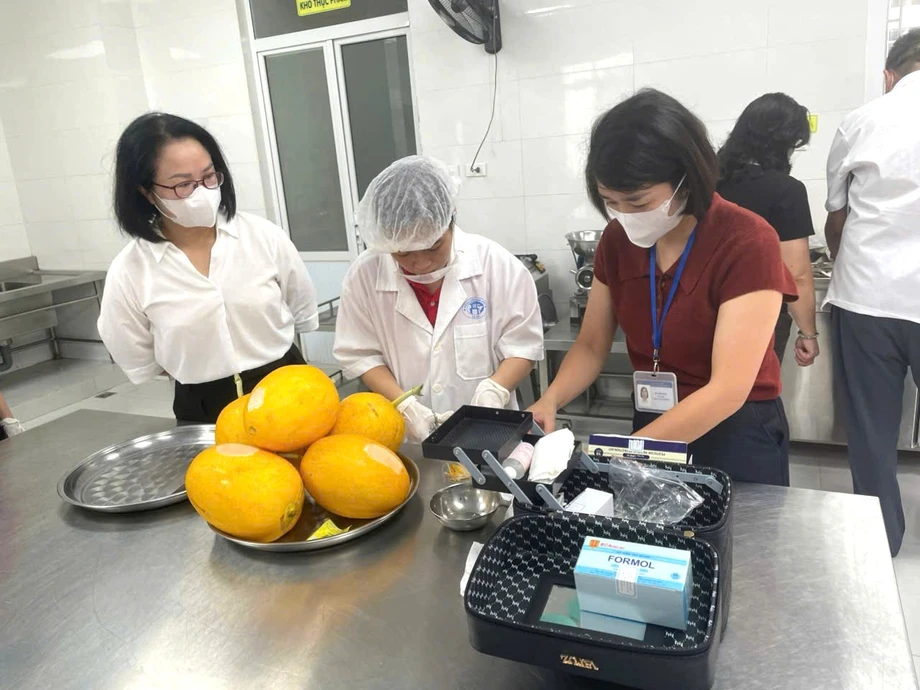
During a September 14 inspection at Tran Phu Junior High School, a Tam Thang Ward team checked rice and soup containers, asked staff to divide portions for comparison with the published menu, and examined retained food samples. The team recommended locking the sample storage area or installing cameras to improve control.
Hoang Dinh Ke, head of the ward's Socio-Cultural Affairs Office, said scheduled and surprise inspections would continue. Catering contracts could be terminated where serious problems remained unresolved after warnings.
At Le Thi Rieng Primary School, 342 students receive meals at the main campus and 72 at a branch. The main campus cooks on site using staff from a meal company. The branch receives meals from a neighboring primary school in specialized vehicles, with the same provider serving both campuses. Parents can register for surprise inspections and join monthly open meals.
Principal Nguyen Thi Hai described the shift toward local government assessment of suppliers under Directive 33/CT-TTg:
Shifting the responsibility of appraising dossiers and selecting food suppliers from the schools in previous academic years over to the commune-level People's Committee this year effectively helps schools gain an additional monitoring channel and a vastly more secure legal foundation,
Under the arrangement she described, schools propose providers, while local authorities assess and approve them and supervise performance. Parent participation adds another opportunity to compare published menus and promised portions with meals actually served.
From ingredient checks to an emergency response
Hanoi's education department requires schools to use the Ministry of Health's three step food inspection process, retain food samples and maintain records. Schools must disclose menus and suppliers, accommodate allergies and special dietary needs, and give parents opportunities to monitor cooking.
The instructions also address daily handling: kitchens should maintain a flow that separates preparation stages, use safe water, control pests and avoid prolonged storage at room temperature or reuse of leftovers. If poisoning is suspected, schools must stop using the food, provide first aid, arrange medical care, preserve samples and notify health and education authorities.
Dr Lam Quoc Hung of the National Institute of Nutrition recommended stronger training and rapid testing for borax, pesticide residues and E. coli bacteria when ingredients arrive. He warned that tight meal budgets can encourage providers to buy cheaper ingredients of uncertain origin. His recommendations connect safety checks with the financial decisions behind each meal.
Records must work for large suppliers and small sellers
Dao also challenged a proposed requirement for food businesses to retain full purchasing and sales information in a database. She supported digital records but proposed making electronic storage compulsory principally for large businesses and food chains presenting greater risks. Smaller operators could keep paper records or use another suitable method, with training and practical support from the state.
The health minister described three proposed approaches to food products: declarations followed by continuing supervision for most processed packaged foods; exemptions from declaration procedures for specified categories, including certain small food operations; and registration with prior scrutiny for groups such as health supplements, medical nutrition and nutritional products for children under 36 months. These product procedures sit alongside the separate debate over certificates for kitchen premises.
The policy debate has developed through several identifiable stages:
- In 2025, figures cited in Parliament recorded 11 poisoning incidents at schools cooking their own meals and 13 at factories and industrial enterprises.
- On October 24, 2026, parliamentary group discussions focused on accountability, rapid alerts and the rules needed to implement the revised law.
- During the November debate, delegates challenged kitchen exemptions, inspection limits and certificate withdrawal provisions, while the health minister promised tighter controls and clearer leadership responsibility.
No final voting date, implementation date or numerical meal threshold was given. The next legislative decisions concern how those commitments will be written into enforceable duties for providers, principals, inspectors and local authorities.
Key Points
- Collective kitchens preparing their own meals accounted for 22.1% of poisoning incidents but 84.4% of affected people in figures cited by an An Giang delegate.
- Lawmakers want meal volume and risk to guide certificate exemptions and inspection schedules.
- The health minister said Article 57 allows surprise inspections where violations or safety risks are suspected.
- Delegates sought direct leadership responsibility, stronger certificate withdrawal rules and clear authority for recalls across provinces.
- Local staffing, technical support, retained samples and parent monitoring are central to making kitchen supervision work.
- The proposed changes remain part of a legislative revision, with no final voting or implementation date specified.