A vaccine schedule built into a tiny patch
A patch tested in rats delivered doses of Prevnar-13, a vaccine against pneumococcal bacteria, at programmed intervals ranging from a few days to more than a month. The animals developed immune responses similar to those receiving several injections and survived a lethal bacterial challenge. Behind the work is Nguyen Duc Thanh, a Vietnamese scientist whose research at the University of Connecticut has attracted millions of dollars for medical devices designed to disappear after doing their job.
Contents
- A vaccine schedule built into a tiny patch
- From Da Nang to a laboratory in Connecticut
- How one patch could replace several visits
- What fewer appointments could mean
- Patents extend the delivery platform
- Materials that help bone and cartilage repair
- Ultrasound designed to help drugs reach the brain
- A pandemic project beyond implants
- What the funding and recognition cover
- Key Points
Known in scientific publications as Thanh D. Nguyen, the associate professor works across mechanical engineering, biomedical engineering and materials science. His projects include vaccine patches, structures intended to help damaged bones heal, and biodegradable ultrasound devices designed to help chemotherapy drugs reach brain tumors.
The University of Connecticut says he has brought the institution $25 million in research funding since joining in 2016. Funding figures made public by October 2024 included more than $9.5 million from four National Institutes of Health R01 grants and $6.6 million from two grants approved by the Bill & Melinda Gates Foundation.
The central idea connects several seemingly different medical problems: build a material that carries medicine, generates an electrical signal or produces ultrasound, then allow it to break down in the body. For patients, the intended benefits range from fewer vaccination appointments to avoiding an operation to remove an implant.
The most detailed published evidence concerns the vaccine patch. Nguyen was the corresponding author of the microneedle vaccine study, published online on November 23, 2020, in Nature Biomedical Engineering and included in its 2021 volume. The research tested the technology in rats; its use for routine vaccination in people remains a development goal.
From Da Nang to a laboratory in Connecticut
Nguyen was born in 1984 in Da Nang, central Vietnam. He studied physics at Le Quy Don High School for the Gifted before entering the talented engineering program in engineering physics at Hanoi University of Science and Technology.
After graduating in 2007, he received a Vietnam Education Foundation scholarship in 2008 to pursue doctoral study at Princeton University. He completed his doctorate in 2013 and continued as a postdoctoral researcher at the Massachusetts Institute of Technology.
His academic path moved from mechanics and aerospace engineering toward biomedical technology. At Connecticut, where he joined the mechanical and biomedical engineering departments in 2016, he assembled a laboratory working on biomaterials, medicines, vaccines, regenerative medicine and miniature medical devices. He became an associate professor in 2022.
Several dates trace the development of that work:
- 2017: Nguyen received the NIH Trailblazer Award for young researchers.
- 2018: His laboratory reported biodegradable piezoelectric polymer technology for medical applications.
- November 23, 2020: The programmable vaccine patch study appeared online.
- August 30, 2022: A core-shell microneedle patent naming Nguyen and Khanh Tran was granted.
- 2024: Nguyen was elected a Senior Member of the National Academy of Inventors.
How one patch could replace several visits
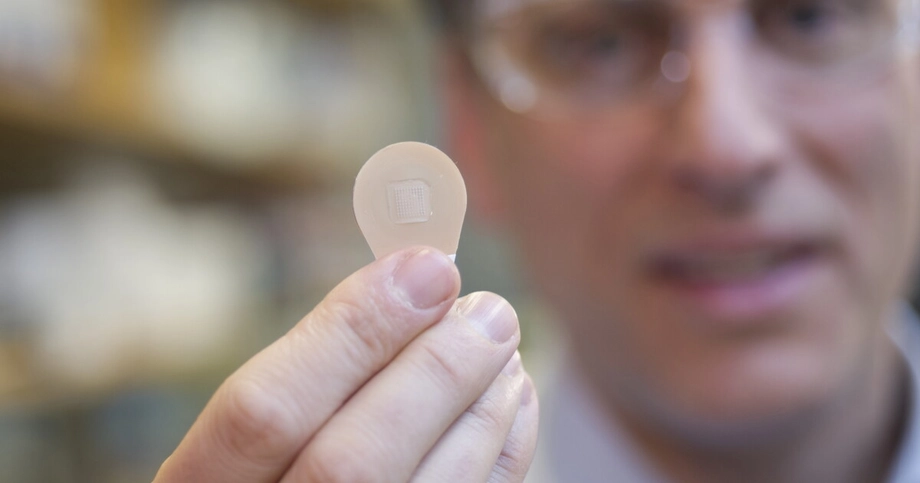
Nguyen's vaccine patch is about the size of a thumb tip and contains hundreds of tiny needles. Rather than using a conventional syringe to deliver each dose separately, it places small vaccine packages into the skin during one application.
Each microneedle has a core containing vaccine and an outer shell made from a biodegradable polymer called poly(lactic-co-glycolic acid), or PLGA. The researchers manufacture and align these miniature parts so that shells with different breakdown rates release their contents at different times.
The aim is a series of timed bursts, similar to separate injections. A dose can be released after a short delay, while another remains enclosed until later. Changing the shell's design and material properties changes the release schedule.
Nguyen, then an assistant professor of engineering at Connecticut, explained the intended benefit for patients:
The patient wouldn't need to remember the schedule of the vaccination," Nguyen says. "They wouldn't need to receive another patch for repeatedly receiving the vaccines.
The rat study used Prevnar-13 against Streptococcus pneumoniae. Its comparison with repeated injections is useful because the practical goal is to preserve protection while reducing the number of times a person must return for treatment.
What fewer appointments could mean
Families living far from a clinic may need to arrange transport, take time away from work and return on several different dates to complete a vaccine course. A patch that carries its own dose schedule could reduce those journeys and the chance of missing a later dose.
Nguyen's approach sits within a wider field of microneedle research. Mark Prausnitz, director of Georgia Tech's Center for Drug Design, Development and Delivery, has worked on patches for influenza and measles. He explains that short needles can cross the skin's thin outer barrier without needing the length of a conventional injection needle.
Some microneedle formulations may also make vaccine distribution easier by reducing dependence on refrigeration. Storage performance depends on the vaccine and patch formulation, so each proposed product needs its own testing. For Nguyen's programmable patch, reliable timing and preservation of the vaccine during storage are both central to its intended use.
Darin Zehrung, a medical devices and health technologies program leader at PATH, identified industrial commitment, manufacturing scale and reasonable cost as practical challenges facing vaccine patches. Nguyen's published work supplies animal evidence for timed delivery; turning that design into a widely distributed medical product also requires manufacturing and clinical development.
Patents extend the delivery platform
Nguyen and co-inventor Khanh Tran filed their core-shell microneedle patent application on March 5, 2019. US patent 11,426,570 was granted on August 30, 2022, with the University of Connecticut as assignee.
The invention describes biodegradable needles that can become embedded in the skin and release controlled amounts of medicine or vaccine in sharp bursts at predictable times. A related application naming the same inventors was filed on July 22, 2022.
A different application, filed on September 28, 2021, names Nguyen and Nicholas Farrell and concerns sustained delivery for pain treatment. It describes a biodegradable microneedle system intended to release medicine at a nearly constant rate for at least 30 days.
The two approaches serve different treatment schedules. Vaccination may call for distinct doses separated by days or weeks, while pain treatment may call for a steady supply. Both use the structure and breakdown of a material to control when medicine becomes available.
Materials that help bone and cartilage repair
Nguyen's laboratory also studies biodegradable structures that generate electrical signals. The relevant property is piezoelectricity: a material produces a small electrical charge when it is pressed, bent or otherwise mechanically stressed.
For severe injuries to long bones such as the femur and tibia, the team is developing a biological scaffold, a temporary framework intended to support repair. Its material can produce electrical pulses designed to stimulate healing where the body's own repair process may struggle.
One NIH project allocated $2.1 million to research intended to improve healing of major long bone injuries. The scaffold combines physical support with electrical stimulation rather than acting only as a passive frame.
Related work reported in 2022 used nanofibers of poly-L-lactic acid, or PLLA, to support cartilage regeneration in damaged joints. Movement, such as walking, puts force on the material and produces weak electrical signals intended to encourage cells involved in tissue repair.
Cartilage and bone require different repair strategies. The common engineering approach is to give a temporary material a useful biological function, then allow it to break down as the tissue recovers.
Ultrasound designed to help drugs reach the brain
Nguyen's brain cancer research applies biodegradable materials to another difficult delivery problem. Many medicines have trouble reaching brain tissue because the blood-brain barrier, a tightly controlled boundary around blood vessels, restricts what can pass through.
His team has developed small, flexible ultrasound chips intended for implantation near brain tissue. The devices produce sound waves designed to help chemotherapy drugs enter the brain and reach cancer cells. The proposed approach would support repeated treatment sessions before the implant breaks down.
An NIH award of $2.16 million supports research aimed at improving chemotherapy through biodegradable ultrasound technology. A device that disappears after treatment could spare a patient another procedure to remove it.
The ultrasound work builds on the laboratory's earlier interest in temporary electronics. In 2018, Nguyen and colleagues developed a sensor using biodegradable material associated with dissolving surgical sutures. The device was designed to transmit information wirelessly and then break down, bringing monitoring and eventual removal into the same material design.
A pandemic project beyond implants
During the COVID-19 pandemic, Nguyen's team explored whether its biodegradable polymer membranes could also serve as mask filters. In January 2021, the group described a prototype intended to approach N95 filtration performance while tolerating sterilization and reuse.
The proposed filter used a piezoelectric membrane that could generate a small voltage when air moved through it. The researchers investigated whether that electrical effect could help capture particles, alongside the membrane's physical filtering action.
Nguyen said the laboratory was measuring filtration, adjusting manufacturing conditions and comparing the material with conventional medical masks and N95 respirators. The team also described testing sterilization with heat and pressure or ultrasound while retaining the membrane's piezoelectric properties.
The project was at the research and product development stage in January 2021, with commercialization under consideration. During the same period, the laboratory was exploring vaccine patches for COVID-19. The published programmable patch experiment used the pneumococcal vaccine Prevnar-13.
What the funding and recognition cover
The funding figures describe several parts of Nguyen's research program. By October 2024, four NIH R01 grants totaled more than $9.5 million. An R01 is a major NIH mechanism for supporting a defined research project.
Three specified awards included $2.1 million for long bone repair, $1.5 million for microneedle technology and $2.16 million for biodegradable ultrasound aimed at brain cancer treatment. The Gates Foundation approved two grants totaling $6.6 million to develop patches capable of delivering multiple vaccine payloads.
The cited NIH and Gates funding together amounted to about $16.1 million, roughly 64% of the $25 million that Connecticut says Nguyen brought in after joining the university. The $25 million figure covers his broader funding record at the institution.
His election as a National Academy of Inventors Senior Member in 2024 placed him in a class of 124 people from 60 institutions. Collectively, that class held more than 1,000 US patents and had more than 340 technologies licensed or commercialized.
The Senior Member designation recognizes invention, patenting, technology transfer and the training of future inventors. Nguyen's other honors include the 2018 SME Outstanding Young Manufacturing Engineer Award, recognition among young innovators in the Asia Pacific region, and selection among Vietnam's outstanding young people in 2019.
Across the projects, the practical ambition is consistent: reduce repeated appointments, help medicine reach difficult targets and make temporary implants disappear when their work is finished. The vaccine study offers a concrete example of that ambition in animals, while the wider program applies the same materials engineering ideas to repair, monitoring and treatment.
Key Points
- Nguyen Duc Thanh joined the University of Connecticut in 2016 and became an associate professor in 2022.
- His programmable vaccine patch delivered timed doses of Prevnar-13 in rats, producing immune responses similar to repeated injections.
- His laboratory also studies biodegradable materials for bone and cartilage repair, temporary sensors and ultrasound devices for brain drug delivery.
- By October 2024, cited NIH and Gates Foundation support totaled about $16.1 million; Connecticut put his broader research funding at $25 million.
- Nguyen was elected a Senior Member of the National Academy of Inventors in 2024.
- Routine use of his programmable vaccine patch in people remains a development goal.