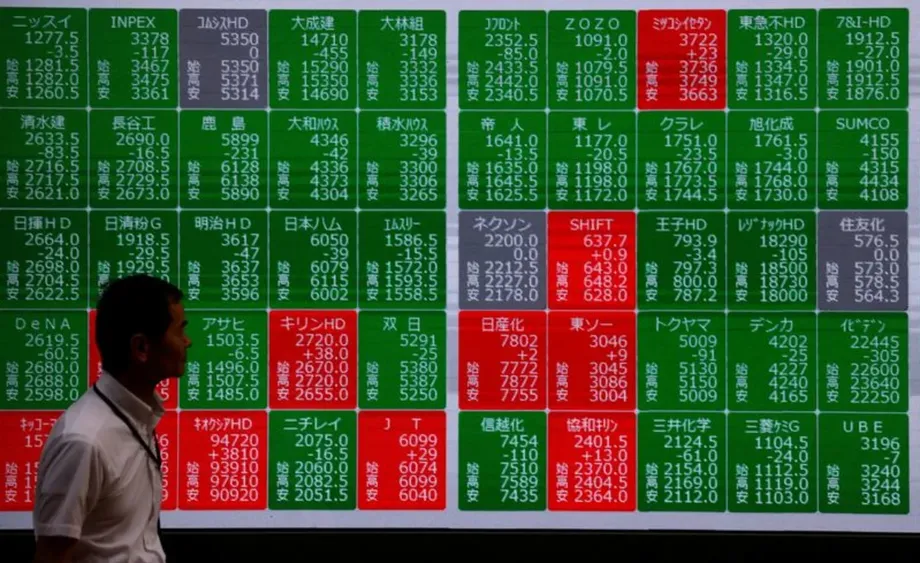
Tokyo shares slide as investors reassess the AI boom
Japan's Nikkei Stock Average fell more than 4 percent on Wednesday, November 4, as projections that Democrats would regain the U.S. House of Representatives prompted heavy selling of shares linked to artificial intelligence and semiconductors. Investors were concerned that tighter American regulation could slow investment in an industry that many Japanese companies are expanding into.
Contents
At 12:52 p.m. in Tokyo, the Nikkei stood at 60,274.46, down 2,807.40 points, or 4.45 percent, from Monday's close. The broader Topix index was down 127.56 points, or 3.25 percent, at 3,802.72. Trading resumed after a Japanese market holiday, bringing the developing U.S. election results into focus.
The Nikkei's decline exceeded 3,000 points at one stage during the session. Selling continued into the afternoon after the index finished morning trading below 61,000, with investors reconsidering how quickly spending on AI infrastructure might grow under a changed political balance in Washington.
Dealers linked the selling to concern that a Democratic victory could bring stricter rules for AI. The concern also extended to data center construction, where tighter regulation could affect the buildings and equipment needed to run AI services.
How the decline unfolded
The Nikkei finished the morning session at 60,835.36, down 2,246.50 points from the previous trading day. That represented a decline of about 3.56 percent. By 12:52 p.m., it had lost another 560.90 points, showing how the selling deepened after the midday break.
A later reading at 1:20 p.m. put the Nikkei at 60,364.56, down 2,717.30 points, or 4.31 percent. That was a modest recovery from the earlier afternoon reading, although the index remained sharply lower. The trading sequence was:
- Monday: The Nikkei closed at 63,081.86, the baseline for Wednesday's reported declines.
- Wednesday morning: The index ended the session at 60,835.36, below 61,000.
- 12:52 p.m.: The Nikkei fell to 60,274.46, a loss of 4.45 percent.
- 1:20 p.m.: The index stood at 60,364.56, still down 4.31 percent.
- During Wednesday's trading: The decline temporarily exceeded 3,000 points.
Why the election projections mattered
Projections of Democratic control of the House were the immediate political development behind the market reaction. There were also projections that Democrats would regain majorities in both the House and the Senate, widening investor concern about the party's ability to pursue its policy agenda.
The House and Senate are the two chambers of the U.S. Congress. Control matters because lawmakers help determine which proposed laws advance. Investors were trying to judge whether a shift in congressional power would increase the likelihood of rules affecting AI businesses and the infrastructure they need.
Democrats were described as advocating tighter regulation of AI and data center construction. For investors, the connection was straightforward: if companies face more demanding requirements when developing AI or building facilities, some investment plans could take longer or become more expensive.
No specific regulatory bill, implementation timetable or final election certification was identified in the accounts of the market decline. The selling reflected expectations about possible policy changes, with investors adjusting share prices before the details of any new measures were known.
Why Japanese technology shares were exposed
Japanese companies linked to AI and semiconductors came under particularly heavy selling pressure. Dealers said many Japanese businesses were expanding their activities in the industry, leaving them sensitive to changes in the outlook for American technology spending.
Semiconductors are the chips that process and store information in electronic equipment. AI services require large amounts of computing power, so the companies supplying chips and related technology have a stake in how quickly that computing infrastructure is built.
A potential slowdown in investment can affect expectations well before it affects company sales. Share prices reflect what investors think a business may earn in the future. When investors become less confident about future demand, they may sell shares even while existing operations continue.
The concern in Tokyo therefore reached beyond the U.S. companies developing AI services. Japanese businesses seeking growth from the same investment cycle could face weaker demand if their customers delay or reduce spending. The market accounts did not identify individual Japanese companies or provide losses for specific technology shares.
Data centers connect AI policy to spending
Data center construction was a specific part of the regulatory concern. These facilities house the computers, storage equipment and network connections that keep digital services running. AI systems depend on that equipment both to develop their capabilities and to respond to users.
Technology companies' capital investment means spending on assets they expect to use over time, such as buildings and computing equipment. When a company commits money to a data center, that spending can generate orders across several businesses, including suppliers of semiconductors and other equipment.
Tighter construction requirements could change the timing or cost of those projects. Investors were concerned that this could slow capital investment by technology companies, reducing the pace at which orders reach businesses connected to the AI sector.
The immediate issue for shareholders was the growth rate they should expect. A company can remain active in a growing industry while its shares fall if investors decide that growth may be slower than they had previously assumed. Wednesday's selling showed how quickly a political development can change those expectations across national borders.
Topix showed selling beyond the Nikkei
The Topix index also declined sharply, indicating that the retreat extended across a broader measure of Japanese shares. At 12:52 p.m., its loss of 3.25 percent was smaller than the Nikkei's 4.45 percent decline, a difference of 1.20 percentage points.
At 1:20 p.m., Topix stood at 3,795.59, down 135.19 points, or 3.44 percent. While the Nikkei had recovered slightly between the two afternoon readings, Topix had moved lower. The broader market was still under pressure even as the headline index regained some ground.
The Nikkei tracks 225 selected stocks, while Topix covers a broader group of Japanese shares. Their different membership and calculation methods mean they can move by different amounts during the same session. Looking at both gives a fuller picture than following the Nikkei alone.
The percentage declines also make the scale easier to compare. At 12:52 p.m., the Nikkei had lost roughly 4.45 yen for every 100 yen of its previous closing value, while Topix had lost about 3.25 yen. Those figures describe the indices; individual shares could move by more or less.
What the afternoon figures leave open
Wednesday's intraday readings captured a market reacting as election projections developed. The reported loss of more than 3,000 points marked a deeper decline than either of the two specified afternoon snapshots, illustrating how much prices moved within the session.
A final closing level was not given. The figures therefore describe the morning finish and parts of afternoon trading, with the Nikkei still down more than 4 percent at 1:20 p.m.
For Japanese companies expanding into AI, the central business question was whether American policy would alter the pace of investment. The immediate consequence was already visible in Tokyo: investors assigned lower prices to shares exposed to that growth, while the broader market also suffered substantial losses.
Key Points
- The Nikkei fell 4.45 percent to 60,274.46 at 12:52 p.m. on Wednesday, November 4.
- The index temporarily lost more than 3,000 points during the session.
- AI and semiconductor shares faced heavy selling after projections of Democratic gains in Congress.
- Investors feared tighter AI and data center construction rules could slow technology investment.
- Topix fell 3.44 percent to 3,795.59 at 1:20 p.m., showing broader market pressure.
- No final market close or timetable for specific regulatory changes was given.