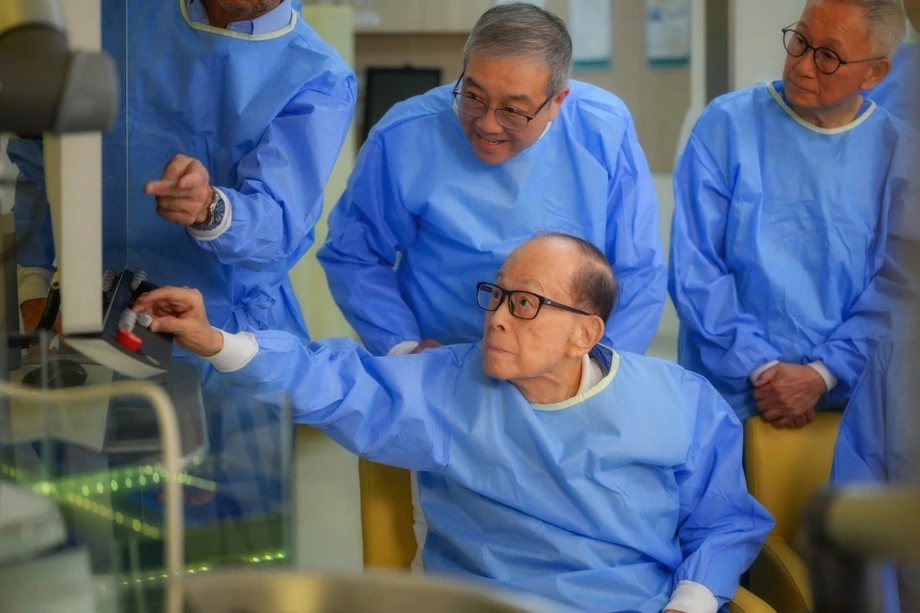
Three hospitals to test ultrasound treatment for kidney tumors
Li Ka-shing is funding 30 places in clinical trials of histotripsy for kidney tumors at CUHK Medical Centre, Gleneagles Hospital Hong Kong and Hong Kong Sanatorium & Hospital, expanding Hong Kong's use of a technology that destroys targeted tissue with focused sound waves.
Contents
- Three hospitals to test ultrasound treatment for kidney tumors
- How sound waves break apart tumor tissue
- Why protecting kidney function is central
- What an international kidney trial is measuring
- Pancreatic trials have completed 26 procedures
- Liver treatment provides the starting point
- Donated equipment and help with liver treatment costs
- How the Hong Kong expansion unfolded
- Recognition for the research behind the technology
- Key Points
The Li Ka Shing Foundation says the initiative will make Hong Kong the first city in Asia to conduct kidney cancer trials using the technique. The announcement follows treatment of more than 400 patients with histotripsy in Hong Kong over the past two years, alongside continuing research involving pancreatic tumors.
The kidney trials will examine whether doctors can destroy tumor tissue while protecting healthy kidney tissue, blood vessels and the structures that collect urine. Preserving those structures matters because treatment must address the cancer while leaving the kidneys able to do their everyday work.
The 30 funded places are for participation in clinical research. Patient eligibility, application arrangements, the allocation of places among hospitals and a starting date have yet to be announced. The participating hospitals will need to assess who is suitable.
How sound waves break apart tumor tissue
Histotripsy uses short pulses of focused ultrasound to create tiny bubbles at a chosen point inside the body. As those bubbles rapidly expand and collapse, they produce mechanical forces that break apart the targeted tissue.
Doctors use ultrasound images to help locate the treatment area and monitor the procedure. The technique works without a conventional surgical incision or an ablation probe inserted into the tumor. Ablation means destroying unwanted tissue.
Unlike treatments that use heat to destroy tumors, histotripsy relies on physical disruption. It also avoids ionizing radiation, the type used in radiotherapy. Some procedures still require general anesthesia, and suitability depends on the tumor's position and its relationship to nearby organs and blood vessels.
Why protecting kidney function is central
The kidneys filter waste and excess water from the blood, producing urine. Inside them, tiny filtering units called nephrons perform much of that work. A treatment that destroys a tumor while sparing these units could help patients retain more kidney function.
William C. Huang, a professor of urology and radiology at NYU Grossman School of Medicine and chief of urology at Tisch Hospital, NYU Langone Health, described that goal while discussing histotripsy for renal tumors at the 2026 LUGPA Annual Meeting in Chicago. Renal is the medical term for kidney.
"We want to provide oncologic control and yet preserve kidney function to the best that we can do by preserving nephrons and avoiding injury to the surrounding structures," he said.
Oncologic control means controlling the cancer. For kidney treatment, researchers must assess both what happens to the tumor and how well the organ continues to work afterward. The Hong Kong research will examine safety and treatment effectiveness, including protection of the kidney's normal tissue and urine collection system.
What an international kidney trial is measuring
The international #HOPE4KIDNEY study provides a specific example of how researchers are evaluating the technology. Identified as NCT05820087, it enrolled 67 patients with kidney masses measuring 3 centimeters or less, with the diagnosis established through a biopsy, which examines a tissue sample.
Participants had an estimated glomerular filtration rate of at least 45 milliliters per minute at the start. This measure, often shortened to eGFR, estimates how well the kidneys filter blood. People with end stage kidney disease or angiomyolipomas, a type of kidney tumor that is usually benign, were excluded.
The study's main assessments examined safety 30 days after treatment and effectiveness at 90 days. Kidney function preservation was also being evaluated. Researchers therefore set separate checkpoints for early complications, treatment performance and the organ's continuing function.
The study was prospective, meaning patients were followed forward after enrollment, and involved multiple treatment centers. It used a single treatment group rather than randomly assigning participants between histotripsy and another treatment. Its 67 participants offer a useful comparison for the scale of Hong Kong's 30 funded places, although the Hong Kong hospitals will determine their own participation arrangements.
Pancreatic trials have completed 26 procedures
Gleneagles Hospital Hong Kong and CUHK Medical Centre are already conducting histotripsy trials involving pancreatic tumors. Gleneagles has completed 20 cases since beginning its trial on March 31, while CUHK Medical Centre has completed six since June 3, according to the foundation.
The combined total is 26 procedures. The pancreas lies deep inside the abdomen, close to many blood vessels, making the location of a tumor and the ability to target it particularly important when doctors assess treatment options.
The foundation says more than 100 pancreatic cancer cases worldwide have involved histotripsy through clinical trials and procedures outside the device's approved use. Such use, commonly called off-label treatment, involves applying a medical device beyond the indication covered by its regulatory authorization.
The next task for pancreatic research is to track complications, tumor response and longer term outcomes after treatment. Patients and doctors need those findings to understand how the procedure performs over time and which patients may benefit.
Liver treatment provides the starting point
The US Food and Drug Administration authorized HistoSonics' Edison histotripsy system in 2023 for destruction of liver tissue, including liver tumors. Kidney and pancreatic applications are being developed through further research.
Huang said the device had been submitted to the FDA for use in destroying renal tumors. A submission begins the regulator's review of a proposed use, with authorization requiring a decision by the agency. The Hong Kong kidney initiative is also focused on building clinical evidence for this application.
Liver, kidney and pancreatic treatments involve different organs, nearby structures and treatment goals. The kidney trials place particular attention on preserving filtration and urine drainage, while the pancreatic work involves targeting tissue deep in the abdomen near blood vessels.
Hong Kong's experience now spans established liver applications and research involving two other organs. That gives the participating institutions practical experience with the technology while each new application undergoes its own clinical assessment.
Donated equipment and help with liver treatment costs
The foundation has donated three histotripsy machines since 2024 to the University of Hong Kong's Li Ka Shing Faculty of Medicine, the Chinese University of Hong Kong's Faculty of Medicine and Hong Kong Sanatorium & Hospital.
Funding has also extended to treatment costs. In May, the foundation added histotripsy to its Love Can Help medical assistance program, working with CUHK Medical Centre, Gleneagles Hospital Hong Kong and Hong Kong Sanatorium & Hospital.
The program aims to subsidize treatment for 200 eligible liver cancer patients over three years. It reduces the patient charge from about HK$260,000 to HK$50,000, excluding the hospital's technical assessment fee.
Using those figures, the reduction is about HK$210,000 per patient, or roughly 81 percent of the original treatment price. For eligible households, that changes the amount they need to find for the procedure from more than a quarter of a million Hong Kong dollars to HK$50,000, plus the assessment charge.
The foundation says 20 subsidized liver treatment cases have been completed, equivalent to 10 percent of the program's target of 200 patients. The liver assistance program and the new kidney trial places serve different groups: one helps eligible liver cancer patients pay for treatment, while the other supports participation in kidney research.
How the Hong Kong expansion unfolded
The equipment donations, patient subsidies and clinical trials form a sequence of investment in both access and research. The key milestones announced by the foundation show how the program has expanded:
- 2023: The FDA authorized the Edison system for destruction of liver tissue.
- From 2024: The foundation donated three histotripsy machines to institutions in Hong Kong.
- March 31: Gleneagles began its pancreatic tumor trial, which has completed 20 cases.
- May: Histotripsy was added to the Love Can Help program for eligible liver cancer patients.
- June 3: CUHK Medical Centre began its pancreatic tumor trial, which has completed six cases.
- The latest announcement: Li Ka-shing committed support for 30 kidney tumor trial places across three hospitals.
For patients, the expansion creates two concrete routes to access: financial assistance for eligible liver treatment and research places for suitable kidney trial participants. Clinical assessment remains part of deciding which route, if either, fits an individual patient's condition.
Recognition for the research behind the technology
Zhen Xu, a University of Michigan engineering professor and a principal inventor of histotripsy, received the 2026 Golden Goose Award on September 29. The award recognizes research supported by US federal funding that has produced scientific and societal benefits.
Xu's work helped move the use of sound waves to mechanically break apart tissue from laboratory research into clinical applications. The award highlights the research history behind a technology now being used in Hong Kong hospitals and tested for additional organs.
The immediate priorities for the kidney initiative are selecting suitable participants, carrying out treatment safely and following patients afterward. The most useful results will address the two goals Huang described: controlling tumors and preserving as much kidney function as possible.
Key Points
- Li Ka-shing is funding 30 kidney tumor trial places at CUHK Medical Centre, Gleneagles Hospital Hong Kong and Hong Kong Sanatorium & Hospital.
- The foundation says Hong Kong will become Asia's first city to conduct kidney cancer trials using histotripsy.
- Histotripsy uses focused ultrasound to create bubbles that mechanically destroy targeted tissue.
- Hong Kong's pancreatic trials have completed 26 procedures across two hospitals.
- The foundation reports more than 400 patients treated with histotripsy locally over two years.
- A separate liver cancer assistance program aims to help 200 eligible patients over three years, with 20 cases completed.
- Kidney research will assess treatment safety, tumor control and preservation of kidney function.