A 23 Minute Check With a Year of Support
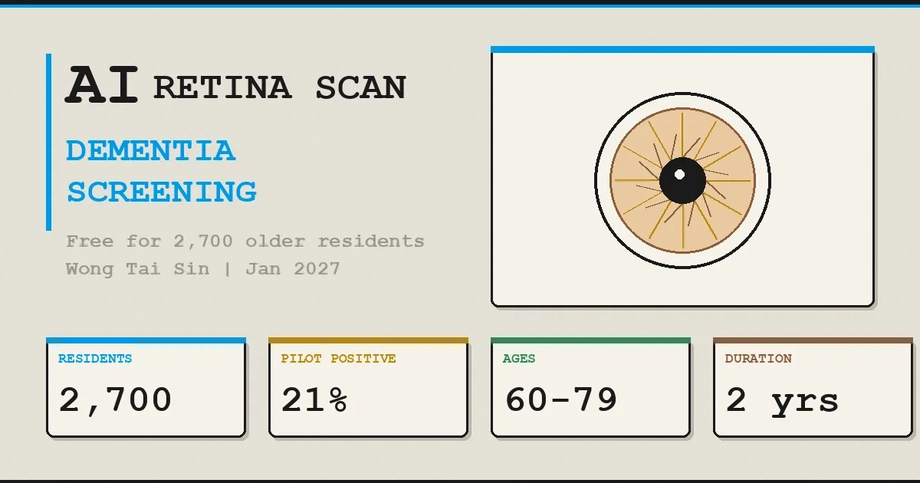
The Chinese University of Hong Kong will offer free brain health screening to 2,700 Wong Tai Sin residents aged 60 to 79 from January 2027, combining an artificial intelligence analysis of an eye photograph with a questionnaire and a short cognitive test. Participants whose retinal images signal higher risk will receive a year of support from a trained volunteer.
Contents
- A 23 Minute Check With a Year of Support
- Who Can Apply and What Happens at Screening?
- Why Look at the Eye to Assess Brain Health?
- What the Published AI Results Mean
- What Changed in the Pilot?
- Moving From Telephone Contact to Local Care
- How the Service Reached Wong Tai Sin
- Why Hong Kong Is Seeking Earlier Intervention
- What Prevention Can Realistically Offer
- Key Points
The programme, BEAT AD@WTS, will run for two years at two elderly centres operated by the Hong Kong Sheng Kung Hui Welfare Council. The Charles K. Kao Foundation will cover the cost. Screening requires no blood draw or magnetic resonance imaging (MRI).
Professor Vincent Mok Chung-tong, a CUHK medical professor and programme co-director, announced the expansion on November 3, 2026. Wong Tai Sin was chosen because 26% of its residents are at least 65, placing it among Hong Kong's districts with the largest shares of older people.
A positive retinal result identifies someone for closer attention and support. A dementia diagnosis requires a clinical assessment. The programme connects a quick community check with help managing everyday risks, including physical inactivity, social isolation and high blood pressure.
The expansion follows a pilot in which about 21% of 831 participants with normal cognitive function screened positive. Among 532 participants followed for a year, the team reported a larger improvement in brain health scores in people receiving personalised management than in those receiving education alone.
Who Can Apply and What Happens at Screening?
Wong Tai Sin residents aged 60 to 79 can apply if they have no previous dementia diagnosis or neurological conditions such as a brain tumour, stroke or Parkinson's disease. Eligibility also excludes conditions that could cause cognitive impairment. Interested residents can register online or send a WhatsApp message to +852 9234 6854.
The assessment takes about 23 minutes and has three stages:
- A questionnaire lasting about 15 minutes covers blood vessel health risks, physical activity, social activity and diet.
- A photograph of the retina, the light sensitive tissue at the back of the eye, undergoes AI analysis taking about three minutes.
- A cognitive assessment lasting about five minutes checks abilities such as memory and thinking.
People found to have mild cognitive impairment will be referred for further tests to identify the cause. Mild cognitive impairment means that memory or thinking has declined beyond what would usually be expected with ageing, while a person can still manage many daily activities.
Participants with a positive retinal result will be paired with a trained volunteer for a year to help them follow an individual care plan. Medical facilities receiving referrals will decide which further examinations are appropriate.
Why Look at the Eye to Assess Brain Health?
CUHK's approach uses a fundus camera, a device that photographs the back of the eye and is commonly found in optical shops and clinics in Hong Kong. AI software examines patterns in the image that have been associated with Alzheimer's disease.
Professor Clement Tham Chee-yung, chairman of CUHK's Department of Ophthalmology and Visual Sciences, explained the biological connection in the university's 2022 research announcement:
The retina is an extension of the brain in terms of embryology, anatomy and physiology. In the entire central nervous system, only the blood vessels and nerves in the retina allow direct visualisation and analysis.
In simpler terms, the retina develops as part of the nervous system, and its visible vessels and nerves can carry clues about changes associated with brain disease. The software learns patterns from photographs rather than relying on a person to spot every small difference.
Mok compared the process with facial recognition. Instead of learning features that distinguish faces, the model learns features that distinguish retinal images from different groups of people.
What the Published AI Results Mean
CUHK's international research team developed and validated its 2022 model using nearly 13,000 retinal photographs from 648 patients with Alzheimer's disease and 3,240 people with normal cognition. Institutions in Singapore, the United Kingdom and the United States took part, and the findings appeared in The Lancet Digital Health.
The model achieved 83.6% accuracy, 93.2% sensitivity and 82.0% specificity in internal validation. CUHK rounded those figures to 84%, 93% and 82% in its announcement. Accuracy across external datasets ranged from 79.6% to 92.1%.
Sensitivity describes how often a test identifies people who have the condition. A sensitivity of about 93% means it identified roughly 93 out of every 100 Alzheimer's patients in that validation setting. Specificity describes how often it correctly identifies people without the condition. At 82% specificity, roughly 18 out of every 100 people without Alzheimer's could receive a positive result in the same setting.
The proportion of positive results that lead to a diagnosis also depends on how common the disease is in the population being screened. A community service involving people with normal cognition therefore needs its own follow-up evidence.
The 2022 research examined photographs from people whose disease status was already known. For Wong Tai Sin, the practical task is to identify residents who need further assessment and support, then track what happens to them.
CUHK's January 2023 research bulletin also said the model retained its ability to distinguish the groups when participants had glaucoma or macular degeneration, eye conditions common among older people. The expansion announcement leaves several details open: which model version will be used, how many positive participants will later develop dementia, whether the pilot management groups were assigned at random, and when services might extend beyond Wong Tai Sin.
What Changed in the Pilot?
The pilot identified about one in five of its 831 cognitively normal participants as having higher risk through retinal screening. Participants with positive results performed worse on cognitive tests, and many had chronic conditions including hypertension and diabetes.
Among 532 people followed for a year, average brain health scores rose by 1.3 points in the group receiving personalised management and by 0.2 points in the group receiving brain health education alone. The difference between those improvements was 1.1 points.
The team said cognitive assessment scores in the personalised management group approached those typically seen in people about three years younger. The reported outcome was a change in assessment scores over one year; longer follow-up would be needed to measure dementia diagnoses and sustained changes in daily habits.
The programme team presented the pilot findings at the announcement. Its results give the Wong Tai Sin service an initial benchmark, including the 21% positive screening rate, against which to compare the larger community rollout.
A participant identified as Ms Lam, aged 74, illustrated the kind of change the service hopes to support. Her cognitive score rose from six out of 12 at an assessment three years earlier to 11 after she became more active and changed her habits. The larger participant groups provide the basis for judging how consistently such improvements occur.
Moving From Telephone Contact to Local Care
The Charles K. Kao Foundation says the wider BEAT AD service has already served more than 1,500 older adults. The Wong Tai Sin expansion will bring its assessments and support into two established community centres.
Dr Chiu Ha-ying, a foundation governor, executive committee member and programme co-director, said previous contact and follow-up had largely taken place by telephone. The expanded service plans to work with trained social workers and healthcare staff based in the community, adding clinical assessments in person and regular follow-up.
For participants, that means the service continues beyond receiving a screening result. Volunteers will help them put a personalised plan into practice, while community staff and medical services provide routes for further assessment.
The change also gives the programme a practical task to measure: whether people keep exercising, maintain social contact and manage health risks after the initial encouragement. The volunteer pairing lasts one year, within a district programme scheduled to operate for two years.
How the Service Reached Wong Tai Sin
CUHK and the foundation launched the Charles Kao CUHK BEAT AD Service in 2023. BEAT AD stands for Brain HEAlth Service for PrevenTion of Alzheimer's Disease. The partnership received support from a donation by its patron and ambassador, Dr Brigitte Lin Ching-hsia.
The university's 2023 launch statement described free screening for Hong Kong adults aged 60 to 80, with early identification and individual preventive measures as its aims. The new district programme has a narrower age range, 60 to 79, and a residence requirement.
- 2022: CUHK announced its retinal AI research, published in The Lancet Digital Health.
- September 21, 2023: CUHK and the foundation launched the BEAT AD service on World Alzheimer's Day.
- November 3, 2026: The team presented pilot results and announced the Wong Tai Sin expansion.
- January 2027: BEAT AD@WTS is scheduled to begin, targeting 2,700 residents over two years.
The foundation was established by Nobel laureate Charles K. Kao and his wife, Gwen. Its funding allows eligible residents to receive the new screening and support service free of charge.
Why Hong Kong Is Seeking Earlier Intervention
Mok projects that Hong Kong's dementia population will rise from about 180,000 in 2026 to 240,000 in 2036. That is an increase of 60,000 people, or one third, over a decade.
By 2036, he expects one in three residents to be at least 65. United Nations figures cited in connection with the announcement put Hong Kong's life expectancy at 85.8 years in 2025, with a projected rise to 89.2 years by 2050.
Dementia is a broad term for a decline in memory and thinking that interferes with daily life. Alzheimer's disease is one cause. CUHK's 2022 announcement said more than half of dementia cases among Hong Kong residents aged 70 or above were attributable to Alzheimer's.
Mok said the aim is to intervene well before symptoms appear. Alzheimer's involves the accumulation of abnormal proteins, including amyloid, and damage can develop over many years. Reaching people while they still feel well creates a practical challenge: persuading them to change habits before memory difficulties make the danger feel immediate.
What Prevention Can Realistically Offer
The 2024 Lancet commission on dementia estimated that addressing 14 modifiable risk factors could prevent or delay up to 45% of cases. Factors discussed in the Hong Kong announcement included physical inactivity, social isolation, hearing loss and hypertension.
The estimate is a population calculation that assumes those factors cause the associated risk and can be fully removed. Applying 45% to Mok's projected 240,000 cases produces 108,000, which he described in rounded terms as about 100,000 potentially avoidable cases.
For an individual resident, prevention means working on risks that can be changed while receiving appropriate medical care. An eye photograph helps select people for attention; regular activity, social contact and management of conditions such as high blood pressure require continuing effort and support.
The Wong Tai Sin programme will provide a way to examine how that approach works in ordinary community settings. Useful outcomes include how many participants screen positive, how many receive a diagnosis after referral, how assessment scores change and whether healthier habits continue beyond the first year.
Mok hopes to extend the service to other Hong Kong districts and has said Singapore has tried a similar approach. For now, BEAT AD@WTS access is restricted to eligible Wong Tai Sin residents. People with memory concerns can seek an assessment from a family doctor rather than wait for a district screening programme.
Key Points
- Free screening for 2,700 Wong Tai Sin residents aged 60 to 79 is scheduled to start in January 2027.
- The assessment combines a questionnaire, retinal photograph and cognitive test, taking about 23 minutes.
- A positive retinal result signals higher risk and leads to support or further assessment.
- Participants with positive retinal results will receive a year of help from trained volunteers.
- The pilot reported average score improvements of 1.3 points with personalised management and 0.2 points with education alone.
- Eligible residents can register online or contact +852 9234 6854 by WhatsApp.