A new way to interrupt a cancer growth signal
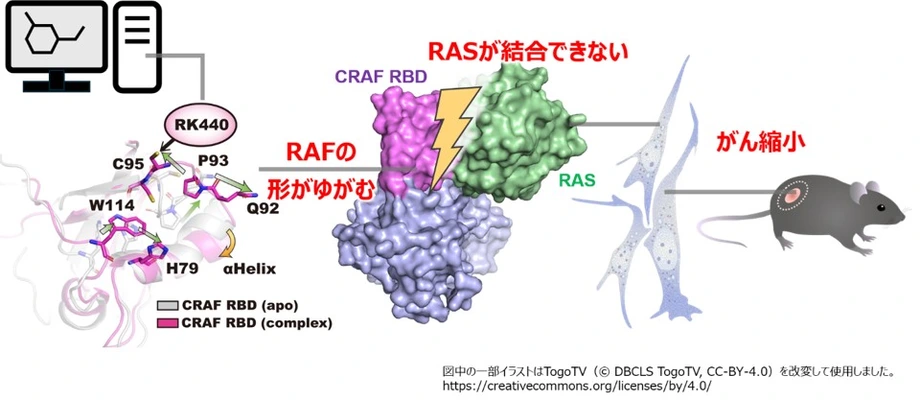
Japanese researchers have identified a compound called Kobe3708 by searching a commercial library of 2.5 million chemicals, opening a possible route to treating cancers driven by several different forms of the RAS protein. Instead of attacking RAS directly, the compound attaches to its signalling partner, RAF, and changes its shape so the two proteins have difficulty connecting.
Contents
- A new way to interrupt a cancer growth signal
- Why RAS is such a difficult target
- Changing the receiving protein rather than the sender
- How computers narrowed 2.5 million candidates
- Structural tests pinpointed the attachment site
- What tests across 66 cancer cell lines found
- Why resistant melanoma matters
- How the work fits into RAS drug development
- Safety and chemical improvements come next
- Key Points
The study, published in Nature Communications on August 27, 2026, describes an experimental approach that suppressed cancer growth in laboratory and animal models. Researchers also developed two related compounds, RK440 and RK447, and reported activity against cancers carrying KRAS, NRAS and HRAS mutations, as well as melanoma that had become resistant to existing BRAF inhibitors.
The collaboration involved a group led by Professor Fumi Shima, then at Kobe University's Graduate School of Medicine, together with researchers from other Kobe University departments, RIKEN and the Japan Synchrotron Radiation Research Institute. Kobe University's research announcement describes the strategy as changing RAF's structure to interrupt the message it receives from RAS.
The findings are preclinical, meaning they come from experiments before testing a treatment in people. For patients, the immediate development is a new direction for drug research. The team plans further chemical improvements and detailed safety and effectiveness testing; no date for human trials was given.
Why RAS is such a difficult target
RAS proteins act like molecular switches that help cells decide when to grow and survive. They switch between an active state, carrying a molecule called GTP, and an inactive state, carrying GDP. Certain mutations keep growth signals flowing when they should slow down or stop.
The study puts the frequency of RAS mutations at approximately 25% of human cancers, including about 90% of pancreatic cancers and 45% of colorectal cancers. Put simply, the figures correspond to roughly one cancer in four across all types, compared with nine in ten pancreatic cancers.
KRAS, NRAS and HRAS are members of the RAS family. Different mutations alter these proteins in different ways, which makes a drug designed for one particular mutation unsuitable for many other cancers. The researchers therefore sought a place in the signalling process that several forms of RAS depend on.
RAF provides such a point of contact. Active RAS binds to a region of RAF called the RAS binding domain, or RBD, helping activate a chain of proteins that carries growth instructions through the cell. Disrupting that connection could interrupt the chain across several RAS variants.
Changing the receiving protein rather than the sender
Kobe3708 binds to a specific building block in CRAF, one member of the RAF family. That building block is a cysteine amino acid at position 95, known as Cys95. The compound forms a covalent bond there, a chemical attachment in which atoms share electrons.
Cys95 sits away from the surface where RAS normally connects. Attaching Kobe3708 at this separate location changes RAF's structure, and the structural disturbance reaches the RAS contact area. The altered protein becomes less able to receive the growth signal.
Scientists call this an allosteric effect: a molecule attaches at one location on a protein and changes what happens somewhere else. A simple comparison is bending one part of a connector so that its plug no longer fits properly. The compound changes the receiving structure rather than covering the connection directly.
The Nature Communications paper explains why this approach appealed to the team. RAF's direct contact surface with RAS is relatively smooth, making it difficult to find a small chemical that can attach there and block the interaction. A separate attachment site offers another way to interfere with the same connection.
How computers narrowed 2.5 million candidates
The researchers used active learning to search the chemical library. In this process, a computer system learns from chemical structures, their properties and existing experimental results, then helps select promising candidates for further investigation.
The search differed from trying to fit a computer model of each compound into a known pocket on a protein. According to the paper, the screening did not use structural information from either RAS or RAF. The team also excluded virtual candidates resembling its earlier RAS inhibitors, seeking chemicals with different structures.
Laboratory experiments then tested whether selected compounds interrupted the RAS to RAF connection. Kobe3708 reduced growth in engineered cells dependent on an active HRAS mutation, while cells driven by a shortened, independently active form of RAF were less affected. That shortened RAF lacked the RAS binding domain.
In a separate binding experiment, Kobe3708 reduced the interaction between HRAS carrying the G12V mutation and the CRAF binding domain, with an IC50 of 7.62 micromolar. IC50 is the concentration needed to reduce a measured activity by half. Here, the measurement concerned protein binding in an experimental assay.
Structural tests pinpointed the attachment site
Nuclear magnetic resonance experiments helped the researchers identify which protein Kobe3708 attached to. The signals from the tested HRAS protein changed little when the compound was added, while signals from the CRAF binding domain changed, directing attention to RAF.
X-ray crystallography then helped reveal the attachment in structural detail. The team used beamlines BL38B1 and BL45XU at Japan's SPring-8 synchrotron facility, where intense X-rays allow researchers to investigate molecular structures.
The scientists initially could not obtain suitable crystals of the ordinary CRAF binding domain combined with Kobe3708. They instead used an engineered binding domain combining CRAF and BRAF features, which retained comparable binding behaviour and was easier to crystallise. Its structure showed the chemical connection between Kobe3708 and Cys95.
Further experiments tested the importance of that site. When researchers replaced Cys95 with a different amino acid, the compound lost its ability to attach and interrupt RAS binding in those assays. The archived full paper also describes experiments in cancer cells carrying KRAS G12V in which Kobe3708 attached to the cells' own CRAF and disrupted the RAS to RAF interaction.
What tests across 66 cancer cell lines found
Kobe3708 was tested in 66 cancer cell lines, including 21 with RAS mutations and 45 with wild type RAS. Wild type means the gene lacks the mutations being considered; a cancer with wild type RAS can still depend on excessive RAS signalling.
Under conditions with a low serum concentration, the reported IC50 values for growth inhibition were 2.14 micromolar for the group with RAS mutations and 3.70 micromolar for the group with wild type RAS. Serum supplies growth factors and other substances that influence how cells behave in culture.
The concentration associated with halving growth was therefore about 42% lower in the group with RAS mutations under those conditions. With normal serum concentrations, the corresponding figures were 4.66 and 6.04 micromolar. The results show both greater sensitivity among the mutant group and a change in response when the culture conditions changed.
The team also measured proteins farther along the growth signalling chain. Kobe3708 reduced activation of MEK, ERK and RSK in the tested cells with active RAS mutations. These proteins pass messages onward inside the cell, so measuring their activity helped connect the growth effects to interruption of the RAS and RAF pathway.
The study reports tumour suppression in preclinical models, including animal experiments, and activity against some cancers driven by wild type RAS. RK440 and RK447, developed from Kobe3708, extended the investigation beyond the initial chemical prototype.
Why resistant melanoma matters
The researchers also tested the approach against melanoma carrying the BRAF V600E mutation that had acquired resistance to BRAF inhibitors. Acquired resistance means a cancer becomes less responsive to a drug after treatment, allowing growth to resume.
BRAF belongs to the RAF protein family. Drugs targeting abnormal BRAF can interrupt growth signalling, but resistant cancer cells can restore activity through routes involving RAS. The study describes how renewed RAS and RAF interaction can help restart the downstream signal.
Kobe3708 and its derivatives target the connection needed for that reactivation. The researchers reported suppression of tumour growth in resistant melanoma models by preventing renewed RAS signalling. This gives the approach a second possible use alongside cancers initially driven by RAS mutations: tackling a route through which another cancer escapes treatment.
RIKEN's August 28 announcement highlights both areas of activity, cancers carrying different RAS mutations and melanoma resistant to BRAF inhibitors. Its publication followed the journal paper by one day.
How the work fits into RAS drug development
The study places this strategy alongside the development of medicines that directly target particular RAS mutations. It cites sotorasib and adagrasib, approved by the US Food and Drug Administration in 2021 and 2022, respectively, for adults with KRAS G12C mutated non-small cell lung cancer that was locally advanced or metastatic.
KRAS G12C accounts for approximately 10% of cancers with RAS mutations, according to the paper. Other variants, including G12D, G12V and G13D, frequently occur in pancreatic and colorectal cancers. Researchers are also developing drugs aimed at other mutations and broader groups of KRAS proteins.
The dates trace the progression from medicines for a specific mutation to this experimental strategy:
- 2021: The FDA approved sotorasib for the specified group of patients with KRAS G12C mutated lung cancer.
- 2022: The FDA approved adagrasib for that molecular subtype of advanced lung cancer.
- August 27, 2026: Nature Communications published the study describing Kobe3708 and its derivatives.
- August 28, 2026: RIKEN issued its announcement about the RAF shape changing approach.
The new compounds seek breadth by targeting a receiving protein shared by several RAS signals. That differs from designing a chemical around one altered version of RAS itself, and explains why the researchers tested multiple RAS mutations and cancers with wild type RAS.
Safety and chemical improvements come next
The researchers conducted an initial safety profiling screen involving 50 commonly tested targets. Kobe3708 produced no more than 20% inhibition at most targets, while a serotonin receptor called 5-HT2B showed 49% inhibition at a concentration of one micromolar. That receptor result gives further safety testing a specific interaction to investigate.
The paper also describes additional binding to CRAF at substantially higher experimental concentrations. At 50 micromolar, changes in the protein's movement through an analytical gel suggested attachment to cysteine sites beyond Cys95. Understanding which proteins and sites these compounds affect will be part of refining their chemistry.
Kobe University says the team intends to improve the compounds and examine safety and effectiveness in greater detail. The practical task is to turn the observed interruption of cancer signalling into a medicine that reaches tumours at useful concentrations while keeping effects on healthy tissues within acceptable limits.
The central result is a new way to interfere with a difficult protein connection: attach away from the contact surface, change RAF's shape and interrupt the message from RAS. Kobe3708, RK440 and RK447 provide experimental starting points for that work.
Key Points
- Researchers identified Kobe3708 through a computer assisted search of 2.5 million compounds.
- The compound attaches to CRAF at Cys95 and changes its shape, disrupting its connection with RAS.
- Kobe3708 and derivatives RK440 and RK447 showed activity in preclinical models involving several RAS mutations.
- The study also reported tumour suppression in models of melanoma resistant to BRAF inhibitors.
- The research appeared in Nature Communications on August 27, 2026. Further chemical development and safety testing are planned.