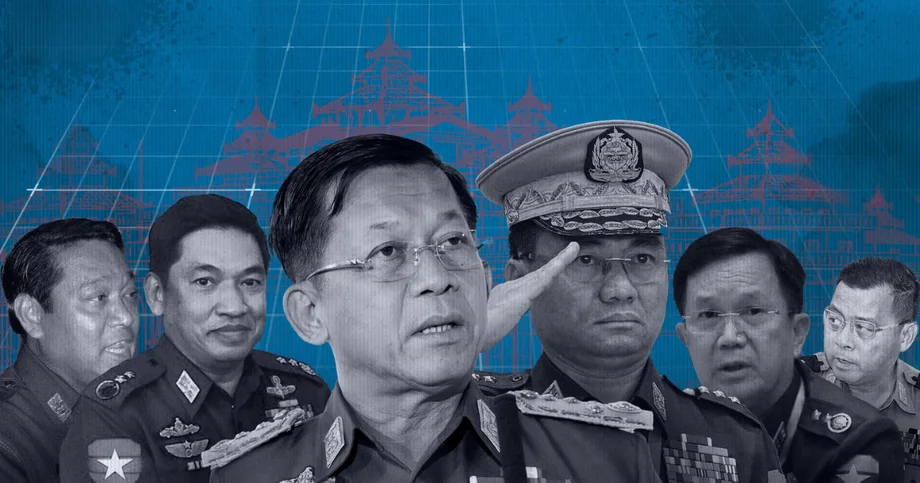
From Army Command to the Presidential Palace
Min Aung Hlaing secured Myanmar's presidency on April 3, 2026, after roughly 15 years as commander in chief, completing a move prepared through a new advisory council, a parliament dominated by military allies and the selection of a trusted successor to lead the armed forces. His change of office followed the February 2021 coup that removed Aung San Suu Kyi's elected government.
Contents
- From Army Command to the Presidential Palace
- How Parliament Opened the Door
- The Council Created Before the New Government
- Why an Advisory Body Matters
- A Trusted Successor Takes the Army
- Loyalists Across Parliament and Party
- The Dates Behind the Transfer of Power
- Personal Ambition and Military Interests
- Recognition Abroad, Accountability Demands at Home
- Key Points
The central issue is who controls the military after he leaves its command. Under the 2008 Constitution, the armed forces retain substantial independence from civilian government. Becoming president therefore meant surrendering the position that had given Min Aung Hlaing direct control over the institution at the heart of Myanmar's political power.
General Ye Win Oo, a former intelligence chief and close ally, was chosen to replace him. Earlier speculation had focused on deputy commander Vice Senior General Soe Win and Chief of General Staff General Kyaw Swar Lin. The eventual choice put personal loyalty at the centre of the succession.
A second part of the arrangement emerged on February 3, when the military authorities enacted the Union Consultative Council Law. Its broad remit covers security, foreign relations, peace and legislation. Accounts of Min Aung Hlaing's plans described the council as another means of maintaining influence over civilian and military affairs.
By October, his efforts to gain acceptance abroad had brought a further development: Malaysian Prime Minister Anwar Ibrahim hosted him in Putrajaya. Taken together, the appointments, legislation and diplomacy show a project extending beyond obtaining a presidential title to preserving power and seeking recognition for it.
How Parliament Opened the Door
Lower house lawmaker Kyaw Kyaw Htay nominated Min Aung Hlaing for vice president on March 30. That was a step in the presidential selection process: parliament would then choose the president from three candidates, with the other two becoming vice presidents.
Min Aung Hlaing faced two loyalists considered unlikely to challenge him. Around 90% of the new parliament's members were described as loyal to him, either as serving military officers or elected representatives of the military aligned party. The Constitution reserves a quarter of parliamentary seats for serving officers, giving the armed forces a substantial presence without winning those seats in an election.
The figures show how much support extended beyond that constitutional allocation. A reserved military share of 25%, within a chamber described as roughly 90% loyal, left about 65 percentage points of support coming from outside the military's guaranteed seats. Those elected allies made the parliamentary route to the presidency highly predictable.
The elections took place between December 2025 and January 2026. Major opposition parties were excluded, while conflict prevented participation in parts of the country. The military authorities presented the vote as a route to peace and maintained that it was free and fair. Opponents rejected that account, pointing to the exclusions and the continuing repression of dissent.
The Council Created Before the New Government
The Union Consultative Council Law was enacted by the National Defence and Security Council during military rule, before the incoming parliament could consider it. The timing gave the future president an additional institution already established in law.
The president appoints the council, including its chair and secretary. The initial description of the plan referred to five members; the more detailed account of the law specified at least five. Its duties include advising and coordinating on national security, the rule of law, international relations, peace and legislation. The president's office handles its administrative work.
Section 9 ties the council's term to the president's term. That provision connects the institution directly to the presidency rather than giving it an independent term extending beyond the president who appoints it.
The Myanmar Lawyers' Council warned that the body could interfere with parliament, government and the judiciary, and described it as a move toward permanent military dictatorship. A person familiar with the law in Naypyitaw offered a narrower interpretation, saying the council had no administrative power. Its final membership, whether Min Aung Hlaing would personally chair it and how far its authority would reach remained unresolved in the accounts describing its creation.
Why an Advisory Body Matters
Myanmar already has a cabinet and a National Defence and Security Council under the 2008 Constitution. The latter brings together the president, two vice presidents, both parliamentary speakers, the commander in chief, the deputy commander and ministers responsible for foreign affairs, defence, home affairs and border affairs.
The new consultative council adds another place where senior figures can coordinate decisions. Its remit reaches across matters ordinarily handled by different institutions. Security connects it to the military; legislation connects it to parliament; foreign affairs and peace connect it to government policy.
Military sources described an intention to use the council to keep the next commander within Min Aung Hlaing's political orbit. Another interpretation circulating in Naypyitaw was that it would provide senior positions for officers leaving military rule who might be considered too senior for an ordinary ministry.
The distinction between formal duties and personal influence is central to understanding the arrangement. A council charged with giving advice can still carry political weight when its members are powerful former commanders and its work is organised through the president's office. Its practical role depends on those relationships as well as the wording of the law.
A comparable plan was discussed during former military leader Than Shwe's transition in 2011. A proposed body of retired senior leaders was intended to retain influence over civilian and military affairs, but it never became operational. The new law gives Min Aung Hlaing's proposed institution a legal framework that the earlier arrangement lacked.
A Trusted Successor Takes the Army
Ye Win Oo's selection followed weeks of attention to two other senior officers. Soe Win, a graduate of the Defence Services Academy's 22nd intake, was the military's second ranking officer. Kyaw Swar Lin, from the academy's 35th intake, had risen rapidly under Min Aung Hlaing and served as quartermaster general and chief of general staff.
A former officer close to military headquarters had considered Kyaw Swar Lin the most likely choice by the end of March. Other military contacts said Min Aung Hlaing had not yet settled on a name. Ye Win Oo's eventual selection showed how quickly expectations based on seniority could be displaced by the outgoing commander's preference.
Public appearances had also attracted attention. Soe Win attended Chinese New Year celebrations in Min Aung Hlaing's place and had made the first official visit to China by a senior Myanmar military leader after the coup. Kyaw Swar Lin accompanied Min Aung Hlaing on a visit to China in 2025. Both had visible connections to a country with considerable influence over Myanmar's military authorities.
Kyaw Swar Lin also carries international sanctions imposed by Switzerland, Canada, the European Union and Britain. Researchers have linked him to the military's 2017 operations in Rakhine State. Ye Win Oo, the officer ultimately chosen, has been described as having a reputation for brutal treatment of dissidents.
Loyalists Across Parliament and Party
Min Aung Hlaing's preparations extended beyond army headquarters. Aung Lin Dwe, a former secretary of the military's ruling council, and Khin Yi, a former minister and leader of the Union Solidarity and Development Party, were placed in parliamentary leadership roles.
People close to senior party figures also described plans to transfer the party leadership from Khin Yi to another trusted figure. Control of the party matters because its elected lawmakers supplement the officers who enter parliament through the Constitution's reserved seats.
The arrangement was described as an effort to avoid a repeat of the rivalry between former president Thein Sein and former parliamentary speaker Shwe Mann. A president, a speaker and a party leader can each build a separate base of influence. Filling those positions with dependable allies reduces the room for competing centres of power.
Myanmar's military succession history helps explain that concern. In 2011, Than Shwe selected Min Aung Hlaing rather than his powerful deputy Maung Aye or Shwe Mann, who had also been widely discussed as a successor. Rank and public expectations offered limited guidance then, just as they did during the 2026 transition.
The Dates Behind the Transfer of Power
Min Aung Hlaing's route to the presidency developed over years, then accelerated through a series of decisions in early 2026. The sequence connects the overthrow of an elected government with the institutions used to install its military successor in civilian office.
- 2015 and 2020: The National League for Democracy won national elections, frustrating the military aligned party's ambitions.
- February 2021: Min Aung Hlaing led the coup that removed the elected government.
- December 2025 to January 2026: Elections were held with major opposition parties excluded and participation restricted by conflict.
- February 3, 2026: The military authorities enacted the Union Consultative Council Law.
- February 18: Thai Foreign Minister Sihasak Phuangketkeow said Myanmar was preparing to appoint a president, prime minister and new military commander.
- March 30: Lawmakers nominated Min Aung Hlaing for the presidential selection process.
- April 3: Min Aung Hlaing secured the presidency through a parliamentary vote.
- April 6: Advocates submitted a genocide complaint against him to Indonesian prosecutors.
- October 7 and 8: He visited Malaysia for talks with Anwar Ibrahim.
The February 18 statement followed an informal meeting between Sihasak and Myanmar's military appointed foreign minister, Than Swe. It publicly connected the civilian appointments and the military succession as parts of the same government formation process.
Personal Ambition and Military Interests
David Steinberg, a scholar of Myanmar, argued in 2021 that the coup involved more than a personal struggle between Min Aung Hlaing and Aung San Suu Kyi. His analysis also pointed to the military's defence of its longstanding institutional interests and what its leaders considered the national interest.
Mary Callahan's book Making Enemies supplies a related explanation rooted in military history. She describes an institution shaped by warfare and state building, whose leaders came to view themselves as the builders and guardians of the country. Within that outlook, ordinary civilians could become objects of suspicion or be treated as enemies.
Those arguments help connect the presidency to a longer pattern: military involvement in government in 1958, the 1962 coup, the political structure created under the 1974 Constitution, direct military rule after 1988 and the protected military role established by the 2008 Constitution. The current arrangement draws on institutions that give commanders political authority alongside their military responsibilities.
Naing Min Khant, an analyst at the Institute for Strategy and Policy Myanmar, described the purpose of the latest manoeuvring in direct terms:
This political maneuvering signals that Min Aung Hlaing intends to continue ruling the country with an iron fist.
Naing Min Khant also addressed the search for acceptance that accompanies the shift to a civilian title:
He fundamentally lacks legitimacy but desperately craves the facade of it.
Recognition Abroad, Accountability Demands at Home
Myanmar's civilians face the consequences of a conflict that continued through the political transition. Accounts published during the succession debate put the toll since the coup at more than 7,000 people killed, over 20,000 detained and more than 3.5 million displaced. Large areas remained under the control of armed opposition groups.
The Special Advisory Council for Myanmar has said that the military's elections and political arrangements cannot erase responsibility for war crimes. The demand for accountability became concrete days after the presidential vote, when advocates filed a genocide complaint in Indonesia on April 6. The filing concerns military operations that drove more than 730,000 Rohingya from Myanmar in 2017. Indonesian prosecutors received it for review, with prosecution still subject to a decision.
Diplomatic engagement has developed alongside those legal efforts. During October talks in Malaysia, Anwar supported efforts toward Myanmar's fuller participation in the Association of Southeast Asian Nations while discussing refugee returns. Malaysia said it had returned 10,493 Myanmar nationals that year by October 8, and rights groups warned of persecution, forced recruitment and other dangers facing returnees.
For Min Aung Hlaing, foreign meetings offer opportunities to be received as a president rather than solely as a coup leader. For displaced people, detainees and communities facing military operations, the practical measures are different: whether violence stops, whether they can return safely and whether those responsible for abuses face justice.
Key Points
- Min Aung Hlaing became president on April 3, 2026, after a parliamentary process dominated by military allies.
- General Ye Win Oo, a close ally and former intelligence chief, was chosen to succeed him as military commander.
- The February 3 Union Consultative Council Law created a body advising on security, foreign affairs, peace and legislation.
- The council's term matches the president's, while its practical authority became a focus of legal and political concern.
- The transition combines loyalist appointments in the military, parliament and party with efforts to gain diplomatic acceptance.
- A genocide complaint in Indonesia and continuing demands for accountability accompanied the move to civilian presidential office.