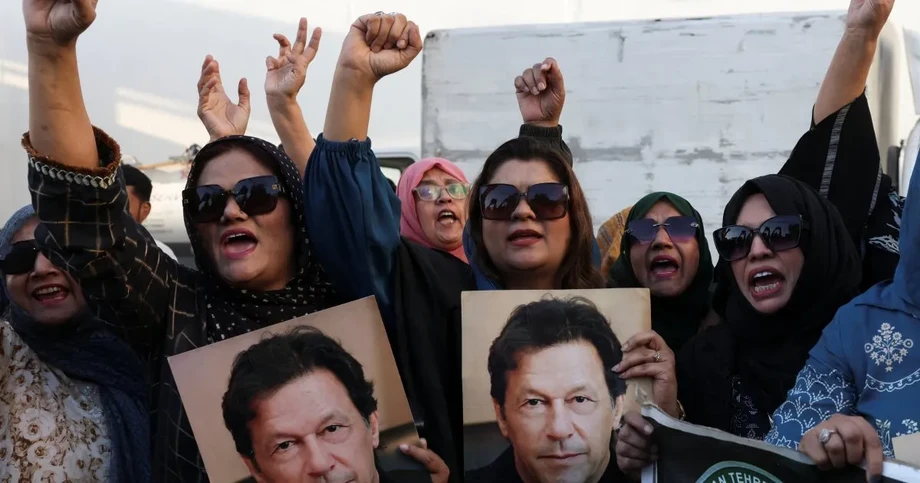
Hospital discharge renews demands for access
Pakistan's jailed former prime minister Imran Khan received another injection for a condition affecting his right eye during an overnight hospital visit on November 10-11, 2026, before being returned to Adiala Jail. His Pakistan Tehreek-e-Insaf (PTI) party demanded immediate access for his family, personal doctors and lawyers, saying they had not been told about the transfer.
Contents
- Hospital discharge renews demands for access
- What doctors did at PIMS
- Family and personal doctors were absent
- Blood pressure concerns predate this visit
- Why the August hospital order matters
- Medical recommendations reached beyond injections
- How the medical dispute developed
- Legal access and a wider political confrontation
- Another senior PTI leader remains in hospital
- Key Points
The Pakistan Institute of Medical Sciences (PIMS) in Islamabad said the 74-year-old was discharged at about 2:30am on Wednesday after an examination and treatment recommended by his ophthalmologist. He spent approximately 40 to 50 minutes at the government hospital, which said he remained stable before, during and after the procedure.
The visit renewed a dispute over an August 18 Supreme Court order directing Khan's transfer to the private Shifa International Hospital in Islamabad. Authorities instead took him to PIMS and returned him to prison, citing security concerns. PTI wants that court order implemented and his treatment supervised by his personal physicians.
Khan's medical care has become closely tied to restrictions on contact with him. His lawyer told the Islamabad High Court on Tuesday that Khan had described an improvement in his eyesight, while blood pressure remained a concern. Parliamentary Affairs Minister Tariq Fazal Chaudhry said Khan was receiving the required care and that his treatment was not being neglected.
For Khan's family and legal team, the immediate demands concern both his treatment and their ability to see him, receive information about his condition and participate in decisions about further care.
What doctors did at PIMS
PIMS said its ophthalmology team examined Khan, including an assessment of his eyes, before administering an intravitreal anti-VEGF injection. The hospital said he gave informed consent, meaning he agreed to the procedure after receiving information about it.
An intravitreal injection delivers medicine into the gel inside the eye. Anti-VEGF medicines block a protein called vascular endothelial growth factor, which can contribute to leakage from blood vessels and swelling in the retina. The retina is the tissue at the back of the eye that detects light and helps produce vision.
Khan has been receiving injections in his right eye for central retinal vein occlusion (CRVO), diagnosed after he reported reduced vision. CRVO occurs when the main vein carrying blood away from the retina becomes blocked. The resulting bleeding and swelling can damage sight.
PIMS, the government hospital responsible for the overnight treatment, described his condition in its statement:
His vital parameters were found to be normal. He was clinically stable, and his general physical examination was normal.
The hospital said Khan left with instructions for further care and follow-up. It gave no date for his next appointment or detailed measurement of his remaining vision.
Family and personal doctors were absent
PTI information secretary Sheikh Waqas Akram said Khan's family and personal doctors had not been notified about the hospital visit. He said the party learned of it through news coverage rather than through the authorities responsible for Khan's custody.
Akram, speaking about who was present during the transfer and treatment, said:
No one from the family or party was there [at the hospital]; our personal physician was not there either.
PTI demanded access for three groups with different responsibilities: relatives concerned about Khan's welfare, doctors familiar with his medical history, and lawyers handling his cases. The party's statement set out that demand:
His family, personal doctors and legal team must be given immediate and unrestricted access.
The demand follows a meeting after seven months between Khan and his lawyer, Barrister Salman Safdar, at Adiala Jail earlier in November. Safdar said that consultation lasted about 40 minutes and included Khan's wife, Bushra Bibi, whom he had not met for 11 months. He described the time as insufficient to discuss all their legal matters.
Blood pressure concerns predate this visit
Safdar raised Khan's blood pressure during Tuesday's Islamabad High Court hearing, where he represented Khan and Bushra Bibi in appeals against their convictions in a property case. His account combined Khan's reported improvement in eyesight with continuing concern about his wider health.
Akram separately claimed that Khan's blood pressure had reached 192. That figure could not be independently verified, and he did not provide a complete reading. Blood pressure is normally recorded as two numbers, so a single figure gives an incomplete picture of the measurement.
An unnamed official also said Khan had blood pressure problems and received treatment during the overnight visit. PIMS described his vital signs as normal during its examination and said he remained stable throughout the procedure.
Earlier prison medical records had already recorded similar complaints. An annexure to a jail report said Dr Akhtar Ali Bandeshah examined Khan on August 1 and noted fluctuating blood pressure, palpitations, headache and restlessness. Palpitations are sensations of a racing, pounding or irregular heartbeat.
The jail administration said adequate healthcare was being provided to Khan and his wife. Khan attributed some of his stress and symptoms to infrequent meetings with his wife, family and other contacts, as well as the absence of newspapers and television.
Why the August hospital order matters
The Supreme Court directed the government on August 18 to transfer Khan to Shifa International Hospital after receiving information about his health. The order followed a report submitted by the Adiala Jail superintendent the previous day.
Authorities took Khan to PIMS instead, where he underwent medical tests before returning to prison. The government cited security concerns. Information Minister Attaullah Tarar blamed a security situation involving PTI workers near the hospital; PTI rejected that allegation and accused the government of disregarding the court's direction.
Akram is now demanding implementation of the August 18 order and transfer to Shifa under the supervision of Khan's personal physicians. Khan's family has also sought treatment at a private hospital.
The November transfer again took Khan to PIMS, leaving the choice of hospital at the centre of the dispute. The government's position is that he is receiving appropriate treatment, while his party wants the court directed transfer and direct access to the doctors it trusts.
Medical recommendations reached beyond injections
A medical board comprising PIMS specialists previously recommended daily walks, access to newspapers and television, and more frequent family meetings to help manage Khan's anxiety and blood pressure.
Those recommendations placed contact and daily prison conditions alongside clinical treatment. For a prisoner, permission to exercise, read or meet relatives depends on arrangements made by the authorities controlling his detention.
PTI said the latest hospital visit and return to prison raised concerns about the quality of care and the transparency surrounding Khan's condition. In its statement, the party connected those concerns to the state's responsibility for a person in custody:
A human being's health is not a political bargaining chip. Nor can the medical treatment of a former prime minister be reduced to a procedural formality.
Chaudhry's assurance that treatment was not being neglected addressed the government's provision of care. The party's demands also cover notification, family contact and supervision by personal physicians, arrangements that remain disputed.
How the medical dispute developed
Khan's eye treatment began in January, months before the Supreme Court's hospital transfer order. His latest visit comes after repeated legal interventions over healthcare and access to him.
- August 2023: Khan entered the period of imprisonment that has continued through the latest hospital visit.
- January 2026: He received his first injection after reporting reduced vision in his right eye.
- August 1: Dr Akhtar Ali Bandeshah examined him and recorded complaints including fluctuating blood pressure, palpitations, headache and restlessness.
- August 18: The Supreme Court directed his transfer to Shifa International Hospital. Authorities took him to PIMS instead and returned him to jail.
- October: Thousands protested in Khyber Pakhtunkhwa over his treatment and restrictions on access by doctors and relatives.
- November 10: Safdar raised blood pressure concerns during an Islamabad High Court hearing.
- November 10-11: Khan was taken from Adiala Jail to PIMS for another eye injection and discharged at about 2:30am.
The November visit was the first known hospital treatment followed by a return to prison since an August visit that was cut short. One chronology places his preceding PIMS visit in June rather than August, but the August hospital transfer and dispute over the Supreme Court order are described across the accounts of his treatment.
Legal access and a wider political confrontation
A Pakistani court has also directed jail authorities to allow Khan's legal team to meet him and Bushra Bibi, according to PTI. Access allows lawyers to obtain instructions from their clients while preparing appeals and responding to other proceedings.
Khan is serving a sentence of 14 years in a corruption case. All but one of his convictions have been suspended or overturned, with appeals pending. He faces more than 100 cases, including corruption allegations and allegations related to inciting violence.
Khan denies wrongdoing and describes the proceedings as politically motivated. The government rejects that allegation. He served as prime minister from 2018 until his removal through a parliamentary vote of no confidence in April 2022.
The medical dispute has also drawn supporters onto the streets. Thousands protested in October in Khyber Pakhtunkhwa, a PTI stronghold, demanding treatment and access for doctors and family members. Governor's rule imposed that month suspended the party's provincial administration.
The confrontation has extended to PTI detention challenges in the province. On November 5, the Federal Constitutional Court suspended related proceedings at the Peshawar High Court while considering constitutional restrictions linked to military assistance to civilian authorities. That case concerns detained activists, while Khan's lawyers continue pursuing his own appeals and access applications.
Another senior PTI leader remains in hospital
PTI deputy chairman and former foreign minister Shah Mehmood Qureshi was also taken from prison to a hospital in Lahore on Tuesday and remained hospitalised when Khan returned to Adiala Jail.
A prison official said Qureshi, 70, suffered a dizzy spell while walking inside his barrack at Kot Lakhpat Jail on Monday. He injured his knee and arm in the fall and was subsequently taken to the Punjab Institute of Cardiology.
For PTI, the two hospital transfers brought the health of senior detained leaders into focus at the same time. Khan's immediate medical follow-up now sits alongside the party's renewed demands for family contact, access for personal physicians and implementation of the August hospital transfer order.
Key Points
- Imran Khan received another injection for his right eye at PIMS during the night of November 10-11, 2026.
- The hospital said he remained stable and was discharged at about 2:30am before returning to Adiala Jail.
- PTI said his family and personal doctors were not notified and demanded immediate access.
- His lawyer reported improved eyesight but continuing blood pressure concerns.
- PTI wants implementation of the August 18 Supreme Court order directing transfer to Shifa International Hospital.
- PTI deputy chairman Shah Mehmood Qureshi remained in a Lahore hospital after a fall in prison.