A faint electrical signal points to a missing piece
Electron pairs with energies reaching 70 millielectronvolts have given physicists a new clue to a mystery that has lasted nearly four decades: why copper oxide superconductors lose electrical resistance at temperatures far above those of conventional superconductors. By measuring tiny fluctuations in electrical current, researchers found that pairing followed the energy of a puzzling feature called the pseudogap, even as that energy changed across a crystal's surface.
Contents
- A faint electrical signal points to a missing piece
- What the pseudogap means
- Listening for pairs instead of individual electrons
- Four years of work to hear a weak signal
- The pairing energy followed the pseudogap
- A magnetic field provided another check
- Why forming pairs is only the first step
- Room temperature is a goal, with a measurement gap to close
- The next experiments will separate pairing from coordination
- Key Points
The team, led by Milan Allan of Ludwig Maximilian University of Munich and Ingmar Swart of Utrecht University, with collaborators at Leiden and other institutions, studied a copper oxide material known as BSCCO. Their results connect the pseudogap to the formation of electron pairs and direct attention toward another requirement for superconductivity: getting those pairs to act together.
The study by Jiasen Niu and colleagues, titled Equivalence of pseudogap and pairing energy in a cuprate high-temperature superconductor, was published in Science on November 5, 2026, according to the university research announcement. Its DOI is 10.1126/science.adt3444. The experiment offers a more precise target for research seeking materials that carry electricity without resistance at warmer temperatures.
What the pseudogap means
BSCCO belongs to a family of copper oxide materials called cuprates. Above the temperature at which these materials become superconducting, measurements can show fewer available electron states within a particular energy range. Physicists call this partial shortage a pseudogap. The electrons remain in the material, but their behavior changes what measuring instruments can detect.
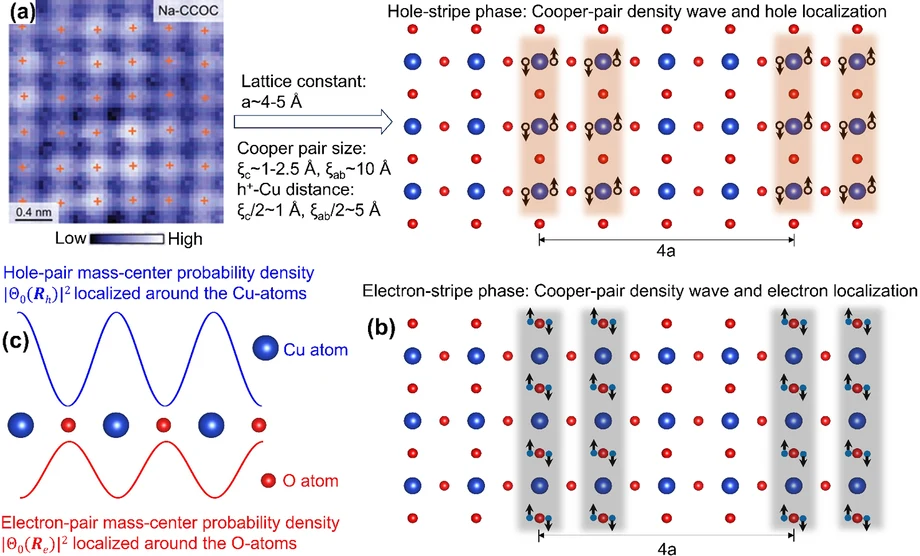
Two broad explanations have competed for decades. Electrons might arrange themselves into patterns, such as charge density waves, in which electrical charge forms a repeating structure. Alternatively, electrons might already be joining into Cooper pairs, the paired state associated with superconductivity, before the material can carry current without resistance.
The difference matters because it changes what researchers should try to improve. If pairs already exist, a central challenge becomes organizing them into a shared quantum state. The new measurements put electron pairing at the center of the pseudogap while leaving room for charge patterns and pairing to exist together.
Listening for pairs instead of individual electrons
The researchers looked for pairs by measuring shot noise, the tiny random fluctuations that arise because electrical charge arrives in separate amounts. A current may seem smooth at an everyday scale, but a sufficiently sensitive instrument can detect its microscopic unevenness.
Allan, one of the research leaders, explained the principle by comparing electrical charge with raindrops hitting a roof:
If you imagine that you have raindrops and then all of a sudden you make the drops twice as heavy, there'll be more noise.
Electron pairs carry twice the charge of individual electrons. Their contribution changes the current's noise, giving researchers a way to identify pairing rather than relying only on changes in the number of detectable electron states.
The team used a scanning tunneling microscope, which passes current between an extremely sharp tip and a sample. Moving the tip allowed measurements at different surface locations. Changing the voltage selected the energy being examined. Together, those controls let the researchers compare the local pseudogap with the local pairing signal.
Four years of work to hear a weak signal
BSCCO presented a demanding measurement problem. In conventional superconductors, pairing can produce a clean doubling of shot noise. In the cuprate experiment, individual electrons continued to contribute current alongside pairs, making the extra noise much weaker.
Students spent about four years refining the electronics needed to extract that signal. The equipment was developed and built by the researchers themselves, giving them the sensitivity required to distinguish contributions from single electrons and electron pairs.
Allan described the effort behind the instrument:
There was not a single trick. It was electronics craftsmanship.
The researchers also had to examine other possible causes of fluctuating current, including movements of atoms at the surface. Establishing where the extra noise began, how it changed from place to place, and how it responded to a magnetic field became essential parts of the experiment.
The pairing energy followed the pseudogap
The BSCCO crystals, made from bismuth, strontium, calcium, copper and oxygen, were cooled to a few degrees above absolute zero. At each location examined, the extra noise associated with pairing appeared at the local pseudogap energy. Where the pseudogap energy changed, the pairing signal followed it.
A March 19, 2025, presentation by Utrecht researcher Maialen Ortego Larrazabal at the APS Global Physics Summit described pairing energies reaching 70 millielectronvolts, or meV. The APS presentation abstract also recorded that pairing energy varied across the material and identified the related preprint as arXiv:2409.15928.
A millielectronvolt is a unit of energy used to describe processes at the scale of atoms and electrons. Here, the pairing energy describes the strength of the paired state. The important result was the close match between that energy and the pseudogap, including their local variations.
The same relationship appeared in samples with different chemical compositions. That gave the researchers a repeated connection across both surface locations and samples, rather than a match found at a single point.
A magnetic field provided another check
The researchers applied magnetic fields of up to 6 tesla to test the origin of the extra noise. As the field increased and suppressed the pairing contribution, the noise fell back toward the level associated with individual electrons. Meanwhile, the broad pattern of reduced electron states largely remained.
This response strengthened the connection between the extra noise and electron pairing. The pseudogap's explanation now has to account for pairing as well as any charge structures present in the material.
Swart, a research leader at Utrecht University, described the conclusion:
Whatever the detailed explanation of the pseudogap is, pairing should be part of it.
Charge density waves may still be intertwined with the paired state. The task is to explain how these behaviors fit together and how they affect the temperature at which superconductivity begins.
Why forming pairs is only the first step
Superconductivity requires both electron pairing and phase coherence. Phase coherence means that the pairs share an organized quantum state across the material. A simple comparison is a dance floor: each couple can move together, but the whole group still needs a common rhythm.
In conventional superconductors, pairing and collective coordination appear together at the critical temperature, often written as Tc. The cuprate results support a different sequence, with pairing associated with a larger energy scale and collective coherence appearing only as the material cools further.
Swart explained the picture emerging from the measurements:
So the picture that emerges is that you first have pre-formed pairs, and then only at lower temperatures, phase coherence sets in.
For researchers trying to raise Tc, that shifts attention toward what controls coordination among pairs. Strong pairing could provide room for a higher transition temperature if the material can also sustain coherence. The strength of pairing and the onset of coordinated behavior therefore need to be examined separately.
Room temperature is a goal, with a measurement gap to close
The university announcement presents the pairing strength as encouraging for the search for superconductivity at room temperature. Swart argues that the interaction holding pairs together can be strong enough to survive at such temperatures, making phase coherence the likely bottleneck.
Swart described that interpretation in the announcement:
The 'glue' that holds the pairs together is strong enough to keep them together even at room temperature.
The direct noise measurements were performed at very low temperatures. The technique becomes less sensitive as temperature rises, and the team could not measure the pairing signal above Tc, where the pseudogap is usually studied. Direct measurements in that warmer region remain an experimental goal; the room temperature interpretation rests on the measured pairing energy.
Allan also expects the search to involve several connected physical effects rather than a single adjustment. Achieving coherence at warmer temperatures will require understanding how pairing, charge patterns and other properties of the material affect one another.
The next experiments will separate pairing from coordination
Swart wants to produce noise maps with finer spatial detail and eventually build an instrument that detects phase coherence directly. Measuring both properties separately could show where pairing appears, where coherence develops, and what changes at the superconducting transition.
Measurements at higher temperatures are another priority. Extending the noise technique above Tc would let researchers investigate pairing directly in the temperature range most closely associated with the pseudogap. No completion date was given for these developments.
The work has already progressed through several public stages:
- March 19, 2025: Ortego Larrazabal presented local noise measurements and pairing energies up to 70 meV at the APS Global Physics Summit.
- November 5, 2026: The university announcement records publication of the study in Science.
- Next research goals: improve spatial resolution, extend measurements to warmer temperatures and detect phase coherence directly.
Allan also sees a role for chemistry and experiments aided by artificial intelligence in finding better materials. Understanding the physics can identify useful targets, while making and testing new compositions can reveal which combinations actually raise Tc.
The practical motivation is substantial. Resistance converts useful electrical energy into heat, while superconductivity allows current to flow without that loss. Cooling remains a major burden for many superconducting technologies. A material that maintained both pairing and coherence at warmer temperatures could reduce that burden, but the immediate achievement is a sharper understanding of what researchers need to measure and control.
Key Points
- Researchers linked the pseudogap in BSCCO to electron pairing by measuring tiny fluctuations in electrical current.
- Pairing energies reached 70 meV and varied across the surface, tracking the local pseudogap energy.
- Magnetic fields up to 6 tesla reduced the extra noise toward the level associated with individual electrons.
- The findings support a picture in which pairs form before they gain the collective coordination needed for superconductivity.
- The experiment measured noise at very low temperatures. Direct measurements above the superconducting transition remain a goal.
- Future work will focus on warmer measurements, more detailed maps and direct detection of phase coherence.